A little arrowroot powder won’t hurt your hens, but it’s almost pure starch and it’s not a calcium source, so there’s no reason to buy it for them.
The short version.
- Arrowroot powder is starch, at 88.2 grams of carbohydrate per 100 grams, with 0.3 grams of protein.
- It has 40 milligrams of calcium per 100 grams. It won’t build an eggshell.
- A typical egg takes about 2 grams of calcium.
- A little won’t hurt, but it adds nothing her layer feed doesn’t already give her.
- If a hen gets some, it counts against her 10 to 15 grams of treats a day. And it doesn’t go in the feeder.
- For calcium, it’s layer feed first, with oyster shell or baked, crushed eggshells offered free choice on the side.
What Arrowroot Powder Actually Is

Arrowroot is a plant first. The name covers several Maranta species whose fleshy underground stems give an edible starch. The main one’s Maranta arundinacea, native to Guyana and western Brazil and grown across the West Indies and Southeast Asia, and in Australia and South Africa too.
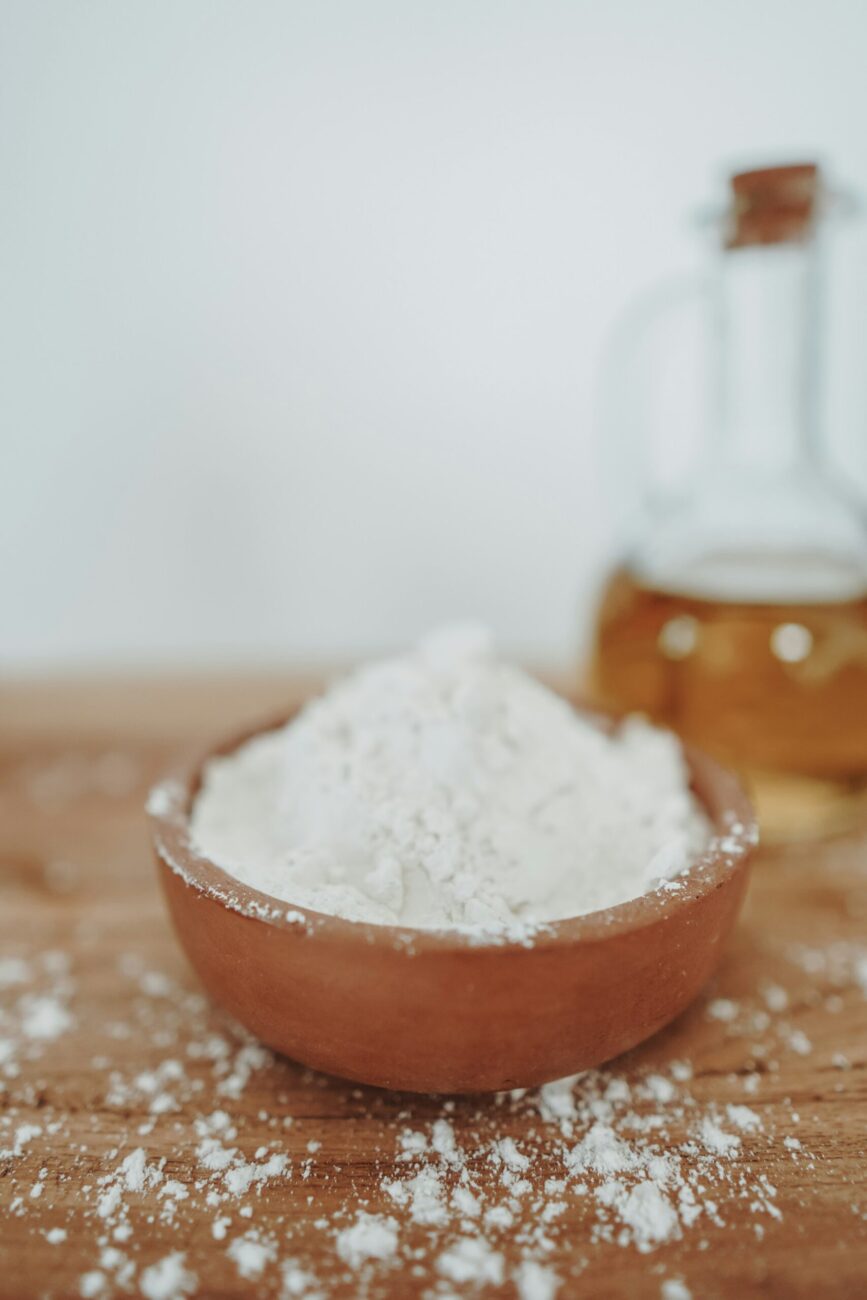
The powder in your pantry is that starch, not the whole root, and to a hen those are two different foods.
How the Powder Is Made, and What Else Gets Sold as Arrowroot

The roots are peeled, grated in water and dried to a powder, then purified with several washings. What’s left is starch, with no vitamins and only 0.2 percent protein.
Watch the label when you shop, because other plants’ starches get sold as arrowroot too. East India arrowroot comes from Curcuma species, Brazilian arrowroot’s from the cassava plant, the source of tapioca, and potato farina has been sold as British arrowroot. So a bag sold as arrowroot may hold another plant’s starch.
What’s in Arrowroot Powder

In 100 grams of each, the powder and the fresh root stack up like this against cornstarch and plain yellow corn:
- Arrowroot flour (the powder). 357 calories, 88.2 grams of carbohydrate, 0.3 grams of protein, 0.1 grams of fat, 40 milligrams of calcium and 0.005 milligrams of vitamin B-6.
- Arrowroot, raw (the fresh root). 65 calories, 13.4 grams of carbohydrate, 4.24 grams of protein, 6 milligrams of calcium and 0.266 milligrams of vitamin B-6. It’s 80.8% water.
- Cornstarch. 381 calories, 0.26 grams of protein, 2 milligrams of calcium and no vitamin B-6.
- Yellow corn grain. 365 calories, 9.42 grams of protein, 7 milligrams of calcium and 0.622 milligrams of vitamin B-6.
The powder’s almost all starch, and its calories per 100 grams come in a little under both cornstarch and corn. Its protein is next to nothing.
Vitamin B-6 is in the fresh root, at 0.266 milligrams per 100 grams. So the B-6 belongs to the root, not the powder. Plain yellow corn has far more than either.
And the Calcium?

Arrowroot flour has 40 milligrams of calcium per 100 grams, and a teaspoon holds about 2.7 grams of powder.
A typical egg takes about 2 grams of calcium from her diet. That’s 2,000 milligrams.
Her feed’s where the calcium really comes from. Laying mashes run about 2.5% to 4% calcium, and she’ll eat 100 to 150 grams of feed a day.
So if you were hoping for stronger eggshells, arrowroot won’t help. Overdo the extras and your birds will fill up on them and not eat enough complete feed to keep laying. Chickens eat to meet their energy needs, and starch gives a hen energy and little else.
Starch in a Hen’s Diet

I wouldn’t go out of my way to feed arrowroot. If you’re not sure, don’t. There’s always another treat. For other foods, try our can chickens eat it checker.
Starch is nothing strange to a hen. Carbohydrates make up the largest part of a poultry diet, and your birds use most starches and sugars well. If yours eats a store-bought feed, it’s most likely corn first, which means starch already.
That’s also the trouble if you add more. Watering down a complete feed with scratch or other extras is one of the common problems in backyard flocks. Use extras sparingly or not at all, because too much energy can turn into fat on your hen.
It’s worth knowing the plant, too. Day-old chicks fed the dried, minced root of Indian arrowroot, a different plant, all lived through 20 days, but their weight, how much they ate and how well they used their feed all dropped as the root went up. That was ground whole root and not washed starch, so check which plant a bag sold as arrowroot came from.
How Much, If Your Hens Get Any

Hens don’t need arrowroot, and I wouldn’t buy it for them. If you’ve got a box in the pantry, or a hen gets into a spill, count it as a treat.
Keep treats to 10% of her daily diet at most, which is 10 to 15 grams a day. Our brown rice page has more on feeding rice.
Arrowroot powder is light. Half to one teaspoon per hen comes to about 1.3 to 2.7 grams.
If you do give a little, treat it like scratch grain. Give it in the afternoon after your birds have eaten their complete feed, and don’t blend it into the feeder, since that only dilutes the nutrients your birds need. Put out no more than your flock can eat in 5 to 10 minutes, so you don’t draw in nuisance animals.
Where a Laying Hen’s Calcium Should Come From

Your layer feed does most of the work. Laying hens need a lot of calcium, since an eggshell’s around 96 percent calcium carbonate. Hens that don’t get enough draw it from their bones, and that can mean cage layer fatigue and thin-shelled eggs.
On the side, offer ground oyster shell free choice. If your hens lay eggs with thin shells or shells that crack easily, it might help. Hens on a good layer feed probably don’t need it, but it’s cheap and it won’t hurt them.
You can use your own eggshells too. Dry and bake them before you break them up, or your chickens may develop a taste for eggs. Sun-dry them for 1 or 2 days, or oven-dry them at 350 degrees F for 10 minutes. Give your birds free access to grit as well.
Don’t use oyster shell as grit. And all this calcium’s for laying hens only. Growing chickens need just 1.2% calcium in their feed, and high-calcium layer diets can do lasting kidney damage to nonlaying, growing birds. Our page on chicks and adult chicken feed goes through that in detail.
Mixes, Chicks and Shelf Life

- Supplement mixes. Offer oyster shell free choice.
- Chicks. Chick starter runs 20 to 22% protein for the first 6 weeks, and arrowroot powder is 0.3%. Chicks get their starter, not starch. Our baby chicks and rice page keeps rice away from them for their first 6 weeks too.
- Shelf life. Old feed can lose its nutritional value and grow mold, and moldy scraps don’t go to your flock. So a clumpy, musty box goes in the trash, not the run.
Sources
- USDA FoodData Central: Arrowroot flour (SR Legacy, FDC ID 170684).
- USDA FoodData Central: Arrowroot, raw (SR Legacy, FDC ID 168490).
- USDA FoodData Central: Cornstarch (SR Legacy, FDC ID 169698).
- USDA FoodData Central: Corn grain, yellow (SR Legacy, FDC ID 170288).
- Britannica: Arrowroot (revised and updated by Melissa Petruzzello).
- Jacquie Jacob, University of Kentucky, on poultry.extension.org: Feeding Chickens for Egg Production in Small and Backyard Flocks.
- Jacquie Jacob, University of Kentucky, on poultry.extension.org: Basic Poultry Nutrition.
- Wilmer Pacheco, Joseph Gulizia and Kevin Downs, Alabama Cooperative Extension System: Feeding the Laying Hen (ANR-2913) (September 2022).
- Howard Enos, Colorado State University Extension: Raising Poultry the Organic Way – Disease Control and Feeding (published December 2019, reviewed August 2025).
- Yuko Sato, Iowa State University, Merck Veterinary Manual: Management of Backyard Poultry (full review November 2024).
- Latif and colleagues, British Journal of Nutrition 41(1) (1979): Toxicity of shoti (Indian arrowroot: Curcuma zedoaria) for rats and chicks (PubMed abstract).
- Chicken Rise: Can chickens eat it? (our food checker).
Related read: How to Raise Chickens for Eggs — Instant PDF download. Secure checkout by Stripe