Yes, your chickens can eat broccoli and cauliflower, raw or cooked, as long as it’s plain. The florets are fine. So are the broccoli stalk and the leaves, which means the bits you’d normally toss can go to your flock instead. Keep it a treat, keep the butter and cheese sauce off it, and skip anything that’s gone moldy at the back of your fridge. The short version:
- Stalks and leaves count too. Not just the florets.
- Raw or cooked, both work. Plain only, since the seasoning’s the risk, not the vegetable.
- Broccoli packs more than cauliflower. More vitamin C and far more lutein per bite, though both are mostly water.
- It’s a treat. All your hen’s treats together stay at or under a tenth of what she eats in a day.
Can Chickens Eat Broccoli Stalks and Leaves?

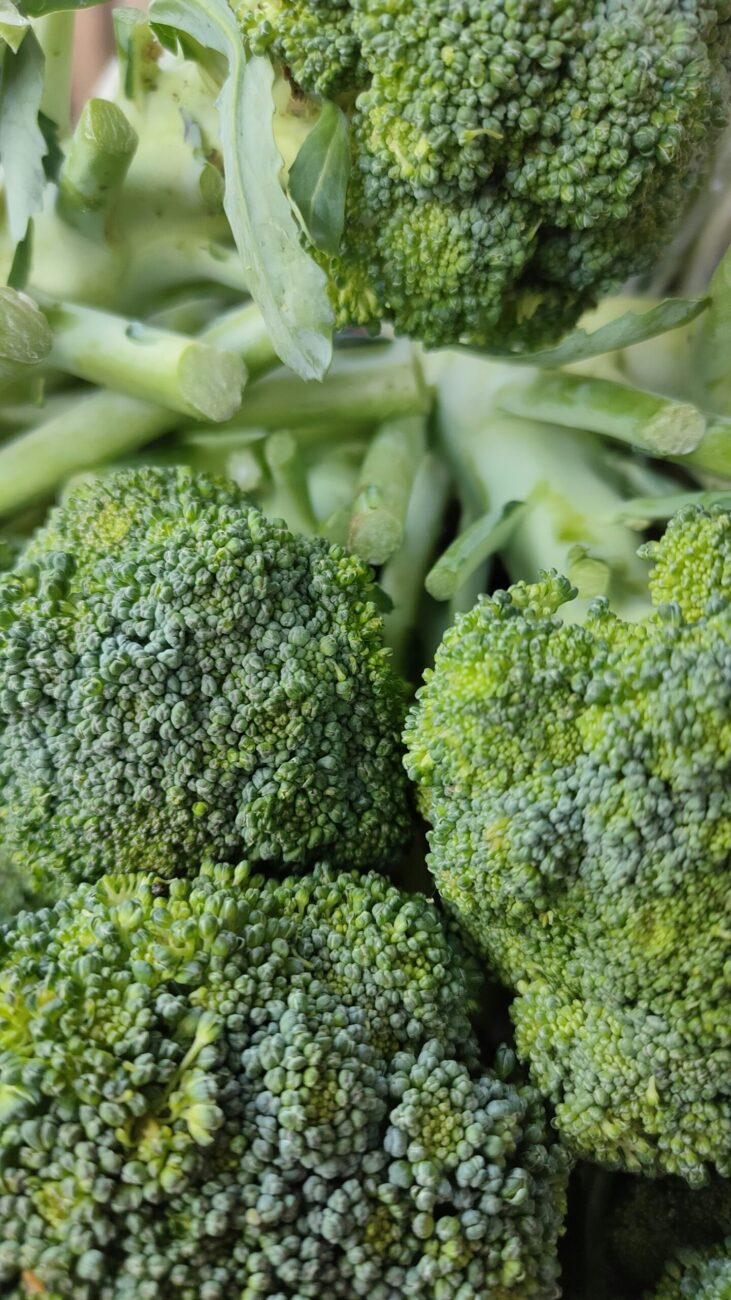
They sure can. Broccoli is a tight bunch of green flower buds that haven’t opened yet. The head sits on thick stems like a little tree, and on the plant, leaves grow all around it. And the stalk and leaves are as edible as the head, so your flock can have all three.
The stalk is the part most people throw out, and honestly, it can go to the run instead. I’d just chop it small first, so your hens aren’t stuck pecking at one big chunk.
If you grow broccoli, there’s a timing thing to know. Once you cut the main head, the plant sends out side shoots with smaller heads, and it keeps doing that for as long as the cool weather holds. So I’d keep your flock out of the bed until you’re done picking. Hens peck the leaves along with any bugs, and you don’t want droppings on side shoots you’re planning to eat. Then once the plant’s finished, pull the leaves and carry them to the run. Those velvety green caterpillars you find on them can go too. In a North American garden, they’re most likely cabbage white caterpillars, and a hen will gobble one up like any other bug. One catch: if you sprayed the bed, read the label before any of it goes to the run, and throw out caterpillars off sprayed leaves instead of feeding them.
Cauliflower is the same species as broccoli, Brassica oleracea. The white head you buy (it’s called the curd) is a mass of fused flowers. Break it into flowerets and it’s ready for your hens. Its stem and leaves are edible too, same as broccoli’s. So the thick core and the leaves you’d trim off can go to the run, chopped small.
Raw or Cooked: Can Chickens Eat Cooked Broccoli?

Either one. Most vegetables are fine for chickens cooked or raw, so it comes down to what’s less work for you. Raw usually is, and it’s what I’d go with. Steamed or boiled is fine too, as long as nothing went in the pot but water.
But plain is the whole catch, because cooked broccoli and cauliflower rarely come off the stove alone:
- Salt. The trace of salt in most kitchen scraps is okay. Anything with a lot of salt isn’t. So if it was seasoned for your plate, it stays on your plate.
- Butter and cheese sauce. Chickens don’t need much fat, so fatty food is one to skip. Fat scraps promote fatty liver, and that can end in sudden death from a ruptured liver.
- Breading and frying. Fried cauliflower bites and breaded broccoli carry the oil they were cooked in. I’d put them in the same pile as the butter.
- Casseroles. Broccoli and cheese casserole brings the fat right back. And if onions went in too, that’s a second strike. A little onion usually does no harm, but large amounts can damage a hen’s red blood cells and may cause anemia.
Look at it before it goes out, too. Scraps for chickens should still be good food, not rotten and not moldy. Cauliflower with fuzzy spots or broccoli that’s gone slimy belongs in your compost.
The easy fix, if you ask me, is to set a handful of florets aside before the rest goes in the pan. Then you know exactly what’s on them, which is nothing.
Broccoli or Cauliflower: Which Is Better for Chickens?

Both are safe, and both are fine as treats. Broccoli carries more in each bite, though. Here’s how they compare per 100 grams raw:
- Broccoli: 89.2 mg of vitamin C, 2.82 g of protein and 1,400 µg of lutein and zeaxanthin.
- Cauliflower: 48.2 mg of vitamin C, 1.92 g of protein and 1 µg of lutein and zeaxanthin.
Both are mostly water (about 89% for broccoli and 92% for cauliflower). Neither one is a protein food for a hen, either. Fifteen grams of broccoli, the top of a hen’s daily treat share, has less than half a gram of protein in it. Her protein has to come from her feed, which is one more reason I’d keep scraps small.
I wouldn’t sell either one on vitamin C. Turns out poultry make their own vitamin C, so there’s no set requirement for it in their feed. A vitamin C supplement can help birds under stress, though.
The lutein is the bigger gap. Broccoli has plenty and cauliflower has almost none.
Aren’t Brassicas Bad for Chickens?

Broccoli and cauliflower are brassicas, the cabbage family, and all brassicas carry compounds called glucosinolates. Those block the production of thyroid hormone and can cause goiter (an enlarged thyroid gland). In sheep and cattle, goiter comes with long exposure. Ewes wintered on kale can have lambs born with severe goiter. And brassica stalks and roots can concentrate nitrate, so nitrate poisoning can matter for livestock grazing those crops.
Laying hens have a record of their own, and it comes from rapeseed meal. That’s a feed ingredient made from the seed of rape, the oilseed brassica that canola comes from. Fed in big enough amounts, rapeseed meal is hard on a hen’s thyroid.
- Hens fed rations with 17.64% to 29.40% rapeseed meal for 12 weeks showed signs of goiter. At 5.88%, their thyroids showed no effects.
- On a diet with 10% rapeseed meal, hens’ thyroids got bigger, and their livers bled more than those of hens on the plain diet.
That 10% was mixed through all of their feed, so those hens got rapeseed meal in every bite they ate. And it’s a seed meal from a different plant, not a fresh vegetable. Plus raw broccoli is about 89% water, so a 15-gram treat comes to about 1.6 grams once the water’s out.
Fresh kale, the same species as broccoli, didn’t slow laying. Hens offered 120 grams of it a day on top of their regular organic feed for five weeks laid at the same rate as hens given corn silage. Their eggs came out heavier, too, with redder yolks and more lutein and beta-carotene.
That 120 grams is eight to twelve times a hen’s whole daily treat share, though, so I wouldn’t count on broccoli doing the same for your eggs. A floweret or two is a snack, not a yolk-color plan.
So I wouldn’t worry about broccoli or cauliflower at treat size. Where I would worry is a flock living on brassicas as most of its diet, and the treat limit already keeps your birds well clear of that.
How Much Broccoli or Cauliflower Can a Chicken Have?

Less than you’d think. Treats should make up no more than 10% of a chicken’s daily diet. A laying hen eats about 100 to 150 grams of feed a day (roughly a quarter pound), so her treat share is 10 to 15 grams. That’s every treat for the day added together, not 15 grams of each one.
Here’s what that looks like in broccoli and cauliflower:
- One floweret. A broccoli floweret weighs about 11 grams and a cauliflower floweret about 13. So one is pretty much a hen’s whole treat share, and I’d call that the day’s treat.
- One cup, chopped. A cup of chopped broccoli is 91 grams. If you’ve got six hens, they get 60 to 90 grams of treats a day between them, so one cup is about a day’s treats for all six.
- One medium head. A medium cauliflower, 5 to 6 inches across, weighs 588 grams. For six hens that’s six and a half to almost ten days of treats.
The ceiling is there for the feed’s sake. Think of ice cream at every meal. Give too much scratch or treats or kitchen scraps and the birds fill up on them and don’t eat enough of their complete feed. Then their egg production is likely to suffer. Too many greens of any kind do the same thing, since a hen that fills up on leaves eats less of her layer feed. That’s why keeping all treats to a tenth covers greens too.
How to Serve Broccoli and Cauliflower to Your Flock

Chopped is the easy way. Cut the florets into bite-size bits and the stalk into small pieces. Then scatter them in the run or drop them in a dish, and let your flock go at it.
Hanging it up is the fun way. In one egg producer’s cage-free barns, anything hung at bird head height or a little higher is in regular use. Food blocks left on the litter floor get less use there, because they blend in and get covered in dust and droppings fast. So I’d try a broccoli stalk or a wedge of cauliflower on a string, hung at about head height, to give your hens something to work at.
Just don’t hang a whole head for a few hens. That’s days of treats in one go, and I’d rather hang a piece sized for your flock and take down whatever’s left. Give them no more than they’ll finish in 5 to 10 minutes, so leftovers don’t draw nuisance animals to your run.
Chicks are the one group I’d hold back. I’d wait until birds are 3 to 4 months old before kitchen scraps start, since chicks have very specific nutrition needs early on. When your young birds do get scraps, put out plenty of clean water and grit sized for them.
Got something else in your crisper drawer? Run it through the Can Chickens Eat It? food checker. The foods that do stay out of the run are on our list of what not to feed chickens. Broccoli and cauliflower aren’t on that list. Stalks and all, I’d call them about as easy as a kitchen scrap gets.
Sources
- Sarah Browning, Nebraska Extension in Lancaster County: The Year of Broccoli.
- North Carolina Extension Gardener Plant Toolbox: Brassica oleracea Cauliflower & Broccoli Group.
- University of Arkansas Cooperative Extension, Plant of the Week: Brassica oleracea Cauliflower.
- USDA FoodData Central: Broccoli, raw.
- USDA FoodData Central: Broccoli, flower clusters, raw.
- USDA FoodData Central: Cauliflower, raw.
- Massey University, New Zealand Poisonous Plants: Cabbage.
- Zhu LP and others. The Deposition and Elimination of Glucosinolate Metabolites Derived from Rapeseed Meal in Eggs of Laying Hens. Journal of Agricultural and Food Chemistry, 2018.
- Pearson AW and others. Effects of rapeseed meal on laying hens (Gallus domesticus) in relation to fatty liver-haemorrhagic syndrome and egg taint. Research in Veterinary Science, 1978.
- Hammershøj M, Steenfeldt S. The effects of kale (Brassica oleracea ssp. acephala), basil (Ocimum basilicum) and thyme (Thymus vulgaris) as forage material in organic egg production on egg quality. British Poultry Science, 2012.
- University of Maryland Extension: Vitamins and Minerals.
- Jacquie Jacob, University of Kentucky, for eXtension Small and Backyard Poultry: Basic Poultry Nutrition.
- Maurice Pitesky and Nancy Reimers, UC Davis and UC Cooperative Extension: Feeding your Flock.
- Murray McMurray Hatchery: Safe Table Scraps for Chickens.
- Colorado State University Extension: Raising Poultry the Organic Way, Disease Control and Feeding.
- Kalyn Waters, with Jewellyn Owens, UF/IFAS Extension Holmes County: 10 Foods You Should Never Feed Chickens.
- Merck Veterinary Manual: Management of Backyard Poultry.
- Wilmer Pacheco, Joseph Gulizia and Kevin Downs, Alabama Cooperative Extension System: Feeding the Laying Hen (ANR-2913).
- Ronda Payne, Canadian Poultry Magazine: Peck a Block, Spare a Feather.
Sources checked November 16, 2026. We aren’t vets. If a bird looks sick after eating something, call a vet who sees poultry.
Related read: How to Raise Chickens for Eggs — Instant PDF download. Secure checkout by Stripe