Yes, chickens can eat buckwheat. The seed has a long history as poultry feed, and a little of it makes a fine treat, dry or cooked plain. Where I’d slow down is the green plant, and its flowers most of all. They hold fagopyrin, a substance that makes pale skin burn in sunlight in the animals where it’s been seen.
This page used to say a tablespoon or two per bird a day is plenty. It also said buckwheat’s manganese keeps bones strong and that it’s good for chicks in the brooder. Two tablespoons can be up to double a hen’s whole treat share for a day (my math is below). I found nothing that backs the bone claim for hens. Chicks belong on starter feed. So I rewrote the page from the research and the extension guides.
I worked from 17 sources, all listed at the bottom. The plant and feed facts come from Feedipedia’s two buckwheat pages and from two crop guides, Purdue’s and SARE’s. For nutrients, I used the USDA’s FoodData Central. For fagopyrin, I read the Merck Veterinary Manual and six research papers, and for bones, one broiler trial. Four extension guides supplied the feeding rules. When a number is my own math, I’ll say so.
The short version.
- Buckwheat seed is fine for hens as a treat. Most of the old U.S. crop went to livestock and poultry.
- A level tablespoon of dry groats weighs about 11 grams. That’s roughly one hen’s whole treat share for a day.
- It can’t stand in for layer feed. It has less protein, and next to no calcium.
- Whole seed comes in its hull, so hens eating it need grit.
- Fagopyrin sits mainly in the green plant and the flowers. The seed carries much less.
- Sprouts are a small side dish, not a meal.
- Chicks stay on starter feed.
Buckwheat Is a Seed, Not a Kind of Wheat

Despite the name, buckwheat isn’t wheat. It isn’t even a grass. Feedipedia files it with the cereal grains because it’s fed like one, “even though it is from the Polygonaceae family and not from the Poaceae (grasses) family like proper cereals”. What you buy as a grain is really a small dry fruit. In Feedipedia’s words, “the seed (actually an achene) can be used whole, dehulled (groats) or further milled to produce flour”.
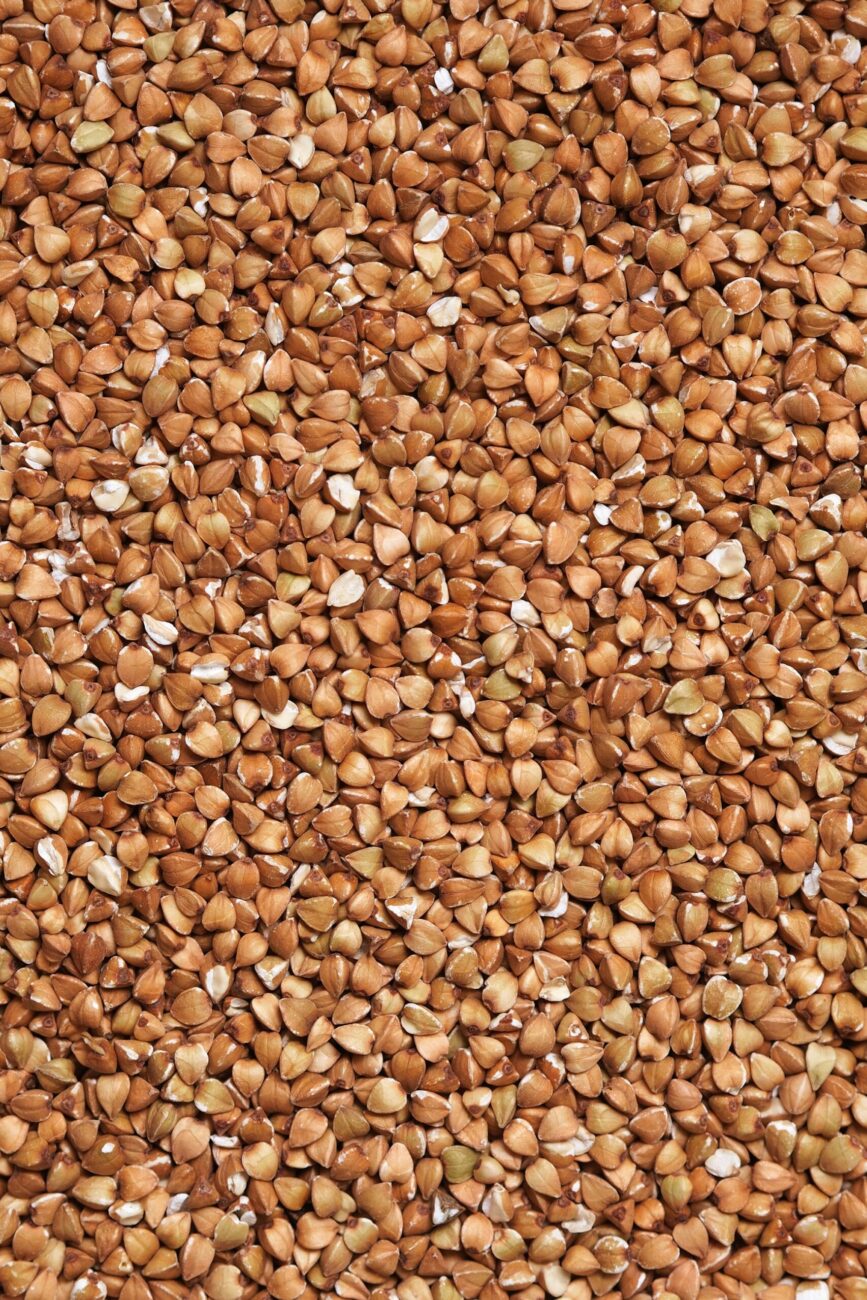
Groats are the hulled kernels, the little three-sided seeds in the photo above. Whole buckwheat still wears its dark hull.
It’s an old farm feed, too. A buckwheat guide on Purdue’s NewCROP site, written by agronomists at the Universities of Wisconsin and Minnesota, says U.S. production “reached a peak in 1866 at which time the grain was a common livestock-feed”. It adds that until people took a new interest in eating it, “about 75% of the grain produced was used for livestock and poultry”. And the guide says the seed “is an ingredient in commercial bird feed mixes”. So buckwheat in a hen’s dish is nothing new.
What’s in Buckwheat, Next to Layer Feed

FoodData Central lists 100 grams of buckwheat at 13.2 grams of protein, 3.4 grams of fat and 10 grams of fiber, for 343 kilocalories. It has 18 milligrams of calcium and 347 milligrams of phosphorus. One cup weighs 170 grams.
Now hold that up against a laying hen’s ration. Alabama Extension’s layer diet table calls for protein at “16% or more” and calcium at “3% to 4%”. Buckwheat’s protein comes to 13.2%, under that floor. Its calcium works out to about 0.02% (my math, from 18 milligrams in 100 grams). Layer feed carries roughly 170 to 220 times as much. Alabama also notes that “The eggshell is composed of around 96 percent calcium carbonate.” So buckwheat can only ever be a side dish for a laying hen.
For a grain, its protein is decent. Feedipedia says that compared to maize and wheat, buckwheat grains are “richer in lysine (5-6% of the protein) and arginine”.
There’s one laying trial worth knowing about. Feedipedia reports that hens fed whole or shelled buckwheat “at a dietary level of 40% dry matter had similar egg production and significantly heavier eggs compared to those on wheat-based control diet” (Leiber and co-authors, 2011). Whole grains also gave stronger shells in that work. But read it for what it was. Those hens ate a planned diet with buckwheat in place of wheat, not buckwheat piled on top of a full ration. An older study with a less productive strain of hen didn’t get the same good results, Feedipedia adds.
About the bone claim this page used to make. FoodData Central does list 1.3 milligrams of manganese in 100 grams. But the one bone study I found was about something else. In a 2018 broiler trial at Shinshu University in Japan, chicks ate a diet short of phosphorus. Swapping part of their maize for buckwheat brought back their growth and their leg bone strength, and sprouted buckwheat did it better. Their point was an enzyme in the seed, phytase, which frees phosphorus that’s locked up in feed. Buckwheat, they wrote, “especially when germinated, can be used as an alternative phytase source in broiler diets”. A complete layer feed isn’t short of phosphorus to begin with. Alabama Extension says most commercial feeds “contain enough vitamins and minerals to meet your birds’ requirements easily”. So I wouldn’t count on buckwheat for your hens’ bones.
How Much Buckwheat to Give a Hen

Colorado State University Extension’s rule is “Treats should make up no more than 10% of their daily diet”. Alabama Extension says a laying hen eats “between 100 and 150 grams of feed per day or roughly 0.25 pounds”. So a hen’s treat share is 10 to 15 grams a day (my math). That covers every treat she gets, not buckwheat alone.
A cup of buckwheat weighs 170 grams, going by FoodData Central. A cup holds 16 tablespoons, so a level tablespoon of dry groats weighs about 10.6 grams (my math again). One tablespoon is roughly a hen’s whole treat allowance for the day. Two tablespoons per bird, the old advice here, ran to as much as double that. For a flock, one cup of dry buckwheat covers the day’s treat share for about 11 to 17 hens.
Alabama Extension compares treats to ice cream. Hens given too much fill up on them and stop eating enough of the complete feed to keep laying. In its words, extras “should be used sparingly or not at all”. Colorado State adds, “Do not feed more than can be consumed in 5 – 10 minutes to not attract nuisance animals”. So scatter only what the flock cleans up fast.
Purdue’s guide says buckwheat once went into scratch feeds for poultry, so the scratch grain rules fit it. Jacquie Jacob of the University of Kentucky says to give scratch “in the afternoon after birds have eaten complete feed, and then provide only as much scratch grains as chickens can finish in 15 to 20 minutes”.
Chicks are a different story. UC Davis says a chick starter should have “a protein content of approximately 20%”, and buckwheat is well short of that. On grit, UC Davis says chicks that aren’t on commercial pelleted feed can start getting it “after the first week”. My call is to keep buckwheat out of the brooder and save treats for later. Our page on what baby chicks can eat besides starter covers when and how much.
Whole Seed, Groats or Cooked

Whole buckwheat comes in a dark, three-cornered hull, like the seeds in the museum dish above. Purdue’s guide says the hulls “have little or no feeding value, but they contain most of the fiber of the seed”. For poultry, Feedipedia says that fiber is “not considered a limiting factor”. It only starts to matter at very high levels. Broilers fed more than 40% buckwheat turned feed into weight less well, and Feedipedia says hull fiber could be why. A treat-sized handful won’t come close to that.
Whole seeds need grit to grind. Jacob’s advice for scratch grains is that “it is also important to provide grit to help the chickens grind and digest the grains properly (since chickens do not have teeth)”. Alabama Extension makes the flip side clear: birds on ground commercial feed alone don’t need it. Colorado State says free-range birds pick up their own grit, but a small run needs a grit source. So if buckwheat goes in whole and your hens don’t range, set out a dish of grit. Oyster shell doesn’t count. Jacob calls it “too soft”.
Groats spoil faster than you’d guess. Purdue says “Buckwheat flour and groats must be used fresh because their fat content is high and they soon become rancid.” A bag that’s sat at the back of the pantry for a long while is worth a sniff first. If it smells off, the compost gets it, not the flock (my call).
Cooked buckwheat, often sold as kasha, is fine too if it’s plain. Cook it in water with no salt or butter, and let it cool. Colorado State’s scrap rule is to make sure scraps “are not salty or have citrus or are moldy”. Cooking may also lower fagopyrin, the substance in the next section. In a 2026 lab study from Sungshin Women’s University in Seoul, researchers tried seven kitchen methods on buckwheat grain, from boiling to air frying. They reported that “All treatments reduced measured fagopyrin F content.”
The Catch: Fagopyrin in the Green Plant

Buckwheat has one real catch, and it’s in the plant more than the seed. The Merck Veterinary Manual names fagopyrin, from buckwheat, as one of the primary photosensitizing agents. An animal eats it, and then sunlight damages its skin. Merck says, “Lesions are most common on unpigmented skin with frequent UV exposure.”
Where the fagopyrin sits is what matters. Feedipedia puts it plainly: “Because fagopyrins are more present in the green plant than in the grain, ruminants fed buckwheat forage are more at risk than pig and poultry fed on grain.” For birds, it says the risk is “considerably lower than in ruminants as the fagopyrin is mainly contained in the green parts of the plant and not in the seeds”. The flowers are the richest part. In a 2026 study from the University of Ljubljana in Slovenia, “the fagopyrin concentration was 12.7-times higher in buckwheat flowers than in leaves during the peak flowering period”. A 2025 paper in Scientific Reports, from Poland’s W. Szafer Institute of Botany and partners, states that “Buckwheat flowers accumulate high levels of phototoxic fagopyrin”.
One note on the sources. Purdue’s guide, from 1989, says “The substances that produce the rash are in the buckwheat hulls.” The newer work points at the green parts and the flowers, so that’s what I’d plan around.
The animals where it’s been seen are mostly farm mammals. In a 1928 Mayo Clinic study, guinea pigs reacted the most after eating buckwheat, plant or seed. White pigs and goats reacted too. Rats and mice showed nothing, and neither did rabbits or dogs. Chickens weren’t part of that study. Feedipedia says that while people have noticed this since the early 1700s, “there are actually few reported cases, which are old and partly anecdotal”.
I didn’t find a single report of buckwheat doing this to chickens. That’s not proof it can’t happen. Merck lists other plants that cause photosensitization “in production animals and poultry”, so birds aren’t immune to the problem. Here’s how I read it (my call). The seed is the low-risk part, which fits its long history as poultry feed. A hen nibbling buckwheat leaves in passing is a small thing. A flock turned loose on a flowering patch day after day is the case I’d avoid.
Sprouts and Young Greens

Sprouting buckwheat for the flock sounds healthy, but a sprout isn’t the seed anymore. In a 2013 study of buckwheat sprouts, fagopyrin and flavonoids “were located almost exclusively in cotyledons”, the first pair of seed leaves. For people, the authors put the recommended intake of buckwheat sprouts at “less than 40 g per day”. Nobody has worked out a number for chickens.
A 2015 review by Benković and Kreft calls buckwheat seeds and flour “safe in normal amounts”. Its warning is for diets made up mostly of buckwheat sprouts and herbs, “and particularly flowers”. That review was about human food, but I’d still use it as a guide for hens. A small handful of sprouts now and then is a treat. A tray of sprouted buckwheat every day as their greens isn’t something I’d do (my call).
Growing a Buckwheat Patch for the Flock

Buckwheat is quick. SARE’s cover crop handbook says it “reaches maturity in just 70 to 90 days”, and its seeds “germinate in just three to five days”. It’s “not frost tolerant”, so it goes in after the last frost and it’s done before winter. Even in the South, SARE says, it isn’t grown as a winter crop.
Hens can graze it. Feedipedia’s forage page describes buckwheat grown with phacelia and flax for free-range poultry. It says “This mixture of forbs was well accepted by the hens without affecting performance” (Horsted and co-authors, 2006). If flax is new to you as a chicken food, our page on flax seeds for chickens covers it.
Two of SARE’s management notes fit a chicken run well. Buckwheat “will regrow after mowing if cut before it reaches 25 percent bloom”. And it can turn into a weed, so SARE says to kill it “within 7 to 10 days after flowering begins, before the first seeds begin to harden and turn brown”. Put that next to the fagopyrin facts. If I were sowing a patch for a run, I’d let the hens graze it while it’s young and green, and mow it as the first flowers open (my call). Mowing early keeps both the flowers and the weed problem in check.
What I’d do
- Keep a complete layer feed as the main food.
- Give buckwheat as a treat, about a level tablespoon of dry groats per hen a day at most. Give less if she gets other treats.
- Feed it in the afternoon, only as much as the flock cleans up in a few minutes.
- If it goes in whole, put out grit. Oyster shell isn’t grit.
- Smell groats before you use them, and skip any that are rancid.
- Cook it plain, with no salt or butter.
- Go easy on sprouts, and don’t let hens live in a flowering buckwheat patch.
- Keep chicks on starter feed.
To check another food fast, try our Can Chickens Eat It? checker. And for the foods that never go in the run, see what not to feed chickens.
Sources
- V. Heuzé and co-authors, Feedipedia: Buckwheat (Fagopyrum esculentum) grain and by-products (INRAE, CIRAD, AFZ and FAO, 2019).
- V. Heuzé and co-authors, Feedipedia: Buckwheat (Fagopyrum esculentum) forage (2019).
- E. S. Oplinger and co-authors, Alternative Field Crops Manual: Buckwheat (University of Wisconsin-Madison and University of Minnesota, on Purdue’s NewCROP site, 1989).
- SARE, Managing Cover Crops Profitably: Buckwheat.
- USDA FoodData Central: Buckwheat (SR Legacy, FDC ID 170286).
- Lauren Bookbinder, Merck Veterinary Manual: Overview of Photosensitization in Animals (2024).
- C. Sheard and co-authors: Photosensitization of animals after the ingestion of buckwheat (Journal of Experimental Medicine 47(6), 1928).
- S. Kreft and co-authors: The content of fagopyrin and polyphenols in common and tartary buckwheat sprouts (Acta Pharmaceutica 63(4), 2013).
- E. T. Benković and S. Kreft: Fagopyrins and Protofagopyrins: Detection, Analysis, and Potential Phototoxicity in Buckwheat (Journal of Agricultural and Food Chemistry 63(24), 2015).
- Marta Hornyák and co-authors: Distribution of photosensitive fagopyrin in buckwheat flowers and its potential biological relevance (Scientific Reports, 2025).
- Eva Tavčar and co-authors: Flavonoids and fagopyrins in buckwheat leaves and flowers during the growing season and their relationship with weather conditions (Open Life Sciences, 2026).
- Jimin Kim and co-authors: Effects of Household Processing on Rutin and Fagopyrin F in Common and Tartary Buckwheat (Foods, 2026).
- R. Chowdhury and K. Koh: Growth Performance, Bone Quality, and Phosphorus Availability in Broilers Given Phosphorus-Deficient Diets Containing Buckwheat (Fagopyrum esculentum) (Journal of Poultry Science 55(4), 2018).
- Wilmer Pacheco and co-authors, Alabama Cooperative Extension: Feeding the Laying Hen.
- Colorado State University Extension: Raising Poultry the Organic Way: Disease Control and Feeding.
- Jacquie Jacob, Poultry Extension: Feeding Chickens for Egg Production in Small and Backyard Flocks.
- Maurice Pitesky and Nancy Reimers, UC Davis: Feeding your Flock.
Related read: How to Raise Chickens for Eggs — Instant PDF download. Secure checkout by Stripe