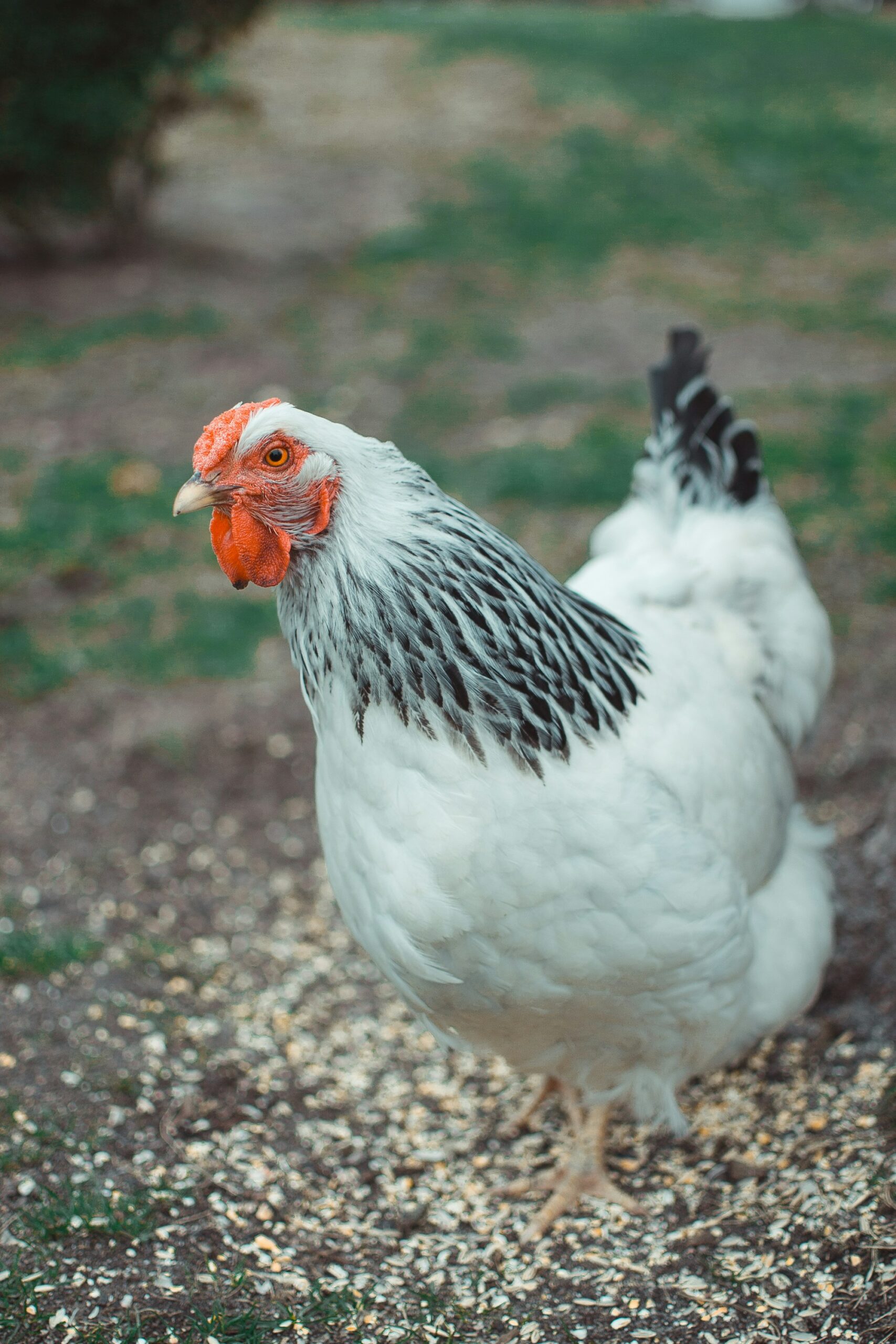

Yes. Plain long grain brown rice is fine for your hens as a treat, dry or cooked. Keep it to about a tablespoon per hen a day, and throw it on the ground after they’ve had their layer feed. What sets brown rice apart from white is the bran and the germ. They carry more of most of the minerals, and the bran carries more of the arsenic too.
The short version.
- Plain brown rice, dry or cooked, is a fine treat.
- Give each hen about a tablespoon a day, and no other treats on top of it.
- Treat it like scratch grain. Throw it on the ground in the afternoon, after the layer feed, and don’t stir it into the feeder.
- If you throw dry grain to hens in a run, put grit out.
- Brown rice holds more arsenic than white rice.
- Hens have eaten feed that was up to 15% brown rice for 5 weeks, and laying and yolk color didn’t change.
- Nothing salty and nothing moldy, and keep out butter, soy sauce and fried rice too.
Treat Brown Rice Like Scratch Grain

Rice is a grain scrap, the kind of thing that makes a good treat, and it isn’t on the usual lists of foods to avoid. You can check other foods in our can chickens eat it checker.
Scraps are a fine way to use food that would otherwise go to waste, as long as they aren’t salty, citrus or moldy, and treats shouldn’t go past 10% of your hen’s daily diet. Scratch grains are low in protein and high in energy or fiber. Don’t mix them into your complete feed, and don’t overfeed them, because too much scratch can leave your hens on an imbalanced diet.
Feed your rice like scratch, in the afternoon after your birds have eaten their complete feed, and only as much as they can finish in 15 to 20 minutes.
How Much Brown Rice Per Hen

Start with the feed. A laying hen eats between 100 and 150 grams a day, and treats should stay at 10% of that or less, so she gets 10 to 15 grams a day. That’s all of your hen’s treats for the day, rice and anything else together.
A cup of cooked long grain brown rice weighs 202 grams, so a tablespoon is about 12.6 grams. A cup of dry rice weighs 185 grams, so a dry tablespoon is about 11.6 grams. So a level dry tablespoon fits a hen that eats 116 grams of feed a day or more, and a cooked one fits at 126 grams or more. For a lighter eater, make it a little under a tablespoon.
Turned around, one cup of leftover cooked brown rice is the whole treat share for 13 to 20 hens for a day. So if you’ve got a small flock and a full cup, don’t dump it all in the run at once. Save some for tomorrow, or skip it.
Cooked brown rice is about 70% water, and dry is about 12%. Per 100 grams, dry has 367 calories and cooked has 123, so a spoonful of dry rice packs about 2.7 times the calories of a spoonful of cooked, about 42 against 16. So with dry rice, stay at the low end.
Leftover cooked rice is a scrap, so don’t put out more than your flock can eat in 5 to 10 minutes, and you won’t draw in nuisance animals.
Dry or Cooked, and Where Grit Comes In

Dry or cooked are both fine, as long as it’s plain. Dry rice is just a whole grain, like the corn and wheat in a scratch mix.
The bigger question with dry grain is grit. Your chickens don’t have teeth, so when they get scratch grains they need grit to grind them. Hens that can get to the ground can usually find enough small rocks and pebbles on their own, though it still helps to supply commercial grit in chick or hen size. In a limited run, you need to provide it. Hens that only eat ground commercial feed don’t need any, because that feed’s already ground.
So if your hens live in a run and you toss them dry rice, put out grit. Fine gravel works in place of commercial grit. Just don’t count oyster shell, which is too soft to help with grinding.
Got chicks? Our baby chicks and rice page keeps rice away from them for their first 6 weeks.
What’s in Brown Rice

Brown rice and white rice come from the same plant. Brown rice keeps some of its bran and germ, and white rice has them stripped away. You can see the difference in dry long grain rice, brown against white, per 100 grams.
- Protein. 7.54 grams for brown, 7.13 for white. About the same.
- Fat. 3.2 grams against 0.66. Brown has nearly five times as much.
- Fiber. 3.6 grams against 1.3.
- Magnesium. 116 milligrams against 25.
- Manganese. 2.85 milligrams against 1.09.
- Thiamin. 0.541 milligrams against 0.07 for unenriched white rice.
Selenium barely differs: 17.1 micrograms for brown, 15.1 for white.
What matters more for your laying hen is what rice doesn’t have. Layer feed should run 16% protein or more, and dry brown rice is about half that. Cooked, it’s 2.74 grams of protein per 100 grams, so layer feed carries nearly six times as much. Calcium is the bigger gap. A layer diet has 3% to 4% calcium, and dry brown rice has 9 milligrams per 100 grams, which is 0.009%. The eggshell is about 96 percent calcium carbonate, so every spoonful of rice takes the place of feed that has what her eggshells need.
Arsenic: More in Brown Rice, and the Advice Is for People

Rice absorbs arsenic more readily than other crops, taking up nearly 10 times more from the soil than other grains, because it grows in flooded paddies.
Brown rice gets more of it than white, and the bran is the major reason. That bran is also part of what carries the extra minerals above, so with brown rice you get both.
There are no acute public health risks for the general American population from arsenic in rice. There is a potential risk from brown rice for children under 5, and arsenic has been linked to cancers and heart disease even below the levels that cause acute toxicity. If you want less of it, cook rice the way you cook pasta, with 6 to 10 parts water to 1 part rice, then drain it. That can cut 40 to 60 percent of the inorganic arsenic, depending on the rice. Rinsing has a minimal effect.
Keep brown rice to a spoonful, as a treat, and it stays a small part of what your hens eat. If you already cook rice the pasta way for your family, the leftover spoonful from that pot has had the same cut.
Brown Rice in a Laying Hen’s Feed

Hy-Line Brown hens that ate feed with up to 15% brown rice for 5 weeks laid just as well, and their eggs came out just as good.
But that rice replaced corn and soybean meal in a feed balanced to match the regular feed’s energy and amino acids. That’s a feed mill’s job. It’s not the same as rice tossed on the ground next to a layer feeder.
As for yolk color, 15% brown rice didn’t change it. At 50% or more paddy rice, yolk color dropped, because rice is so low in the xanthophylls that color a yolk. Yellow corn has 1,360 micrograms of them per 100 grams, and brown rice has none.
A tablespoon a day only takes a small bite out of what your feed brings, so I wouldn’t expect your yolks to go pale.
What to Keep Out of the Rice Bowl

Plain rice is the easy part. It’s what gets cooked into it that causes trouble.
- Salt. Scraps can’t be salty, and heavily salted leftovers can quickly lead to dehydration and kidney damage in your chickens. Plain cooked brown rice has 4 milligrams of sodium per 100 grams, and salted cooking water changes that.
- Fried rice, soy sauce and seasoned mixes. You can’t tell how much salt, oil or onion went into takeout fried rice, and onions don’t belong in your run. Skip it.
- Butter and oil. Avoid fat scraps. Our coconut rice page shows how cooking rice in coconut milk turns a lean grain into a fatty food.
- Moldy or rotting rice. Don’t let scraps rot, or botulism might result. Rice that smells musty goes in the trash.
Clean up what’s left, too, once your flock’s had its few minutes.
Sources
- USDA FoodData Central: Rice, brown, long-grain, raw (SR Legacy, FDC ID 169703).
- USDA FoodData Central: Rice, brown, long-grain, cooked (SR Legacy, FDC ID 169704).
- USDA FoodData Central: Rice, white, long-grain, regular, raw, unenriched (SR Legacy, FDC ID 169756).
- USDA FoodData Central: Corn grain, yellow (SR Legacy, FDC ID 170288).
- FDA: What You Can Do to Limit Exposure to Arsenic (content current as of 04/27/2022).
- Christian Kelly Scott and Felicia Wu, Risk Analysis (2025): Arsenic content and exposure in brown rice compared to white rice in the United States.
- Byoung-Ki An and colleagues, Journal of Animal Science and Technology 62(3) (2020): Evaluation of energy and amino acids of brown rice and its effects on laying performance and egg quality of layers.
- Howard Enos, Colorado State University Extension: Raising Poultry the Organic Way – Disease Control and Feeding (published December 2019, reviewed August 2025).
- Wilmer Pacheco, Joseph Gulizia and Kevin Downs, Alabama Cooperative Extension System: Feeding the Laying Hen (ANR-2913) (September 2022).
- Jacquie Jacob, University of Kentucky, on poultry.extension.org: Feeding Chickens for Egg Production in Small and Backyard Flocks.
- Anne Lichtenwalner and H. Michael Opitz, University of Maine Cooperative Extension: Salt is an Important Nutrient for Poultry.
- Yuko Sato, Iowa State University, Merck Veterinary Manual: Management of Backyard Poultry (full review November 2024).
- Kalyn Waters, UF/IFAS Extension Holmes County: 10 Foods You Should Never Feed Chickens (May 25, 2026).
- Chicken Rise: Can chickens eat it? (our food checker).
Sources checked November 4, 2026.
Related read: How to Raise Chickens for Eggs — Instant PDF download. Secure checkout by Stripe