
Every October the two big oaks behind my place drop more leaves than I can rake in a weekend, and for years I bagged them for the town truck like everybody else on my road.
Then one fall I dumped a few bags in the run instead.
My birds went through that pile like it owed them money. They had it scratched flat in two days, ate every bug in it, and pooped all over it. By spring the bottom layer had gone dark and crumbly. That’s compost, more or less, and I never lifted a fork.
So I got a little cocky. I figured the flock could run my whole compost setup, coop bedding and all, and I’d just shovel finished dirt onto the garden every April.
Turns out they can’t. Hens are great at turning a pile and pretty much useless at heating one, and if chicken manure is headed for your vegetables, the heat is the part that matters. Here’s the two-pile setup I run now, plus the numbers I actually go by.
Two Piles: One for the Hens, One That Gets Hot

The whole idea fits in two sentences. A loose scratch pile lives inside the run, and it belongs to the flock. A closed bin sits out past the garden, well away from the coop. The hens never touch it, and that’s where the manure goes to cook.
One pile for everything doesn’t work, because a compost pile only gets hot if it’s big enough to hold its own heat. Oregon State University Extension says smaller piles may not heat up, and it puts hot composting at about 0.5 to 1 cubic yard of fresh material. The University of Arizona’s Master Gardener sheet calls 1 cubic yard the ideal size, which works out to a box about 3 feet on every side.
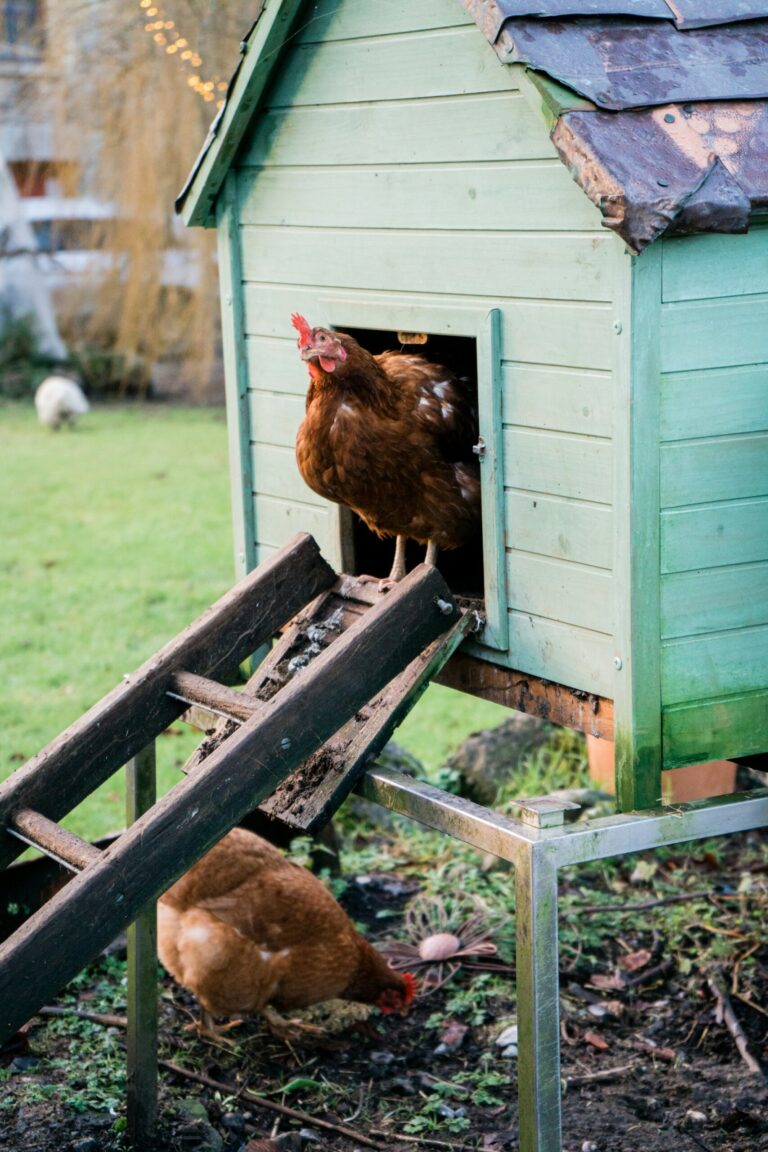
Now look at hens like the ones in that photo, working their way down the run fence with their heads in the grass. That’s what a dozen birds do to anything you give them. They climb a 3-foot pile, kick it, and spread it across the run until it’s maybe 6 inches deep. A layer that thin can’t hold heat any better than a bedsheet can. Nope.
So the hens’ pile stays cold. That’s fine for leaves and garden trimmings. It’s not fine for a few months of droppings you plan to put under your lettuce.
Bag Every Leaf You Can Get This Month

Leaves are the cheapest thing on this whole list, and October and November are the only months they’re free and everywhere.
I rake my own, and on a Saturday I’ll drive the back roads and grab the bags people leave at the curb. Ask first, sure. Nobody’s ever said no (people seem glad to see them go), and one guy helped me load.
Dry brown leaves like these are your carbon. Chicken manure is nitrogen, and a lot of it. A pile needs both, and the carbon is the part that’s hard to find in July, when the coop needs mucking out and every tree is still green.
So the bags get stacked behind the shed and I pull from them all year. Dry leaves keep fine as long as they stay dry. A bag that gets rained into turns slimy and sour, so mine sit on a pallet with a tarp over the top.
Shred them if you can. You don’t need a fancy shredder for it. I run the mower over the pile with the bagger on, and the shredded stuff breaks down a lot faster than whole oak leaves, which like to mat into wet sheets.
The hens get their share too. Every couple of weeks I dump a bag or two straight into the run. It gives them something to do, and it soaks up the mud around the waterer.
The Leaf-to-Manure Numbers I Go By

You don’t need a chemistry set for this. But one set of numbers made the whole thing click for me.
Compost people talk about the carbon-to-nitrogen ratio, written like 30:1. Arizona’s extension sheet says a pile does best somewhere between 25:1 and 40:1, and the USDA’s organic rule uses that same window as the starting mix for anything it’ll call compost.
Here’s how the stuff around a coop lines up on Arizona’s chart.
Look at the two ends. Chicken manure sits at 7:1, way too rich on its own, which is why a fresh heap of coop cleanings stinks of ammonia. Dried leaves sit at 60:1 and straw at 75:1. Leaves that are still green, like the ones mixed in with the fall colors up top, run richer, at 40:1, so the dry brown ones are the better carbon.
Pine shavings aren’t on the chart (I looked). Sawdust is, at 325:1, and wood chips at 400:1, which tells you shavings sit way out on the carbon end with them. Cardboard is 350:1, if you’re ever short on browns.
Honestly, I don’t do this with a calculator. I go by nose, which is kinda what Arizona’s sheet suggests anyway. If the bin smells like ammonia, it needs carbon, so in goes another bag of leaves. If it’s damp and just sits there cold, it needs nitrogen, so in goes a bucket of droppings from under the roost.
Water counts as much as the mix. Oregon State says to aim for 60% to 65% moisture, which it describes as damp like a wrung-out sponge. Grab a handful and squeeze. If water drips out, add leaves. If it crumbles dry, get the hose.
Coop Bedding Goes in the Hot Bin

This is the bin the hens don’t get into.
Mine is four old pallets (free, if you ask nicely at the lumber yard) wired into a box, one side on hinges (that’s the gate), sitting out past the garden, about as far from the coop as my yard allows. Every time I muck out the coop, the old bedding and everything in it goes in there, with a layer of leaves on top. Shavings like these hold a lot of droppings, and the leaves keep the smell down.
The goal is heat. Oregon State’s extension says a pile should reach 130 to 135°F to kill weed seeds and many pathogens. The USDA’s organic rule is stricter. To count as compost, the pile has to hold between 131°F and 170°F for 3 days in a bin or static aerated pile, or for 15 days in a long windrow that gets turned at least five times.
You can’t feel 131°F with your hand. I picked up a long-stem compost thermometer at the feed store and push it into the middle of the bin every few days. It was cheap, worth it, and genuinely the only way I know my bin did its job.
When the reading climbs past 131 and holds, I leave it alone. When it drops, I turn it with a fork, outside edges into the middle, and it usually heats back up within a few days.
Arizona’s sheet gives a rough clock for the whole thing. Turn it weekly and a pile can finish in 1 to 2 months. Turn it monthly and it takes 4 to 6 months. Either way, it then sits untouched for a month to cure.
What Never Goes in a Pile the Flock Can Reach

The scratch pile in the run is a buffet. Anything you toss in there, somebody’s going to eat it, and it’ll be the bossiest hen first (it always is).
So it only gets what I’d hand my birds on purpose. That means leaves, garden trimmings, weeds that haven’t gone to seed, and kitchen scraps I’d feed them anyway.
Mold is the big one. Moldy food can carry mycotoxins, and the Merck Veterinary Manual says birds pick those up from contaminated feed or bedding, and that once they form, they’re chemically stable and stay in the material. You can’t scrape the fuzzy part off and call it good. I wrote a whole post on whether chickens can eat strawberries with mold, and the answer is the same for a moldy heel of bread or a bag of feed that got wet. It goes in the trash.
Meat, fish, fat, oil, dairy, bread, grains, bones: none of it goes in either pile. Oregon State lists all of those as the scraps that pull wildlife to a compost pile, and around a chicken run, wildlife means predators.
Avocado is sort of a judgment call. The Merck manual says the leaves are the most toxic part of the plant, and that chickens and turkeys seem more resistant than caged birds. More resistant isn’t the same as safe, so avocado skins and pits go in the closed bin at my place.
Not sure about a scrap? Run it through our chicken food checker before it hits the run.
Raccoons Read a Compost Pile Like a Menu

I lost two hens to a raccoon in my third year of keeping chickens (my own fault, mostly). I’m pretty sure it learned the yard from the kitchen scraps I used to fling over the run fence every night.
A pile with food in it is a reason to come back. And once a raccoon is in the yard every night, the coop is the next thing it checks.
The University of Maryland Extension’s predator guide puts it about as plainly as I could. Keep the compost pile far away from the coop, and clean up any scraps the chickens don’t eat before nightfall. That’s why my hot bin lives out past the garden and not up against the run.
Now look at that old window. That’s chicken wire, the hexagon stuff you can grab by the roll at any feed store, and it keeps hens in. It doesn’t keep a raccoon out. Maryland’s guide says raccoons reach through openings in mesh and grab birds right through the wire, and it says to check windows and doors for any opening bigger than ¼ inch. Colorado State’s extension adds that you’ll lose fewer birds behind 1-by-2-inch welded wire or smaller than behind the cheaper 2-by-3-inch kind.
So the closed bin gets a liner and a lid, and if you build one, yours should too. Oregon State says to line or wrap a bin with hardware cloth to keep animals out, and to bury fresh scraps inside the pile instead of leaving them on top. I staple hardware cloth to the inside of the pallets and run it under the bottom too, because rats dig. Maryland’s guide says the same about the coop itself: bury hardware cloth in a trench 12 inches to 1.5 feet deep all the way around.
The scratch pile is only as safe as the run around it, which is one more reason to predator-proof the coop and run before you start feeding a pile in there. Scraps go in in the morning, in amounts the flock cleans up by dark. Nothing edible sits out overnight.
When It’s Ready for the Garden

Finished compost is dark and crumbly and smells like earth, according to the University of Arizona’s extension. The pile shrinks by up to half, and it feels only slightly warmer than the air around it. If you can still pick out shavings, it isn’t done. If it smells like the coop, it isn’t done.
Even when it looks right, I’m careful with anything that came out of the coop (you should be too). The USDA organic rule says raw manure has to go into the soil at least 120 days before you harvest a crop whose edible part touches the soil, like lettuce or carrots, and at least 90 days before a crop that doesn’t, like sweet corn. Manure that didn’t go through the compost process the rule spells out counts as raw. So if your bin never hit 131°F and held there, go by those dates.
Look, that’s not some fussy organic-farm thing. It’s the whole reason the hot bin exists.

And wash your hands when you’re done. The CDC says to wash with soap and running water after touching backyard poultry or anything in the area where they live and roam, and the compost bin is part of that area. The CDC also says to keep a pair of shoes just for poultry chores, kept outdoors. My run boots live on the back step and never come inside.
Winter Slows It Down, So Keep Feeding It

Around here the hot bin goes cold sometime in December, and that’s normal, so don’t panic if yours does the same. The microbes slow way down in freezing weather. The first morning the leaves on top of the bin look like the ones in that photo, frosted white around every edge, I know the heat’s done for the year.
I keep adding to it anyway, layering bedding with leaves, and it all wakes up in spring. If you want yours to keep working longer, Arizona’s sheet says to insulate the sides when it’s cold. I stack a few straw bales around mine, and they go into the coop as bedding come March.
The run pile is where winter really pays off. Frozen ground and snow leave my birds nothing to scratch, and a fresh bag of leaves dumped in the run on a gray January morning keeps them busy for an hour. In my experience, a bored flock picks at each other more, and busy hens make for a quieter winter.
If you’re getting the coop ready for cold weather right now, our winter coop prep list has the rest of what I’d do this month.
Start with the leaves, though. Every bag you grab this fall is carbon you won’t have to go hunting for next July.