Buff Orpingtons and Speckled Sussex get compared a lot, and it’s easy to see why. Both are big, calm English hens with clean legs and a single red comb. Both lay brown eggs, and both love to sit on them. So which one should you get? Here’s the funny part. When I lined up five hatcheries’ breed pages, they disagreed with each other on eggs and heat more than the two breeds differ.
I rewrote this page from 19 sources, and you’ll find all of them at the bottom. Breed history comes from The Livestock Conservancy and University of Illinois Extension. Egg counts and weights come from those five hatcheries. For broody hens and frostbite, I leaned on extension services in Kentucky, Georgia, Mississippi and North Carolina. When two sources give you different numbers, I’ll tell you whose number is whose.
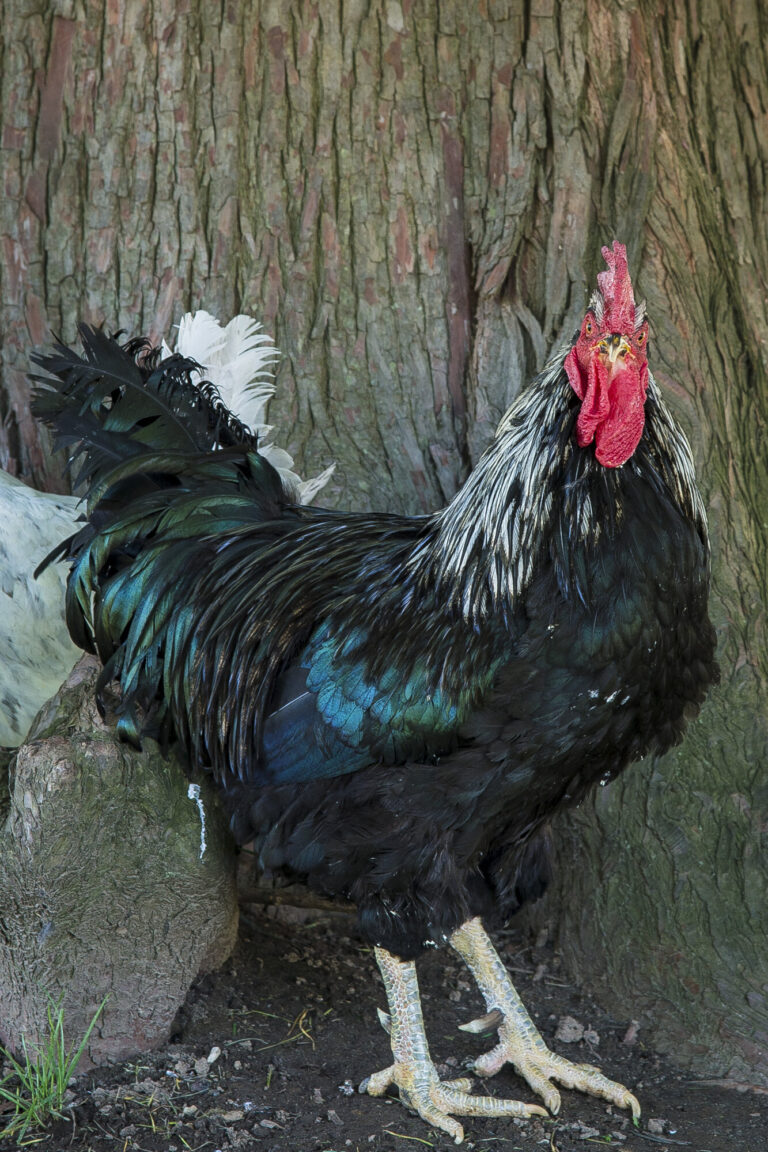
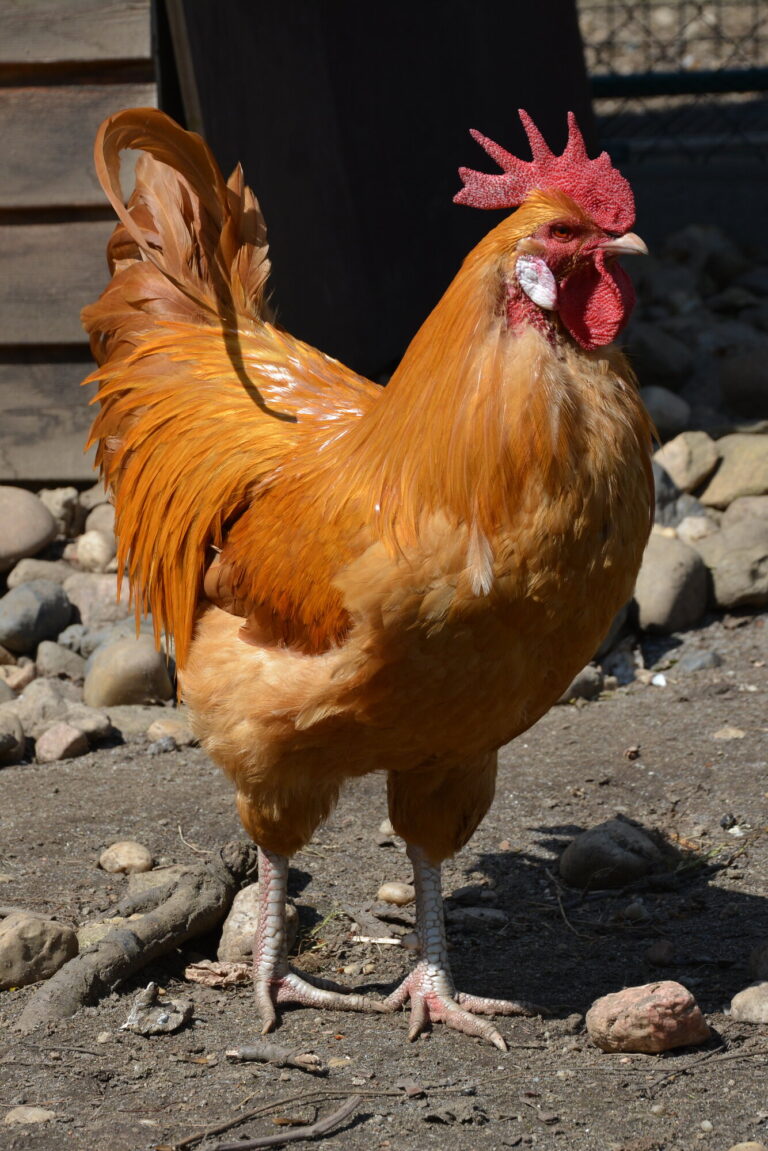
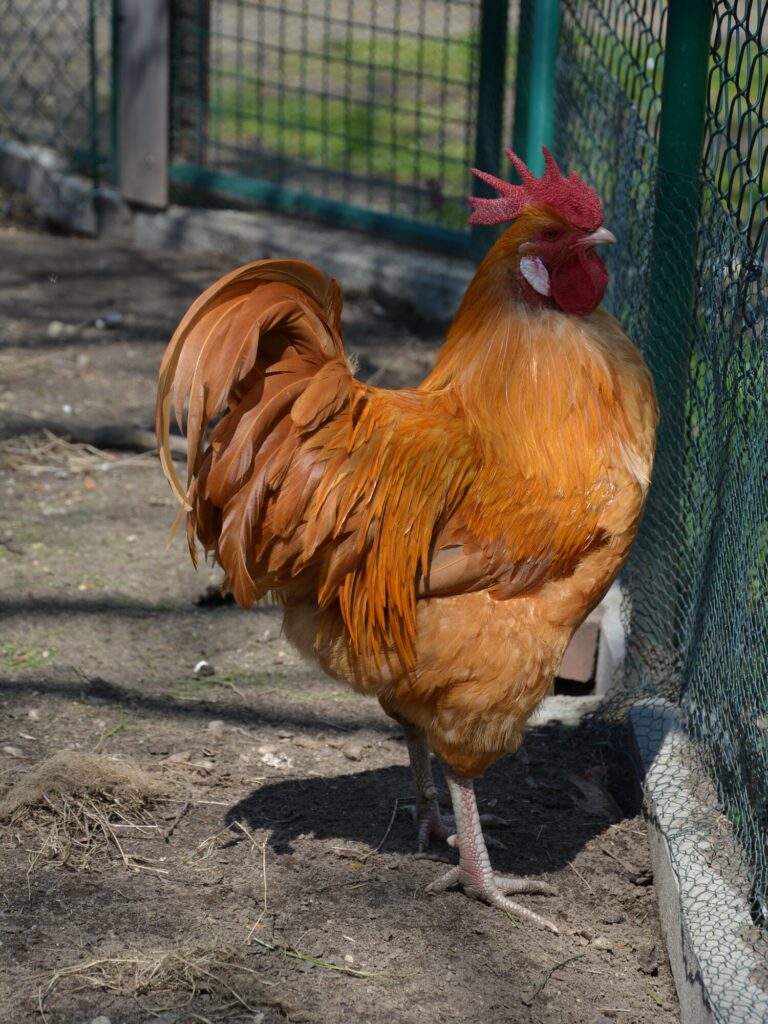
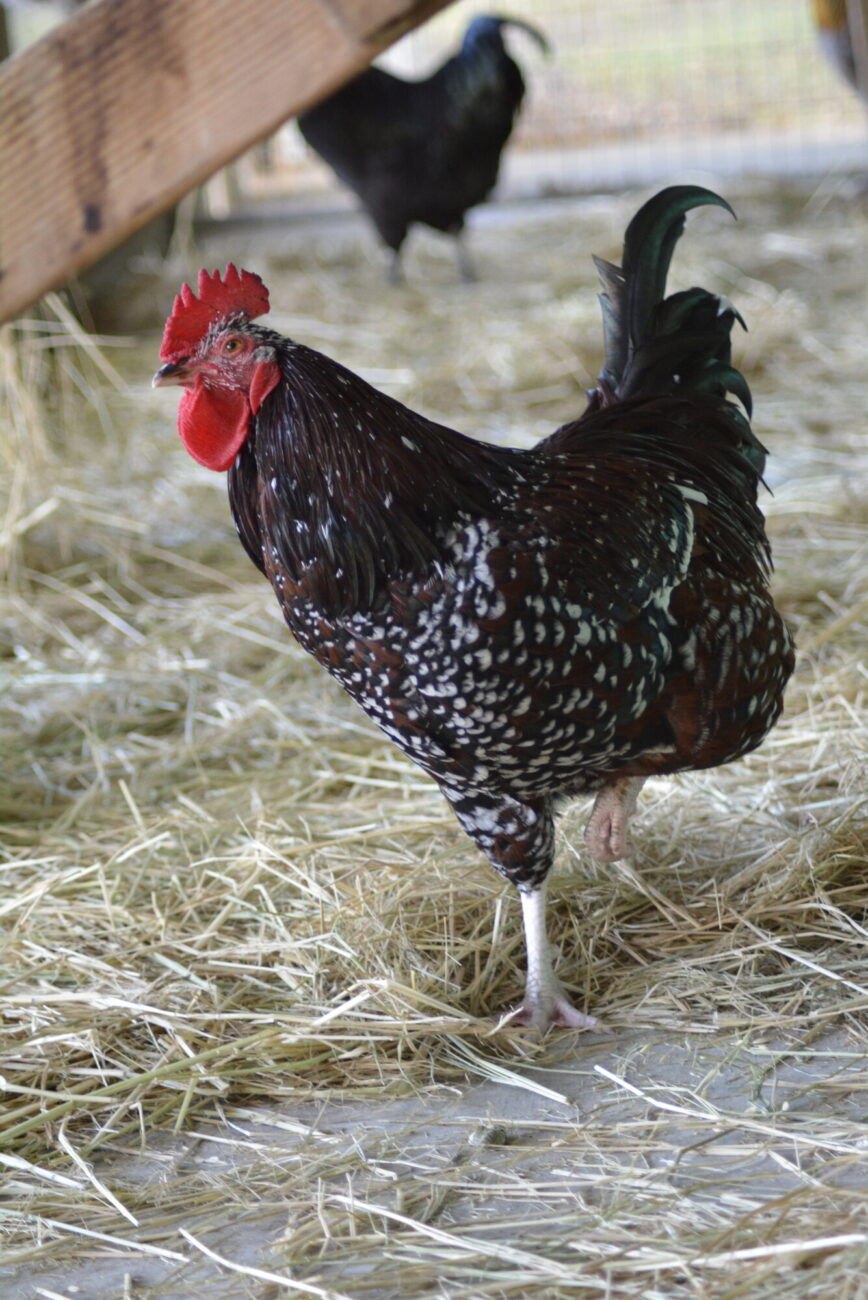
A word on the photos. The rooster at the top and the pair in the foraging section are Speckled Sussex, named as such by their photographer. Every Orpington here was named as one by its photographer, but none of them is a standard Buff Orpington. I couldn’t find a new free photo of a Buff that passed our photo checks. And the broody hen is a different breed altogether (I’ll explain when we get to her).
The short version.
- Color is the quick tell. A Buff Orpington is one even golden shade. A Speckled Sussex is mahogany, and each feather ends in a white tip with a black bar behind it.
- An Orpington runs about a pound heavier. The Conservancy puts Orpington roosters at 10 pounds and hens at 8, and Sussex at 9 and 7.
- Both go broody. Kentucky’s extension service names Buff Orpingtons and Sussex among the broodier breeds.
- Egg counts depend on the hatchery. For Buff Orpingtons, they run from 150 to 280 eggs a year. For Speckled Sussex, it’s 151 to 240 eggs.
- Sussex forage better by most accounts, but the Conservancy says they’re “not fond of the heat”.
Tell Them Apart by Color First

From across the yard, you won’t mix these two up. A Buff Orpington is one even gold from comb to tail. McMurray Hatchery tells a story about a poultry judge at the Hamilton County Fair who was asked to describe the right shade. Out came a gold watch, and the judge said, “That’s the color for Buff Orpingtons.”
But that gold doesn’t always hold. Cackle Hatchery says some Buffs “may molt into a lighter buff or almost white feathering as new feathers grow in”, and the color can deepen again later.
A Speckled Sussex looks nothing like that. McMurray describes a “rich mahogany base color with individual feathers ending in a white tip separated from the rest of the feathers by a black bar”. So every spot is white, with a thin black band behind it, on a red-brown feather. And the speckles add up over the years. Cackle puts it this way: “With each yearly molt, more speckles usually appear”. Your older hens will often look brighter than they did as pullets.
One catch, though. A speckled bird isn’t always a Sussex. William Cook, the breeder behind the Orpington, also made a speckled variety called the Jubilee, according to the Conservancy. Meyer Hatchery still lists Jubilee Orpington chicks.
Chicks give it away too. McMurray says Buff Orpington chicks are “a soft light buff color”. Its Speckled Sussex chicks “vary greatly in color from a creamy buff to dark chestnut”, and some have dark and light stripes down the back. Meyer just calls them chipmunk colored.
Now look at the legs. Neither breed has feathered ones. Meyer lists clean legs for both, white on its Speckled Sussex and white on its Buffs (they’re orange when the chicks hatch). McMurray calls the Buff’s legs “pinkish white”. The old version of this page gave Buff Orpingtons feathered legs. They don’t have them, and I’ve cut that.
Both breeds wear a single comb, McMurray says. For the Sussex, the Conservancy describes a “rich red, five-pointed comb” and “reddish-bay eyes”.
Lori Woods named the roosters in the flock at the top after Lord of the Rings characters. This photo’s title names two of them, Gollum or Boromir, so even the photographer couldn’t say for sure which Sussex it was. Either way, you can see the white tip and black bar on nearly every feather.
Two English Breeds From Neighboring Counties

Both breeds come from the same corner of southeast England. Cook was a coachman in the Kentish town of Orpington. According to the Conservancy, Cook crossed Minorca roosters with Black Plymouth Rock hens, then crossed their offspring with clean-legged Langshans. American breeds were reaching England at the time, but the British didn’t like their yellow skin. So Cook went after a hardy, fast-growing bird that laid well and dressed out the way British buyers wanted. It went public in 1886, and within 10 years Orpingtons were well established in England.
That first Orpington was black. University of Illinois Extension calls the 1886 Black Orpington “the original Orpington”, and it says the Buff and White came from different crosses. Orpingtons reached America by 1891, the Conservancy says, and Cook brought a big shipment over in 1903. Farmers in the Midwest took to the Buff for its table qualities and “its unique color”. The American Poultry Association recognized the Buff in 1902, three years ahead of the Black.
Back then, Orpingtons made broilers of 2 to 2.5 pounds at 8 to 10 weeks old, the Conservancy says. They were good layers too, good enough to compete at the first egg-laying contest in 1887.
Sussex chickens go back much further. The Conservancy traces them to Sussex and the counties next door, which supplied eggs to Victorian London. Kentish and Sussex chickens were shown at London’s first poultry show in 1845. But by 1900, crossbreeding had left only a few pure flocks. In 1903, the poultry writer Edward Brown scolded a group of Sussex farmers for letting the breed slip away. That July, E.J. Wadman started a club for Sussex chickens. The breed reached America about 1912, and the APA recognized the Speckled in 1914.
Here’s a difference that matters if you care about rare breeds. The Conservancy took the Orpington off its priority list in 2016. It still lists the Sussex as recovering.
The hen in the photo is a black Orpington, the color Cook started with. A Wikimedia Commons user named Rex posted her in 2005. Notice how her feathers puff out low on her body? That’s where we’re headed next.
Size and All Those Feathers

An Orpington is the bigger bird, by about a pound. The Conservancy says Orpington males “typically weigh 10 pounds and females 8 pounds.” For the Sussex, it says males weigh 9 pounds and females 7. McMurray and Meyer give those same weights, and so does Valley Hatchery. Stromberg’s lists its Buff Orpington hens at 8 pounds and its Speckled Sussex hens at 7. Mississippi State Extension gives a wider range for Orpingtons, 7 to 10 pounds as adults.
Plus, an Orpington looks bigger than it is. Mississippi State says Orpingtons have “very loose feathering” that makes them look fluffy. Meyer says Buffs get called Big Buffs because they “appear to be heavier than their true weight.” Where did all that fluff come from? Illinois Extension says Cochin blood went into some early Orpington strains, “as evidenced by some of the more loosely feathered specimens.”
A Sussex is built tighter. The Conservancy describes “a rectangular shape, wide shoulders and deep broad body” with “close fitting feathers”. Under the feathers, both breeds have white skin. Sussex hens “will put on fat very easily”, the Conservancy warns, and they “lay best if not allowed to get overly fat.” So go easy on the scratch grains if you want eggs.
Tamsin Cooper tagged the hen in this photo as a blue Orpington. She isn’t a Buff, but she shows off that Orpington coat pretty much perfectly. See how her feathers stand out from her body and almost hide her legs? According to the Conservancy, Cook’s son-in-law, A.C. Gilbert, created the Blue, and the APA recognized it in 1923.
Want to see your Orpington next to a truly huge bird? Our Buff Orpington vs Jersey Giant page has the numbers.
Egg Counts Depend on Whose Hens You Buy

Here’s where the sources stop agreeing. Each hatchery is describing its own chicks, and Cackle, for one, says it has bred its own lines of both breeds since 1979.
For Buff Orpingtons, Cackle gives 150 to 280 eggs a year and calls that an estimate. Stromberg’s and Valley both say 200 to 280 eggs. Meyer says 4 to 6 eggs a week, and McMurray just rates production as good.
For Speckled Sussex, McMurray answers a customer’s question with 151 to 220 eggs a year. Stromberg’s and Valley say 180 to 240 eggs. Cackle says 200 to 240, and Meyer again says 4 to 6 eggs a week. The Conservancy, which isn’t a hatchery, puts Sussex hens at 200 to 250 eggs a year.
So which breed lays more? Honestly, going by these numbers, I can’t tell you. The Buff ranges reach a bit higher, up to 280 eggs, but the ranges overlap so much that I’d worry more about your hatchery than the breed.
Egg size splits them too. Stromberg’s and Valley call Buff Orpington eggs medium. Meyer says L/XL, and McMurray and Cackle say large. The Conservancy goes with large to extra large. For the Sussex, every source I read says large. Both breeds lay brown eggs. McMurray calls Sussex eggs “light brown or tinted”, and the Conservancy says Orpingtons lay “large light to dark brown eggs”.
And when do they start? Meyer lists laying maturity at 20 to 24 weeks for Buff Orpingtons and 16 to 20 weeks for Speckled Sussex. McMurray lists 20 weeks to maturity for both. Winter eggs look good either way. McMurray says the Buff’s heavy plumage makes it an excellent winter layer, and Valley says its Sussex keep laying “even during winter months.”
Tamsin Cooper tagged the two pullets in the photo as Orpingtons. Neither one is a show Buff, as far as I can tell. If you want the same source-by-source egg count for another breed, our Rhode Island Red egg production page does it for Reds.
Both Breeds Go Broody

If you’ve heard that Buff Orpingtons rarely go broody, forget it. The old version of this page said so, and it was wrong. Kentucky’s extension service says some breeds are broodier than others: “These include Buff Orpingtons, Cochins, Australorps, Sussex, Brahmas, and Silkies.” Both of our breeds made that list.
All five hatcheries mark both breeds as broody. McMurray rates its Buffs “extremely likely” to sit and its Sussex “very likely”. The Conservancy says Sussex hens “can be broody and are good mothers”, and Mississippi State credits Orpingtons with “very good mothering abilities”.
That’s great if you want chicks. A broody hen will hatch fertile eggs for you. Turns out she isn’t picky, either. Kentucky says hens will sit on eggs from other kinds of poultry, even guinea fowl.
But it’s a pain if you want eggs. Kentucky puts it plainly: “When broody, hens do not lay eggs.” Georgia’s extension service figures broodiness can cut production “by as much as 8 to 10 eggs per hen.” And if you just wait her out, it can take 21 days, and some hens won’t quit even then.
To break a broody hen, Kentucky suggests collecting eggs often and lifting her off the nest at night onto a perch with the other hens. If that fails, try a wire-bottomed cage in the coop. Give her feed and water but no nesting material, and it may take a few days. Georgia’s version is an isolation pen for 7 to 10 days. Australorps made Kentucky’s list too, and our Buff Orpingtons vs Australorps page covers that pairing.
The hen in this photo isn’t either of our breeds. She’s a Sundheimer, a German breed. I picked her because her photographer, Pedalito, says she hatched both of those chicks herself. One is a Sundheimer chick, and the other is a Sachsenhuhn. I couldn’t find a free photo of a broody Buff Orpington or Sussex that passed our checks. Weirdly, her coloring looks a lot like a Light Sussex, which Cackle describes as “a white bird with black markings” on the neck and tail.
Foraging and Temperament

Both breeds are calm. The Conservancy lists the Orpington’s temperament as calm and friendly and the Sussex’s as calm and curious. Cackle and Stromberg’s label the Buff docile and the Sussex active and curious.
That curiosity is the real difference. The Conservancy says Sussex “are curious and like people”, and they like to free-range “for a while during the week”. They aren’t flighty, either. McMurray says Speckled Sussex “are not considered a flighty breed”, and the Conservancy says they’re “not prone to flying”. The old version of this page called the Sussex flighty, and neither source backs that up.
Foraging is where the sources argue. Mississippi State says Orpingtons “do not forage well”. Cackle calls the Sussex “good at foraging” (Stromberg’s says Sussex “have a good foraging ability”). Meyer goes further and calls its Speckled Sussex “an excellent forager”. Then McMurray flips it. Its chart rates Buff Orpingtons better for free range and Sussex just good. Meyer says both breeds forage.
My take? If your hens will roam, the Sussex is the safer bet, since more of my sources back it there. Cackle adds that the speckles may make a Sussex “less noticeable to predators such as coyotes and foxes”. It’s quick to say “no chicken is truly predator-proof”, though, so you’ll still need a good fence.
Watch one thing in a mixed flock. The Conservancy says Sussex are confident but “not aggressive with other breeds”, so keep an eye out in case your pushier birds pick on them. Orpingtons, for their part, are “known for being a broody bird and for being quiet.” That’s Stromberg’s description.
For a family, either one works. The Conservancy calls the Sussex “a suitable breed for beginners” and a good pick for kids who might get into showing or 4-H.
That’s Gollum and Boromir in the photo, the two Speckled Sussex roosters from the top, digging through the straw.
Hot Summers and Big Single Combs

Both are cold-hardy birds. McMurray rates the Buff’s cold tolerance excellent, and Stromberg’s calls the Sussex “very cold hardy”. Heat is a closer call. The Conservancy says the Sussex “does well in the winter but is not fond of the heat.” Yet McMurray rates the Sussex’s heat tolerance a notch above the Buff’s, and Valley files both breeds under heat tolerant. So again, the sources split.
Whichever you pick, watch your birds on hot days. Mississippi State says the first signs of heat stress are “panting and drooping of their wings”, and then combs and wattles lose some color. NC State adds “holding wings out and away from the body” to that list. Keep fresh, clean water in a shady spot, and put your feeders and drinkers in the shade too. For an overheated hen, Mississippi State suggests setting her lower body in “cool, not icy, water” while you keep her head above it. If heat stress cuts her laying, it can take a month to get back to normal, it adds.
In winter, the comb is the weak spot, and both breeds have a single comb. Jacquie Jacob of the University of Kentucky writes that frostbite “is most common in roosters because they typically have larger combs and wattles”. Pea and strawberry combs get it much less. It’s most likely at night “in a cold, poorly ventilated coop with damp bedding.”
If a bird does get frostbite, warm the spot slowly. Jacob is blunt about it: “Do not use direct heat, such as a hair dryer or heat lamp. Do not rub or massage the affected area.” The old version of this page suggested a hair dryer and a massage, so please skip both. Skip pain pills too, since Jacob warns some are lethal to chickens. Healing can take 4 to 6 weeks. If a bird looks really unwell, call your vet. I’m not one.
Prevention is mostly about the coop. Jacob recommends dry bedding and good ventilation. Petroleum jelly on combs helps with mild freezing, Jacob says, “but coop management is the real key.”
The rooster in the photo is another black Orpington from Rex. Look at the size of that comb and those wattles. That’s exactly what Jacob means. Roosters and hens of the same breed differ in more ways than the comb, and our Buff Orpington rooster vs hen page gets into that.
Which One Belongs in Your Coop?

Honestly, you can’t go far wrong with either one. Here’s how I’d choose.
Pick a Buff Orpington if you want the bigger, fluffier bird of the two, and a calm, pet-like hen. Cackle says that’s why beginners and families like them. Just know she may spend some weeks sitting instead of laying.
Pick a Speckled Sussex if your hens will forage, or if you like a bird that gets prettier every year. It’s also worth it if you want to help keep a recovering heritage breed going. And if your summers run hot, give either bird plenty of shade, but especially the Sussex.
If you can’t decide, both are calm, so a mixed flock is an option. Just keep that note about Sussex getting picked on in mind. Meyer listed day-old chicks of both breeds at $4.72 each when I checked on October 28, 2026. Prices change, so check before you order.
Still on the fence? Our Chicken Breed Finder sorts breeds by what you want from your flock. Looking at other golden birds? Our Buff Orpington vs Buff Rock page shows you how to tell those two apart, legs first. And if your space is tight, Buff Orpington vs Bantam covers the small version.
The pullet in this last photo is another of Tamsin Cooper’s tagged Orpingtons, by that same drinker. She isn’t a show-standard Buff, but she’s a fair picture of a young Orpington-type hen poking around a weedy yard.
Sources
- The Livestock Conservancy: Sussex Chicken.
- The Livestock Conservancy: Orpington Chicken.
- University of Illinois Extension: History of Breeds.
- Jessica Wells, Tom Tabler and F. Dustan Clark, Mississippi State University Extension: Choosing the Right Breed for Your Backyard Flock (Publication 3036).
- Mississippi State University Extension: Protect Backyard Chickens, Livestock From Extreme Heat.
- N.C. Cooperative Extension, Sampson County Center: Are Your Chickens Cool Enough to Beat the Heat?
- Jacquie Jacob and Tony Pescatore, University of Kentucky: Broodiness in Chickens (ASC-247).
- Dan L. Cunningham, University of Georgia: Controlling Broodiness in Backyard Flocks (2009).
- Jacquie Jacob, Poultry Extension: Frostbite in Chickens.
- McMurray Hatchery: Buff Orpingtons.
- McMurray Hatchery: Speckled Sussex (with its questions and answers).
- Meyer Hatchery: Buff Orpington Day Old Chicks.
- Meyer Hatchery: Speckled Sussex Day Old Chicks.
- Stromberg’s: Buff Orpington Chicks, Female.
- Stromberg’s: Speckled Sussex Chicks, Female.
- Valley Hatchery: Buff Orpington Chicks.
- Valley Hatchery: Speckled Sussex Chicks.
- Cackle Hatchery: Buff Orpington.
- Cackle Hatchery: Speckled Sussex.
Sources checked October 28, 2026. The weights and egg counts here are each source’s own, and I didn’t round them.
Related read: How to Raise Chickens for Eggs — Instant PDF download. Secure checkout by Stripe