My call: yes, a hen can have a little chicken and dumplings, but the chicken is the good part and the pot is the problem. My call is that plain cooked chicken is fine for a hen. Chickens are omnivores, and USDA lists plain roast chicken breast at 74 milligrams of sodium per 100 grams. But the dish as a whole is a salty one. USDA’s survey recipe puts 18 grams of table salt in the pot, and the finished dish comes to 488 milligrams of sodium per 100 grams. Colorado State Extension says to make sure scraps “are not salty”. So my call is a few shreds of the chicken, though it’s been soaking in that salty broth. Better still, set a little plain chicken aside before it goes in the pot, and leave the dumplings and the broth in the kitchen. Keep it all to 10 to 15 grams a day. If the pot has onion or garlic in it, none of it goes out. And in Britain, kitchen scraps can’t go to hens at all, by law.
I rewrote this page from 22 sources, all listed at the bottom. The numbers for the dish come from four entries in USDA FoodData Central. For hens I used four extension services: Colorado State, Alabama, the University of California and Maine. I also used three guides by Jacquie Jacob of the University of Kentucky on the national poultry extension site, Cackle Hatchery and six chapters of the Merck Veterinary Manual. The leftover rules come from the USDA’s Food Safety and Inspection Service, and those are written for your kitchen. The law comes from the UK government and the U.S. Code of Federal Regulations. And where a line is my own read of the sources, I’ll tell you so.
The old page opened with a story I can’t back up. “Me and Jake were just shootin’ the breeze on his front porch”, it began, and then Jake’s hens went through “leftover chicken and dumplings from Sunday dinner” in the coop. The punch line was “Who knew chickens had a taste for cannibalism?” I can’t show you any of it happened, so it’s gone. So is Mrs. Tweedy, whose flock finished off “her entire homemade apple pie – crust and all!” So is cousin Earl, whose “accidentally tossed out” bucket of KFC was “shredded to smithereens by Miss Prissy and her girls”. Jake’s hens on “leftover chicken casserole, green bean ends, and crushed egg shells” that were “laying like nobody’s business” are gone too. Flossie, “our top chicken and our first hen”, and her “baby gopher snake in the coop” went with them. A page that said “As a rookie chicken farmer” and “pointers learned from experience” can’t then make up the experience.
The feed section had it backwards. It said store feed has everything a hen needs “without resorting to anything strange or unnatural like meat”. It said “chicken feed is plant-based and does not include meat products for ethical and health reasons”. It said feed makers “avoid ingredients chickens aren’t adapted to digest like animal proteins”. Alabama Extension says some layer feeds do carry animal proteins, and that chickens are omnivores. You’ll see that below. The page also told you to “avoid red meat like chicken as a home remedy”. The home remedies went next: peppermint and ginger “to aid digestion”, turmeric as “a powerful anti-inflammatory that can speed recovery when mixed in their water”, and bone broth that “supports healing and energy levels during sickness”. None of it had a source, so it’s out. A sick bird needs a vet, not a guess.
The rest went for the same reason. Lines like “roosters have no paternal instincts towards eggs” and “Hens can even reabsorb nutrients from eggs that won’t hatch without negative consequences” had nothing behind them. Neither did the claim that chickens “do not ruminate on losses or participate in mourning rituals”.
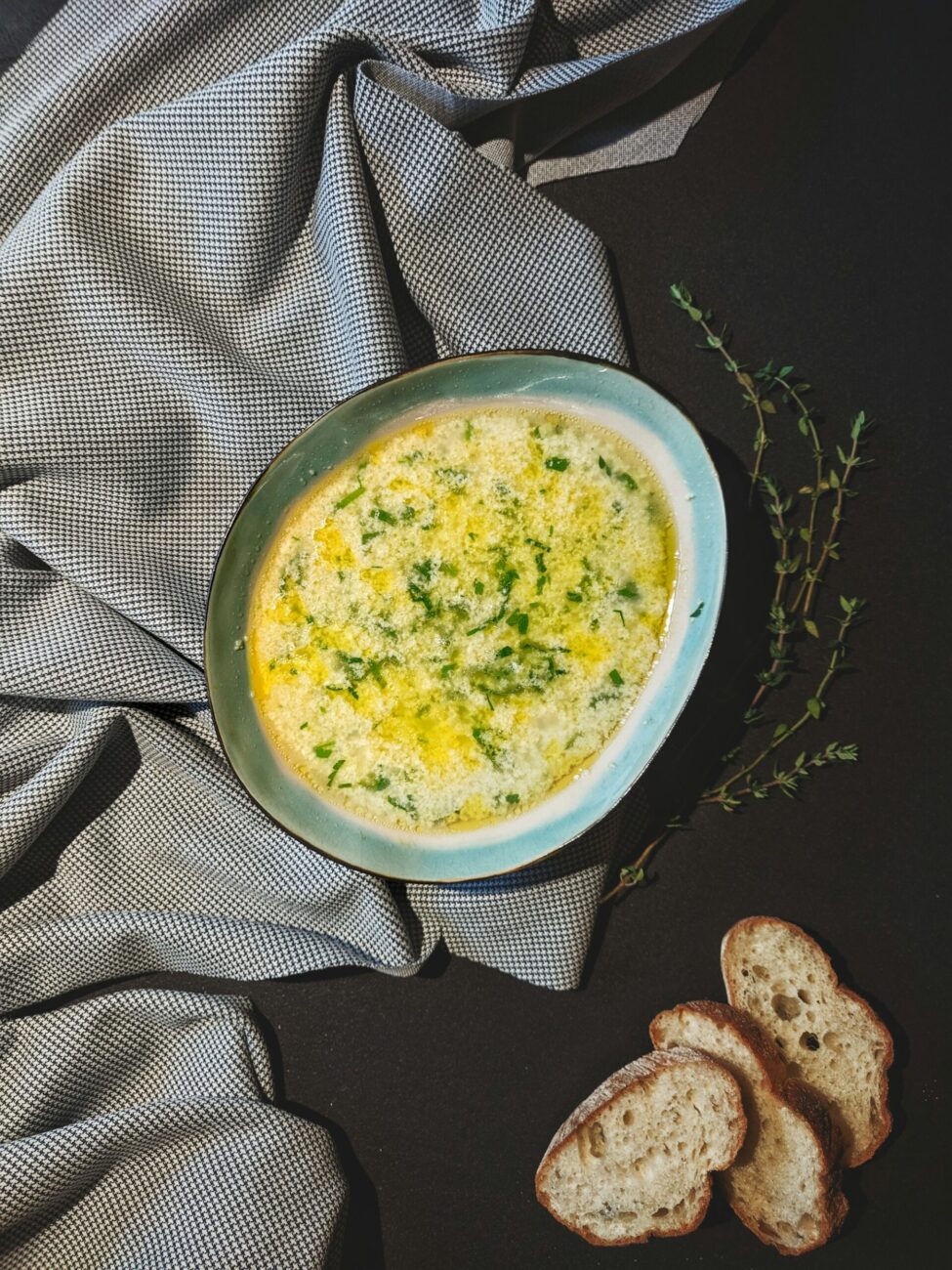
A word on the photos. All 9 are real stock shots, credited under each one. But none of them shows a hen eating chicken and dumplings (I looked). The bowl up top is a creamy chicken soup shot in Kyiv, not a Southern pot of chicken and dumplings. The dough’s photo page doesn’t say what it became. The tureen of broth is a Polish soup its photo page calls rosołek. The corn stands in for the feed section, and its photo page doesn’t say what the crop was grown for. The two bowls are lentil soup with meatballs, standing in for a serving next to a spoon. The blue pot’s photo page doesn’t say what’s in it. The farmhouse in the Scottish Highlands stands in for Britain, and there isn’t a hen in it.
The short version.
- My call: a few shreds of the chicken from the pot are fine as a treat, though it’s soaked in salty broth. Plain chicken set aside before it goes in is better. The dumplings and the broth stay in the kitchen.
- USDA’s recipe for chicken with dumplings has 18 grams of table salt in it. The dish comes to 488 milligrams of sodium per 100 grams.
- That’s about six and a half times the sodium in plain roast chicken breast, by my math from USDA’s numbers.
- Maine Extension says feed is made with about 0.15 percent sodium. On 100 to 150 grams of feed a day, that’s 150 to 225 milligrams, by my math.
- One USDA dumpling weighs 25 grams and carries about 107 milligrams of sodium. That’s about half to nearly three-quarters of what her feed gives her in a day, by my math.
- Her whole treat share is 10 to 15 grams a day. That’s Colorado State’s 10 percent of Alabama’s 100 to 150 grams of feed, by my math.
- No skin, no fat. Merck ties fat scraps to fatty liver and sudden death.
- Onion or garlic in the pot? Then none of it goes out. Colorado State and Kentucky warn about onions for hens, and Merck’s vet manual covers onion and garlic poisoning in other animals.
- Bagged feed isn’t always meat-free, and chickens are omnivores. Cooked chicken isn’t strange food for a hen.
- Leftovers follow USDA’s 2-hour and 3 to 4 day rules, by my read, and nothing gets left out to rot.
- Chicks: Alabama says starter feed only until 6 weeks. I’d wait until then.
- In Britain, feeding kitchen scraps to hens is illegal, even to pet hens.
What’s Really in the Pot

Chicken and dumplings is three foods in one pot: the chicken, the dumplings and the broth they cook in. To see how much of each, I went to USDA FoodData Central. Its survey entry “Chicken or turkey with dumplings” comes with the recipe USDA used to work out the numbers. Here’s what goes in:
- 1,512 grams of rotisserie chicken, the entry says “skin not eaten”
- About 273 grams of all-purpose flour
- 711 grams of tap water and 244 grams of milk
- 51 grams of vegetable shortening
- 13.8 grams of baking powder
- 18 grams of table salt
So the chicken is more than half the pot by weight (before it’s cooked), by my math. Per 100 grams of the finished dish, USDA lists 144 calories, 15.7 grams of protein, 5.55 grams of fat, about 8 grams of carbohydrate and 488 milligrams of sodium. A cup of it weighs 244 grams.
USDA has a second entry for the kind with vegetables and gravy. Its recipe is dumplings, rotisserie chicken, corn, green beans, a little oil and canned or bottled chicken gravy. That one comes to 340 milligrams of sodium per 100 grams. Neither of USDA’s recipes lists onion, garlic or celery as an ingredient, though the canned gravy in the second one isn’t broken down. Yours might have them, and I’ll get to onion below.
So when you ask if a hen can eat chicken and dumplings, it helps to take the pot apart. The chicken is the easy part. The dumplings are a bread food. The salt is all through the pot, dumplings included. And whatever else went in decides the rest. That’s how the rest of this page is laid out.
The Chicken Is the Easy Part

Let’s start with the worry the old page joked about, that a chicken shouldn’t eat chicken. The University of California’s feeding guide says it plainly: “Chickens are omnivores meaning they eat both animal protein and plant produced foods.” Alabama Extension says the same, that “chickens are omnivorous (eat both plants and animals)”. Colorado State notes that “Free-range chickens will consume insects to add to their protein intake.” A hen out ranging is already finding animal protein on her own.
And my call is that plain cooked chicken is a good treat. USDA’s entry for roast chicken breast, meat only, lists 31 grams of protein, 3.57 grams of fat and 74 milligrams of sodium per 100 grams. That’s lean, and it’s low in salt. So if you’re making chicken and dumplings, my call is to set aside a little plain chicken before it goes in the pot. That’s the cleanest treat you’ll get out of the whole meal.
But chicken that’s been simmering in the broth isn’t as plain (it’s been sitting in the salty liquid the whole time). My call: a few shreds are fine, inside the 10 to 15 grams a day we’ll get to below. If it’s a different chicken dish in your fridge, there’s also our page on chicken alfredo for chickens.
Now, skip the skin and the fat. The Merck Veterinary Manual’s chapter on backyard poultry says “Fat scraps should also be avoided, because they promote the development of fatty liver and acute death from liver rupture.” Merck’s chapter on fatty liver hemorrhagic syndrome calls it “a leading noninfectious cause of death in backyard chickens”. The University of California guide says “Chickens don’t require high amounts of fat, so avoid fatty foods.” USDA’s recipe already leaves the skin out, and so would I.
And leave the bones out too. Our own Can Chickens Eat It? checker doesn’t rate chicken bones, because none of the official sources it uses rules on them. I didn’t find one that does either, so my call is to keep it simple and pick the meat off first.
Does cooked chicken teach hens to be cannibals?
Here’s what the vets and extension folks actually say causes cannibalism. The Merck Veterinary Manual: “No single cause of cannibalism in poultry has been identified, but genetics, crowding, excessive light intensity, and nutritional imbalances are correlated with its occurrence”. Jacquie Jacob of the University of Kentucky writes that “Cannibalism is a learned behavior that can spread quickly through a flock.” She also links it to diets short on protein or sodium, with phosphorus on her list too.
But cooked chicken from your kitchen isn’t on either list. My read is that a few shreds of it in a treat dish aren’t what these sources mean. I’ll be straight with you, though: I didn’t find a study that tested it either way. What they do point to is genetics, crowding, bright light and gaps in the diet, and Merck warns that “once this habit gets established it is difficult to eliminate”. Jacob also says “dead birds should be quickly removed from the flock”. There’s more on that in our page on whether chickens eat a dead flockmate. If you want more on meat scraps, there’s also chicken liver for chickens.
The Dumplings Are Little Biscuits

USDA files its “Dumpling, no meat” entry with the quick breads, in a group it shares with biscuits and muffins. That’s about right. Its recipe is 250 grams of flour, a cup of milk, 482 grams of water, 25.6 grams of shortening, 18.4 grams of baking powder and 6 grams of table salt. Per 100 grams, a cooked dumpling has 125 calories, 20.5 grams of carbohydrate, 3.45 grams of protein, 3.37 grams of fat and 428 milligrams of sodium. USDA weighs one dumpling, any size, at 25 grams.
Now, bread-type scraps are on the okay list. Colorado State names “bread products” among the scraps to consider. Jacquie Jacob’s guide on feeding for eggs says “Chickens are often fed table scraps (peelings, stale bread, and leafy vegetables) as treats”. So bread foods aren’t off limits in general. Our checker rates bread “Fine as a treat”, but only plain and not salty.
But there are two catches. The first is salt. A dumpling is salted dough. USDA’s own dumpling recipe has its 6 grams of table salt right in it, and the dumpling comes to 428 milligrams of sodium per 100 grams. That’s close to the whole dish’s 488. One 25-gram dumpling carries about 107 milligrams of sodium, by my math. We’ll put that next to her feed in a minute, and it isn’t small. The second is size. One dumpling weighs more than a hen’s whole treat share for the day.
Plus there’s a third thing (if I’m counting), and it’s what a dumpling isn’t. At 3.45 percent protein, it’s far thinner than layer feed. Jacob writes that “Layer diets that contain 16% protein are more common.” Colorado State warns that “It is important to not over feed your chickens with scraps as they need to get enough protein to meet daily requirements.” A belly full of dough is a belly with less room for feed.
My read is that USDA’s dumpling counts as a salty scrap under Colorado State’s rule, even before it soaks up any broth. So my call is to keep the dumplings in the kitchen with the broth. The salt is the next section.
The Salt Is All Through the Pot

Hens need salt, honestly. That’s worth saying first, because it’s not poison in itself. The University of Maine’s poultry page says sodium is “added to chicken feeds at the rate of about 0.15% sodium in the feed mix”. It also says “Most chickens need between 0.12% to 0.2% sodium in the diet.” Jacob even links cannibalism to too little sodium. So the feed already has the salt she needs.
Here’s the math. Alabama Extension says “A laying hen will consume between 100 and 150 grams of feed per day or roughly 0.25 pounds.” At 0.15 percent sodium, that’s 150 to 225 milligrams of sodium a day from her feed, by my math. Now put the pot next to it:
- A whole cup of chicken and dumplings: 244 grams at 488 milligrams per 100 grams is about 1,190 milligrams of sodium. That’s five to eight times what her feed gives her in a day.
- Her treat share of it: 10 to 15 grams carries about 49 to 73 milligrams. That’s about a third of her feed’s sodium for the day, on top of the feed.
- One dumpling: about 107 milligrams. That’s about half to nearly three-quarters of her feed’s sodium for the day.
- Her treat share in plain roast chicken breast instead: 10 to 15 grams carries about 7 to 11 milligrams.
All of that is my math from USDA’s and Maine’s numbers. It’s why Colorado State’s line about scraps matters here: “Make sure they are not salty or have citrus or are moldy.” Our checker rates salt as “Never” for the same reason. By that rule, my read is that the dumplings and the broth make this a salty scrap. Plain roast chicken on its own isn’t, at 74 milligrams per 100 grams.
How worried should you be about one spoonful? The Merck Veterinary Manual’s chapter on salt toxicosis says “animals can tolerate high concentrations of salt or sodium in the diet if they have continuous access to fresh water”. So fresh water matters most. Merck also says “High salt content in wet mash is more likely to cause poisoning than in dry feed, probably because birds eat more wet mash.” My read is that a soupy scrap is the wet kind, and birds will put away more of it than you’d think. And that’s one more reason to keep the broth out.
Know the signs. Merck’s list for birds starts with “increased thirst” and runs through trouble breathing, “fluid discharge from the beak”, weakness, diarrhea, even “leg paralysis”. If you see that after a salty scrap, don’t wait it out. Call a vet who sees poultry.
If Your Pot Has Onion in It

USDA’s recipes don’t list onion or garlic as ingredients (the canned gravy in one of them isn’t broken down). If yours has them, that changes the answer for the whole pot. My read is that once onion cooks into the broth, it’s in everything the broth touched.
The Merck Veterinary Manual’s chapter on garlic and onion poisoning says “Toxicosis has been reported in production animals after feeding them onions”. It says “raw, cooked, or concentrated forms of onions and garlic can result in Heinz body hemolytic anemia”, and it names food-producing animals right alongside cats and dogs. Merck’s chapter doesn’t name chickens, though. The farm animals it reports on are goats and sheep, plus cattle and pigs, so carrying it over to hens is my read. And it says “Garlic is 3–5 times more toxic than onion.”
And two of the extension services also say to keep onions from hens. Colorado State puts onions on its avoid list, next to rhubarb and undercooked beans. Jacquie Jacob gives a laying-hen reason on top of that. She advises that “scraps with the strong taste, such as onions, not be fed to laying hens because eggs might take on those flavors”. Our food checker rates onion “Never”, whether it’s the bulb, the peel or the leaves.
My call: if onion or garlic went in, none of the pot goes out to the hens. Not the chicken, not the dumplings, not the broth. If you know you’ll want to share, set the plain chicken aside before the onion goes in. Our page on what not to feed chickens covers onion too. It says to go easy on it, so keeping the whole pot back is my own call.
Bagged Feed Isn’t Meat-Free Either

The old page told you feed is plant-based and keeps meat out “for ethical and health reasons”. Alabama Extension’s page on feeding laying hens tells a different story. It says “Most commercially available poultry feeds have corn as their number one ingredient.” Soybean meal is the main protein in most of them. And it goes on: “Some feeds may also contain smaller quantities of animal proteins”. Its examples are poultry by-product meal or fish meal (or meat and bone meal), “although these are less common ingredients in diets for laying hens.”
So some bags do have animal protein in them, poultry by-product meal included, though Alabama says that’s less common in layer feed. Alabama is also frank about the vegetarian bags: “Although chickens are omnivorous (eat both plants and animals), many poultry feeds are available as vegetarian, containing no animal protein or animal fat sources.” Then: “The increase in vegetarian feeds has, in part, been more about marketing than actual nutrition.” And: “There is little, if any, difference in nutrient content between vegetarian and nonvegetarian diets”.
Here’s what I take from that. Cooked chicken isn’t strange or unnatural food for a hen, and nobody’s feed is ruined by a few shreds of it. But it’s also not a reason to cut back on the feed. Alabama’s layer table asks for “Protein 16% or more” and calcium at 3 to 4 percent, and it says “complete feeds are designed to be the sole source of nutrients for your birds.” The University of California guide warns that table scraps “may cause nutritional disorders if the scraps are displacing too much of the balanced diet”. Jacob says “excessive table scraps and greens can adversely affect egg production.” The feed is the meal. The chicken is a treat.
How Much to Share

Colorado State says “Treats should make up no more than 10% of their daily diet.” Alabama puts a hen’s feed at 100 to 150 grams a day. Ten percent of that is 10 to 15 grams of treats a day, by my math. And that covers every treat she gets (not just this one). It’s the same treat share I worked out on our page about coconut milk for chickens.
For scale, USDA weighs a cup of chicken and dumplings at 244 grams. A hen’s share is somewhere between a sixteenth and a twenty-fourth of that cup, by my math. So think a few shreds of chicken on a saucer. That’s why the photo has a spoon and two full bowls: her share is about the spoon.
A few more rules from the extension services, and how I’d use them:
- Short serving time. Colorado State says not to feed more than they can eat in 5 to 10 minutes, so it doesn’t draw nuisance animals. Jacob says scraps and scratch together “should be no more than chickens can finish in 20 minutes”. Whatever’s left gets picked up.
- Its own dish. Alabama says to “avoid mixing scratch grains with your complete feed”. My read is that the same goes for a meat scrap. Don’t stir it into the feeder.
- Treat, not supper. The University of California says to “treat the scraps like a treat not like the main course”. Jacob says to feed scratch grains “in the afternoon after birds have eaten complete feed”, and my read is that the same order suits a scrap.
- Fresh water out. With anything salty in the day, Merck’s line about “continuous access to fresh water” is the one to remember.
For a flock, multiply it out. Six hens get 60 to 90 grams between them a day, and that’s every treat they get, by my math. A full cup of the leftovers is still more than that.
What about chicks?
Wait. Alabama Extension says to “offer pullets a complete starter/grower diet from 1 to 6 weeks of age as their sole source of nutrition.” Cackle Hatchery allows treats sooner. It says “Feed only starter ration for at least the first two weeks”, keep treats to 10 percent of the diet by volume, and “Chop everything into chick-size bits to prevent choking.” But it also says “Never feed chicks foods that are flavored with sugar, salt or other seasoning, butter, or oil.” By my read, that rules this salted pot out for chicks at any age. My call: no chicken and dumplings for chicks, and wait until they’re past 6 weeks for even plain chicken.
If you’ve got other meat leftovers in mind, the same rules run through our page on hamburger for chickens.
Leftovers Run on a Clock

Chicken and dumplings is usually a big pot, and a big pot is slow to cool. The USDA’s Food Safety and Inspection Service says so directly: “A big pot of soup, for example, will take a long time to cool”. Its advice is to “divide the pot of soup into smaller containers so it will cool quickly.”
FSIS gives two more rules. Cooked food goes in the fridge within 2 hours, and perishable food left at room temperature longer than that (1 hour above 90°F) gets thrown away. And “Leftovers can be kept in the refrigerator for 3 to 4 days or frozen for 3 to 4 months.” Now, those rules are written for people. My read is that they’re just as good for hens, and I’d use them. If the pot sat on the stove overnight, it isn’t a treat anymore. It’s trash.
Then there’s the run. Scraps left on the ground don’t stay fresh. Jacob’s guide says “Make sure that the scraps are not allowed to rot, or botulism might result.” The Merck Veterinary Manual says “Botulism may also result from direct ingestion of decaying organic matter that contains toxin.” Her guide on botulism says to “Remove spoiled feed or decaying matter”. Colorado State puts moldy scraps on its no list, next to salty ones.
Know what botulism looks like. Merck says “Initial clinical signs include leg weakness and paresis that develops into a flaccid paralysis”. My call: a hen that’s weak on her legs needs a vet the same day.
So the simple version: serve it from the fridge within 3 to 4 days, give only what they’ll clean up in a few minutes, and pick up the rest. That’s my read of FSIS, Colorado State and Kentucky put together.
In Britain, It’s Against the Law

If you keep hens in England, Scotland or Wales, this whole page has a different answer: no. The UK government’s guidance on animal by-products as farm animal feed covers Scotland and Wales as well as England. It says “There is a complete ban on using any household kitchen waste and from catering waste containing products of animal origin.” Under the things you “must never use”, it lists “scraps and kitchen waste (including from vegan households)”.
And yes, that covers backyard hens. In 2017, the Animal and Plant Health Agency warned farmers and smallholders “not to feed catering or kitchen waste to livestock such as pigs and poultry, even if they are being kept as pets”. It says the rule “includes farm animals which are kept only as pets.” The reason is disease. APHA says the most likely source of the 2001 foot and mouth outbreak was “pigs being fed undercooked catering waste containing the virus”. The outbreak led to the “destruction of more than 10 million cattle and sheep”. So in Britain, a bowl of chicken and dumplings stays in the kitchen.
Now, in the U.S., the federal rule I read is about pigs. Part 166 of Title 9 of the Code of Federal Regulations covers garbage fed to swine. It counts waste from “the meat of any animal (including fish and poultry)” as garbage. Even that rule leaves out “waste from ordinary household operations which is fed directly to swine on the same premises where such household is located.” I didn’t find a federal line in it about backyard hens. I didn’t check every state’s rules, so if you’re not sure, my call is to ask your state’s department of agriculture.
Wherever you are, a good vet is worth having before you need one. Colorado State says “Flock owners must have an identified veterinarian in their area that can diagnose and treat chickens.” That’s the person to call if a hen gets into a salty pot or goes off her legs.
Sources
- USDA FoodData Central: Chicken or turkey with dumplings (FDC ID 2706543).
- USDA FoodData Central: Chicken or turkey, dumplings, and vegetables excluding carrots, broccoli, and dark green leafy; gravy (FDC ID 2706709).
- USDA FoodData Central: Dumpling, no meat (FDC ID 2708344).
- USDA FoodData Central: Chicken, broilers or fryers, breast, meat only, cooked, roasted (FDC ID 171477).
- Colorado State University Extension: Raising Poultry the Organic Way, Disease Control and Feeding.
- Alabama Cooperative Extension System: Feeding the Laying Hen.
- Maurice Pitesky and Nancy Reimers, UC Davis: Feeding your Flock.
- Lichtenwalner and Opitz, University of Maine Cooperative Extension: Salt is an Important Nutrient for Poultry.
- Jacquie Jacob, University of Kentucky, Poultry Extension: Feeding Chickens for Egg Production in Small and Backyard Flocks.
- Jacquie Jacob, University of Kentucky, Poultry Extension: Feather Pecking and Cannibalism in Small and Backyard Poultry Flocks.
- Jacquie Jacob, University of Kentucky, Poultry Extension: Botulism in Poultry.
- Cackle Hatchery: What to Feed Baby Chicks.
- Merck Veterinary Manual: Management of Backyard Poultry.
- Merck Veterinary Manual: Fatty Liver Hemorrhagic Syndrome in Poultry.
- Merck Veterinary Manual: Salt Toxicosis in Animals.
- Merck Veterinary Manual: Garlic and Onion (Allium spp) Toxicosis in Animals.
- Merck Veterinary Manual: Cannibalism in Poultry.
- Merck Veterinary Manual: Botulism in Poultry.
- USDA Food Safety and Inspection Service: Leftovers and Food Safety.
- UK government guidance: Supplying and using animal by-products as farm animal feed.
- Animal and Plant Health Agency, GOV.UK (2017): APHA warns not to feed kitchen scraps to farm animals because of disease risk.
- Code of Federal Regulations, Title 9, Part 166: Swine Health Protection.
Sources checked November 2, 2026. Calling plain cooked chicken fine for a hen is my call. So is setting it aside before it goes in the pot, and so is calling the simmered chicken fine in small amounts. Reading USDA’s dumpling as a salty scrap is my read, and so is carrying Merck’s onion chapter over to hens. Reading Cackle’s line on salted food to rule this pot out for chicks is mine as well, and so is reading a soupy scrap as Merck’s wet kind. Reading Colorado State’s 10 percent as a share by weight is mine, and so is taking Alabama’s no-mixing line for scratch to cover a meat scrap. Saying cooked chicken in a treat isn’t what the cannibalism sources mean is my read, and I found no study that tested it. Using USDA’s 2-hour and 3 to 4 day rules for hens is my read too. My calls: leave bones and skin out, keep the whole pot in the kitchen if onion or garlic went in, wait the full 6 weeks with chicks, and ask your state if you’re not sure of its rules. Any figure I worked out in grams, milligrams, percent or fractions of a cup is my math from the numbers these sources print. We aren’t vets. If a bird looks sick, call a vet who sees poultry.
Related read: How to Raise Chickens for Eggs — Instant PDF download. Secure checkout by Stripe