
My call: yes, your chickens can eat a duck egg, and when they do, it’s usually not about the duck egg at all. Egg eating is a habit. Kansas State’s extension leaflet says “It is quite common for some hens in small flocks to suddenly begin consuming eggs.” The Merck Veterinary Manual says it “typically begins when a hen encounters a broken egg.” Once a hen has learned that eggs are food, a duck egg is just one more egg to her, by my read. It’s a bigger one, and in a shared coop it may be easier to get to. So your fix isn’t about duck eggs either. Keep eggs from breaking and collect them early. Then look for the bird with egg on her face. And don’t assume it’s a hen. Merck puts egg eating in hens “of all poultry species”, so by my read it could be one of your ducks.
I rewrote this page from 16 sources, all listed at the bottom. Most of the egg eating lines come from six university extension services, from Kansas State to the University of Maine. Merck and Cackle Hatchery’s FAQ add more. The duck lines come from a University of Georgia tip on keeping ducks for eggs and Merck’s chapter on backyard poultry. The egg weights come from two USDA FoodData Central entries. The bird flu lines come from Penn State Extension and a guide from the UN’s Food and Agriculture Organization. Jacquie Jacob of the University of Kentucky covered calcium. Where a line is my own read, I’ll tell you so.
The old page opened with a story I can’t back up. It began “I still remember the first time I saw it happen”, with a hen named Henrietta holding “a strange looking egg in her beak”. She “gulped that sucker down whole”, it said. Then old Bucky the rooster got “a duck egg to see what would happen”. Then came “For a test, I left a duck egg in the coop”. The page also claimed to have “witnessed chickens in the neighborhood eat duck eggs on rare occasions with no ill effects”. Later, old Bess was “pecking around the coop looking for snacks”. Then “One morning, I found a big mess on the floor of the coop”, and “Henrietta’s beak was stained yellow”. Within a few days of her time-out, it said, she “seemed less fixated on eggs”. I can’t show you any of that happened, so it’s all gone. So is “I tried sprinkling red pepper flakes into dirty nests between uses”, and so is the “Egg-Be-Gone spray that smells strongly of predators”. I didn’t find either one in any source I read.
Some claims went too, or got fixed. The page said “duck eggs are nearly twice the size of a chicken egg”. USDA’s numbers put a duck egg at 1.4 times a large chicken egg, by my math. It said eating another bird’s egg “helps them learn what a healthy, developed egg should feel and taste like”. It said hens can spot “abnormal eggs not worth the effort to hatch”. I found nothing in my sources for either one. It said “Research shows nutritional imbalances” draw hens to eggs, but it never named the research, and Kansas State says close to the opposite (more on that below). The lines about shells “accumulating in the gizzard” and a big egg straining a hen’s system are gone, since no source I read says so. And the page said “Fake plastic eggs also work well to trick hens”. North Carolina State says white artificial eggs “may also be used”, and Arizona says golf balls in the nest bring “mixed results”. So that’s how I’ve written it now.
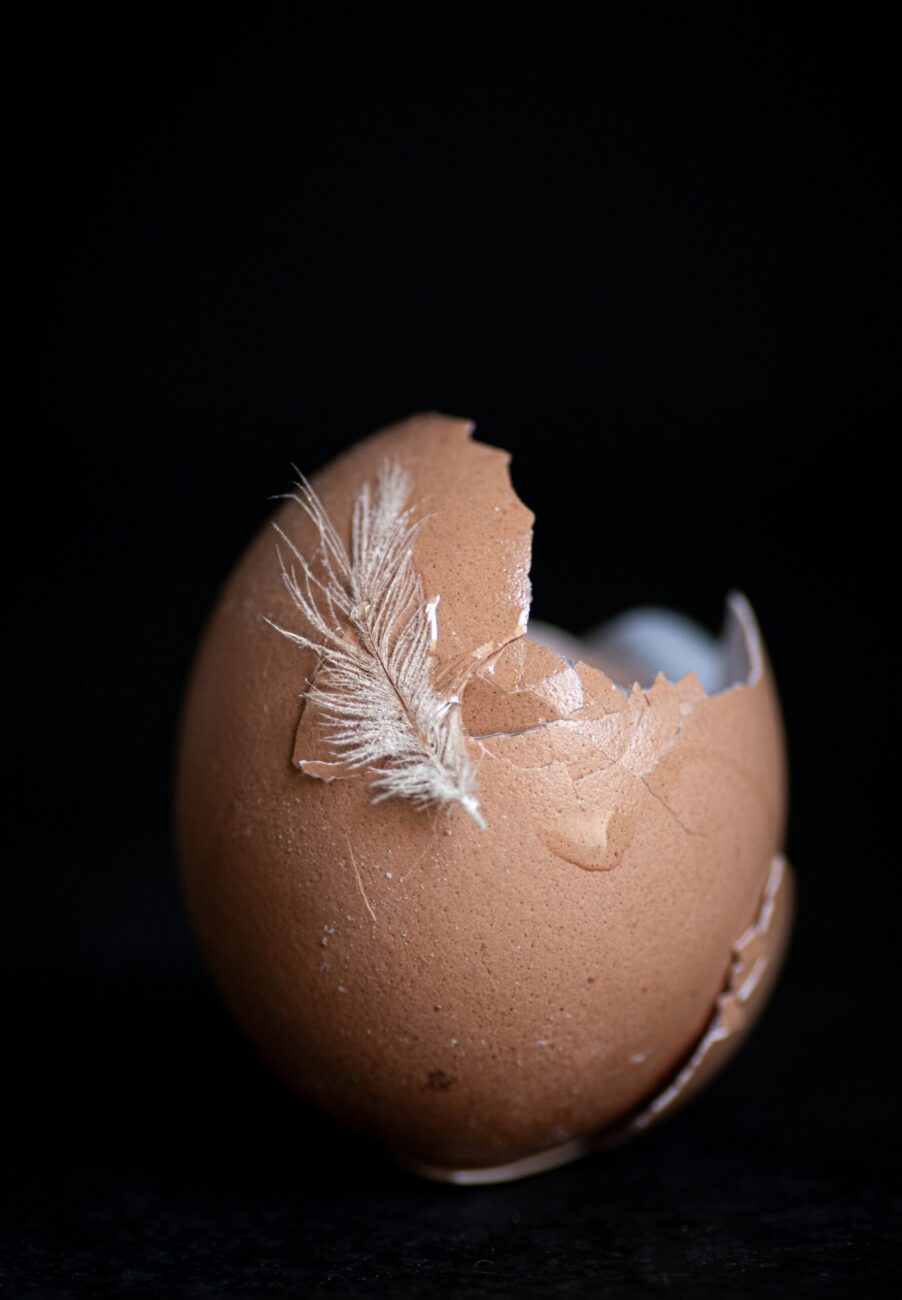
A word on the photos. All 7 are real photos, credited under each one. Five are stock shots from Unsplash. Two are from Wikimedia Commons, one released under CC0 and one in the public domain. If you’re wondering, none of them shows a bird eating an egg (I looked). The broken brown egg up top is shot on plain black, and its page calls it a brown egg with white flower petals. The white wisp looks like a feather to me. The nine duck eggs on gravel were laid at a farm on Margarita Island, the Commons page says. The size photo has two turkey eggs, two duck eggs and a goose egg over a ruler, and its page names each one. There’s no chicken egg in it. The yard of ducks is in Quezon City, in the Philippines. Its page says a white duck and a brown chicken, but every bird I can make out is a Muscovy duck. The tub of eggshells is tagged composting. The white duck was shot in Meran, in South Tyrol, Italy. The heap of pale blue-green and white eggs is from China, and its page doesn’t say what laid them.
The short version.
- My call: yes, chickens can eat duck eggs. A hen that has learned to eat eggs doesn’t seem picky about whose they are, by my read.
- It typically starts with a broken egg (Merck), and Kansas State says hens sometimes start that way. The hen gets a taste, then learns to break eggs herself.
- Other hens can pick it up from the first one (Merck, Kansas State, Cackle).
- A duck egg weighs about 70 grams, and a large chicken egg weighs 50 (USDA). That’s 1.4 times, not twice, by my math.
- Most duck eggs are laid before 7 a.m. (University of Georgia). Collect them early.
- The guides split on feed. Arizona says adequate protein and calcium help prevent it. Kansas State says it’s “more of a learned behavioral problem.”
- To find the egg eater, look for dried yolk on beaks and heads (Kansas State, Merck). Check your ducks too.
- Once it starts, it’s very hard to stop. Prevention does most of the work, and the guides’ answer for a proven egg eater is to separate her or cull her.
It Starts With One Broken Egg

If you’ve got an egg eater, three of the guides tell the same story of how it starts. Kansas State’s leaflet, by R. Scott Beyer, says “Hens will sometimes begin consuming eggs when an egg breaks by accident.” Merck’s section, by Richard Blatchford of UC Davis, tells it in more detail. “The shiny, leaking albumen invites exploration, and the hen develops a taste for eggs.” (Albumen is the egg white.) Then, Merck says, “she quickly learns to break the eggs open herself.” Arizona’s extension guide says the habit “often begins accidentally if an egg breaks in the nest and a hen tastes it.”
Then it spreads. Merck says “Egg eating is also a socially learned behavior, so a single egg eater can lead to the problem of multiple egg eaters.” Kansas State says it “can increase as other hens observe the first hen consuming eggs.” Cackle Hatchery puts it in plain farm words: “She will also teach the other hens to break eggs”. That fits what Alabama’s guide on chicken behavior says about chickens in general. They “can learn a new behavior by observing a flock mate perform the behavior.”
Now to your duck eggs. None of the egg eating guides I read single out duck eggs, or any other bird’s eggs. They talk about eggs, full stop. By my read, a hen with the habit isn’t checking who laid it. By my read, a duck egg is still an egg with a shell she can break, even though our comparison page says its shell is thicker. That’s the heart of my answer. The real question is why she started, and whether the duck eggs make it easier.
Why the Duck Egg Is the Easy One


If your hens have the habit, the duck eggs may be the first ones they find. Most of this section is my read, built on what the guides say about when and where each bird lays.
Start with the clock. The University of Georgia’s tip on ducks for eggs, by Dan L. Cunningham, says “Most duck eggs are laid before 7 a.m.” It also says “Removing the eggs as soon as possible lessens the problems of dirty and cracked eggs.” That tip is about breeder ducks kept on their own, for hatching eggs. Now picture your shared coop. A duck lays at dawn, nobody collects until after breakfast, and her egg sits there while the hens wake up.
Then the spot. For ducks hatching their own eggs, Georgia says they “will make their own nest if straw or other litter material is provided.” Its nest boxes, if you add them, are 12 inches wide, 18 inches long and 12 inches deep, set “in a row along the walls of the breeder house”. Those lines are about breeders, but by my read they describe a nest at floor level, in the litter. Kansas State wants chicken nests “at least 2 feet off the ground”, in “the darker area of your facility”. So by my read, your chicken eggs sit up in dim boxes, while your duck eggs are likely down in the litter, right where the hens walk and scratch.
Then the cushion. Kansas State, talking about nest boxes, says “Eggs can easily crack if this material is not adequate.” An egg laid in thin or trampled litter has less padding under it. And Merck says egg eating typically begins with a broken egg, so by my read a crack is the open door. If you want to know how many eggs your ducks should be laying in the first place, our duck egg calculator works it out by breed.
Bigger, but Not Twice the Size


The old page said a duck egg is “nearly twice the size” of a chicken egg. USDA’s FoodData Central weighs one duck egg at 70.0 grams and one large chicken egg at 50.0 grams. That’s 1.4 times the weight, by my math. An extra-large chicken egg is 56.0 grams, which puts a duck egg at 1.25 times. Bigger, sure. Not double.
Inside, the duck egg is richer. Per 100 grams, USDA lists 12.8 grams of protein in duck egg and 12.6 in chicken egg, so they’re close weight for weight. Fat is where they part. Duck egg has 13.8 grams per 100, and chicken egg has 9.51. Per egg, that’s about 9.0 grams of protein and 9.7 grams of fat in a duck egg, against 6.3 grams of protein and 4.8 of fat in a large chicken egg, by my math. USDA puts calories at 185 per 100 grams for duck egg and 143 for chicken egg. That’s about 130 calories in one duck egg and 72 in a large chicken egg.
So a duck egg is a bigger prize for an egg eater. Whether that makes a hen pick it first, I can’t tell you. No source I read tested which egg a hen goes for. Our duck eggs vs chicken eggs comparison has the rest of the numbers, if you’re weighing the two for your own kitchen.
Sharing a Coop With Ducks

Maybe you keep your ducks and hens together. If so, the guides have a few things to say about that before we get back to eggs. Penn State Extension’s 4-H biosecurity team is against it. “Mixed flocks are highly discouraged for many reasons, the biggest of which being the spread of disease from the waterfowl to the domestic poultry.” The same Penn State guide says “Wild waterfowl are silent carriers of the avian influenza virus”. That line is about wild waterfowl, not your own ducks. But a Food and Agriculture Organization guide, written for animal health workers in Cambodia, says “Ducks infected with Avian Flu and excreting the virus may not show any clinical signs or lesions.” By my read, that’s the worry behind Penn State’s line. A duck can look healthy while it’s shedding bird flu.
If you keep them together anyway, ducks need more space and much more water. Merck’s chapter on backyard poultry says laying hens need a minimum of about 1.5 to 2 square feet each inside the coop and 8 to 10 in the run. “Ducks and geese need much more space”, it says, about 3 to 6 square feet inside and 15 to 18 outside. Water is the other big one. Merck says poultry drink 1.5 to 3.5 parts water for every part of feed, and waterfowl need up to five to six times that. It also says “Water holes and vegetation should be avoided around the coop”, since they draw wild waterfowl. If you’re still planning your setup, our beginner’s guide to raising egg-laying chickens goes through it in order.
By my read, this matters for your eggs. Nervous birds and frustrated birds show up in the guides’ egg eating lines, and a crowded coop can add to both. The University of Maine’s bulletin on lighting says “Nervous birds may resort to cannibalism and egg eating.” Alabama’s behavior guide says a chicken that can’t forage “can become frustrated and exhibit unwanted abnormal behaviors, such as aggressive feather pecking, egg eating, and cannibalism.” And Kansas State asks for “several inches of clean, dry nesting material” in each nest. Ducks splash, and by my read a pen full of splashed water makes it harder to keep any litter clean and dry.
Calcium and Protein: The Guides Split

The old page blamed feed. If a hen runs short on calcium or protein, it said, she’ll go after eggs. One guide leans that way. Arizona’s says to “ensure hens have a balanced diet with adequate protein and calcium to discourage them from seeking extra nutrients in eggs.”
Kansas State says close to the opposite. “There is nothing magic you can put in the feed or water to prevent consumption of eggs.” Then it goes further. “Eating eggs is not usually an indication that the hens are deficient in any mineral, vitamin or dietary supplement. It is more of a learned behavioral problem.” Merck’s section on egg eating doesn’t bring up feed at all. It starts the habit with a broken egg.
Here’s where they meet, by my read. Feed matters for the shell, and the shell matters for breakage. Kansas State says “The stronger the egg shells are, the fewer will be broken during the laying process.” It says to feed “a complete ration supplemented with calcium and phosphorus sources or oyster shells”. Jacquie Jacob says laying mashes “typically contain 2.5% to 3.5% calcium”. The guide adds that oyster shell on the side might help if hens lay “eggs with thin shells or shells that are easily cracked”. North Carolina State says “All hens over one year of age should get a calcium supplement, such as crushed oyster shells”. Alabama’s guide on feeding layers adds the catch. On a good complete layer feed, it says, extra oyster shell “is probably unnecessary”. It’s cheap, though. Alabama says giving it won’t do harm. Kansas State also notes “As hens become older, eggshells become thinner”.
Then there’s feeding shells back. Alabama says the eggshell “is composed of around 96 percent calcium carbonate”. Colorado State lists eggshells as a calcium source next to oyster shell, with one condition. “If you decide to use eggshells, they should be dried and baked before breaking them up. Otherwise, your chickens may develop a taste for eggs.” So if you feed shells back, dry and bake them first, then break them up. My call is to crush them small enough that nothing looks like an egg anymore. Cooked eggs as a treat are a separate question. Our Can Chickens Eat It? food checker counts a cooked egg as a protein treat, so it comes out of the day’s treat share.
Who’s Eating Them? Check the Ducks Too

You’ve found shells and smears but no culprit. Kansas State says “The easiest way to identify the offending hen” is to “observe the flock for a few days and notice if any have dried egg yolk on their beaks or sides of their heads.” Merck says the same. “The finding of dried egg white and yolk on the beak and feathers around the head indicates egg eating.” Cackle’s FAQ says to “watch for hens pecking at eggs”.
Don’t stop at the hens, though. Merck puts egg eating in hens “of all poultry species”, and ducks are poultry. So by my read, a duck could be your egg eater too. I didn’t find a guide that looks at ducks in particular, so I can’t tell you how often it happens. My call is to check every bird’s face, bills included.
The thief might not be a bird at all. Cackle’s FAQ, answering a keeper whose hens aren’t laying, says “Sometimes the hens are laying, except you may have a black snake eating your eggs.” If you suspect one bird, Cackle says to “put her up and see if your egg numbers increase”. That’s the cheap test. Pen her by herself for a while and count the eggs.
Stopping It, and Why It Rarely Stops

I’ll be straight with you. The guides aren’t hopeful about curing an egg eater. Merck says “Egg eating is almost impossible to stop once it starts.” That’s why it calls prevention the key. Kansas State says “about the only way to prevent it from reoccurring is to eliminate the hen from the flock.” Cackle says “Once a hen starts to eat eggs you very seldom can break her and it is best to get rid of her.” Arizona says “Persistent offenders may require culling”. Merck’s version is gentler. An egg eater “should be identified as soon as possible and separated from the flock.”
So prevention does most of the work. Here’s the list, pulled from the guides.
- Collect your eggs early and often. Kansas State says “Remove eggs from the nest as often as possible”. With most duck eggs laid before 7 a.m. (Georgia), my call is a first round at dawn.
- Give your hens enough nests. Kansas State asks for one nest for every 4 or 5 hens, and Arizona says “at least 1 nest box per 4 hens”.
- Pad them. Kansas State says “Wheat straw is an excellent nesting material”. Merck asks for “ample nesting spaces with soft substrates”.
- Clean up every broken egg you find. Kansas State says nesting material soiled with broken egg “should be removed and replaced”. Merck says cleaning up broken eggs “as soon as they are found” is essential.
- Keep the nests dim and calm. Kansas State says to “Reduce the amount of lights reaching the nesting area” and to “eliminate any noises or sudden movement which may cause the hens to bolt from the nest”. North Carolina State also says to “darken the nest area” once you have a problem.
- Move broody hens off the nests (North Carolina State, Arizona).
- Try dummy eggs. North Carolina State says “Artificial eggs painted white, of comparable size, may also be used to deter egg eating, as the hen will get no reward from pecking the artificial egg.” Arizona says golf balls or mustard-filled eggs bring “mixed results”.
- If you’ve got a stubborn case, Arizona points to roll-away nest boxes, which let each egg roll into a covered spot “immediately after being laid”.
And keep the duck eggs out of the hens’ way if you can. My call is to give the ducks their own nests in a corner the hens don’t use much, and collect from there first thing. If you’ve got the room, Penn State’s line on mixed flocks is one more reason to give ducks their own house. Our post on how long an egg can sit in the coop covers the timing in more detail. And if your nest boxes are part of the trouble, our look at bucket nesting boxes checks whether a 5-gallon bucket measures up.
Sources
- R. Scott Beyer, Kansas State University Research and Extension: Preventing Hens From Eating Eggs (EP-70, March 2000, PDF).
- Richard Blatchford, PhD, University of California, Davis, in the Merck Veterinary Manual: Behavior Problems of Poultry (April 2025).
- Merck Veterinary Manual: Management of Backyard Poultry.
- Ashley Wright, University of Arizona Cooperative Extension: Nine Common Reasons Your Hens Aren’t Laying (az2186, January 2026).
- Anne Edwards and Donna Carver, NC State Extension: Keeping Garden Chickens in North Carolina.
- Colorado State University Extension: Raising Poultry the Organic Way, Disease Control and Feeding.
- Cackle Hatchery: FAQs.
- Brigid McCrea and Bethany Baker, Alabama Cooperative Extension System: Common Backyard Chicken Behaviors.
- Wilmer Pacheco, Joseph Gulizia and Kevin Downs, Alabama Cooperative Extension System: Backyard and Small Poultry Flock Management Series, Feeding the Laying Hen.
- University of Maine Cooperative Extension: Maine Poultry Facts, Lighting for Small-Scale Flocks (Bulletin #2227).
- Jacquie Jacob, University of Kentucky, on the Small and Backyard Poultry extension site: Feeding Chickens for Egg Production in Small and Backyard Flocks.
- Dan L. Cunningham, University of Georgia Cooperative Extension: Backyard Flock Tip, Managing Ducks for Egg Production (March 2006, PDF).
- USDA FoodData Central: Egg, duck, whole, fresh, raw (FDC ID 172189).
- USDA FoodData Central: Egg, whole, raw, fresh (FDC ID 171287).
- Erin Greenleaf and Capri Stiles-Mikesell, Penn State Extension 4-H: Protecting your Poultry (video and transcript).
- Food and Agriculture Organization and VSF-CICDA: Prevention and Control of Avian Flu in Small Scale Poultry, a Guide for Veterinary Paraprofessionals in Cambodia (2005, PDF).
Sources checked November 2, 2026. Saying a hen with the habit doesn’t care whose egg it is is my read, since no guide I read looked at hens eating duck eggs. So is the case that duck eggs are easier to reach, from Georgia’s laying times and nests set next to Kansas State’s nest height. Tying crowding and splashed litter to egg eating is my read, from Maine’s and Alabama’s lines on stress and Kansas State’s on nest material. So is reading Penn State’s mixed flock line next to the FAO’s line on ducks and bird flu. The 1.4 times and the 1.25 times are my math from USDA’s numbers. So are the protein and fat per egg, and the calories. Collecting at dawn, giving ducks their own nests, checking every bird’s face and crushing baked shells small are my calls. We aren’t vets. If a bird looks sick, call a vet who sees poultry.
Related read: How to Raise Chickens for Eggs — Instant PDF download. Secure checkout by Stripe