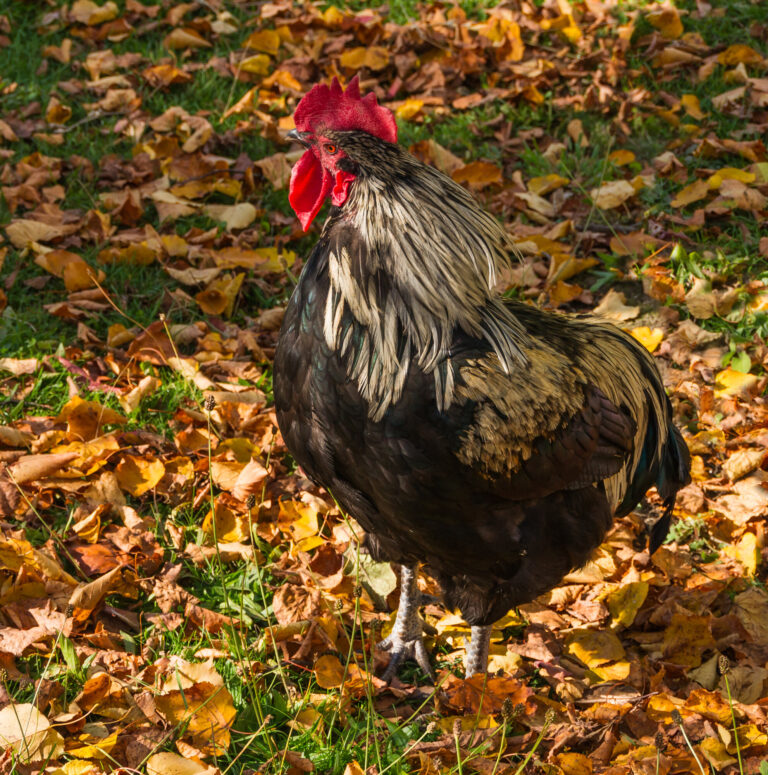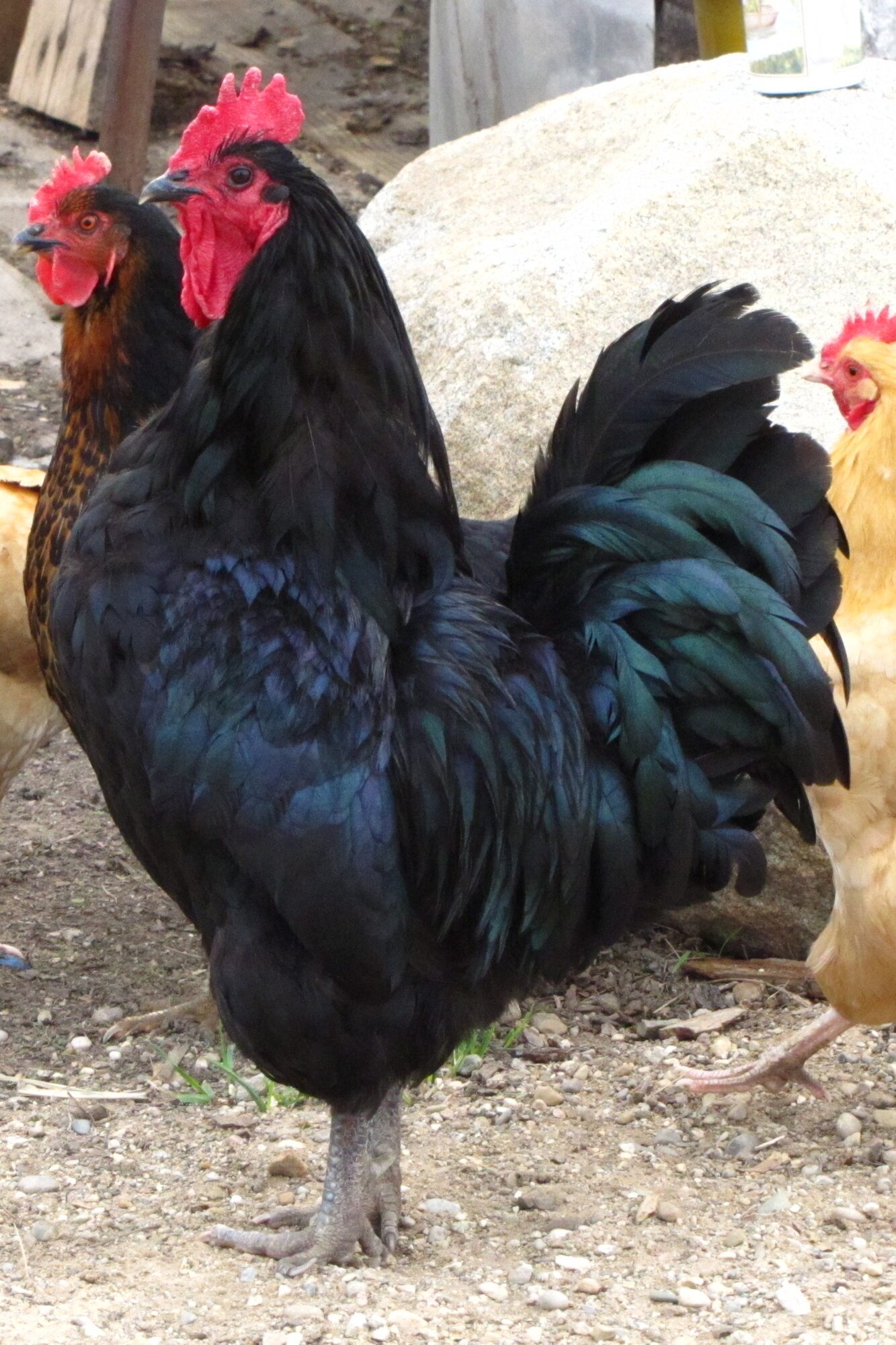
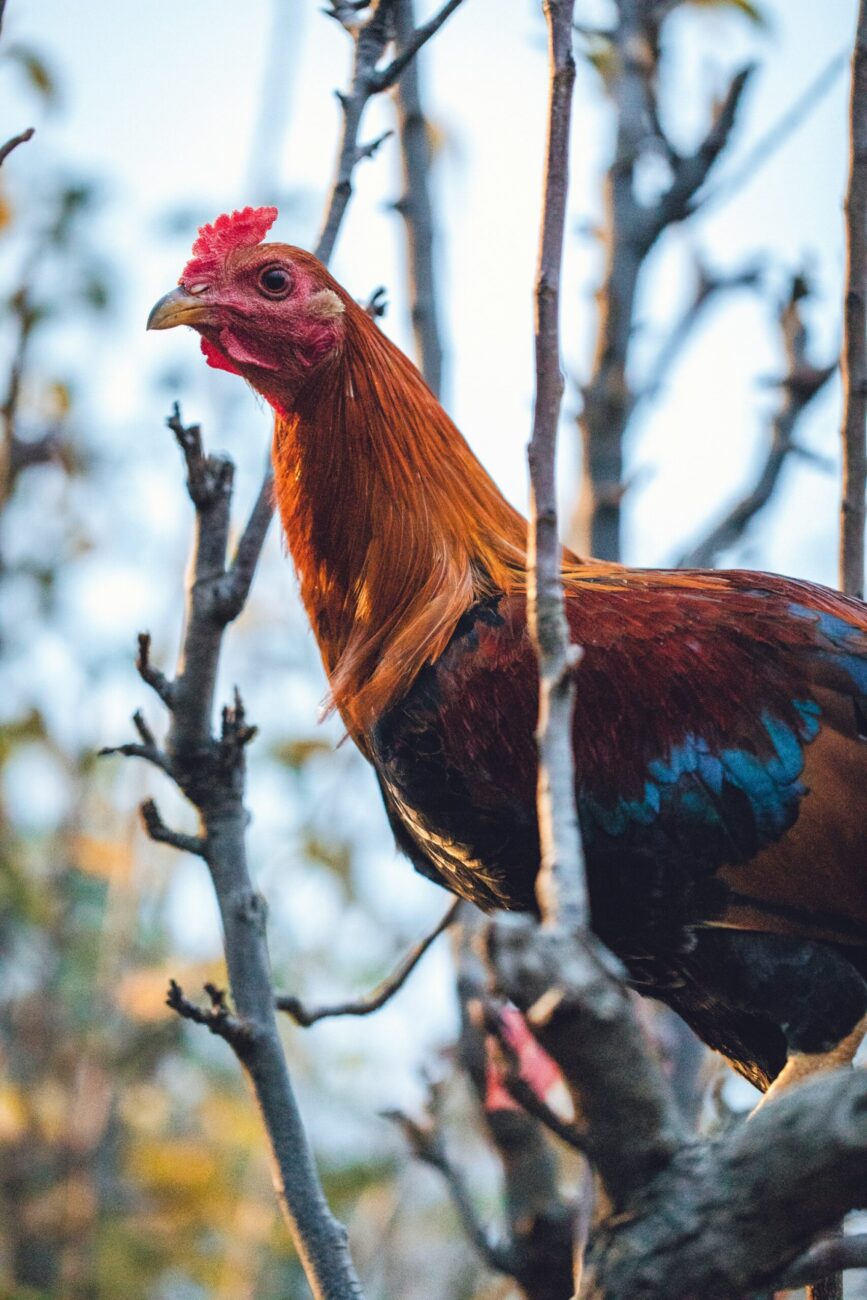
Mostly because you’re the tallest thing in the run to stand on, and she isn’t scared of you. That’s my honest answer. I should say up front that nobody has studied shoulder-hopping as such. I looked for a study, and for a vet or extension page that explains it. I didn’t find one. What has been studied is the two halves of it. One is how badly chickens want to get up off the ground. The other is how a chicken stops being afraid of people. Put those together and a hen on your shoulder makes sense. A rooster on your back can be another story. And whatever bird it is, the CDC would rather it wasn’t next to your face.
I rewrote this page from 10 sources, and you’ll find every one listed at the bottom. The perching side comes from the Merck Veterinary Manual and from Jacquie Jacob at the University of Kentucky. Georgia and Alabama Extension add to it, and so does a study of wild red jungle fowl in Malaysia. The fear side comes from a 2025 study out of LMU Munich. A Western University of Health Sciences factsheet covers roosters. The CDC covers germs, while UF/IFAS and Merck cover mites. Where something is my own reasoning, I’ll say so.
The short version.
- No study looks at why chickens jump on shoulders. Turns out perching and fear of people are both well studied. Between them, they explain most of it.
- Merck calls perching a “highly motivated” behavior. Wild jungle fowl roost 4 to 12 meters up in the trees.
- A hen has to lose her fear of you first. Gentle handling in the first days helps, and so do treats from your hand.
- I found no source that says a hen on your shoulder is bossing you. Alabama Extension says a hen that squats for you is showing submission.
- A rooster that treats you like a rival is different. A vet school factsheet warns his spurs can hurt kids and pets.
- The CDC says don’t put poultry near your face. Wash your hands after, and wash any scratch right away.
- Poultry mites can bite you, but they can’t live on you.
- If you like the visits, offer a forearm instead of a shoulder, and give the flock something higher to stand on.
Your Shoulder Is the Highest Perch Around

Chickens want to get up off the ground, pretty much from the start. Merck’s chapter on poultry behavior calls perching “another highly motivated behavior of poultry.” By perching it means getting somewhere higher to stand or rest. It says chicks begin perching at about 10 days old. Jacquie Jacob’s page says that “At about three weeks of age, chicks start to jump up to higher surfaces.” Alabama Extension says chicks start roosting at 1 to 2 weeks. The sources don’t agree on the week, but they all say it starts young.
The habit goes back a long way. Merck says domestic chickens came from the red jungle fowl, and maybe the gray jungle fowl too. A 2001 study followed wild red jungle fowl in a Malaysian oil palm plantation. They roosted 4 to 12 meters up, mostly on flat palm fronds. That’s roughly 13 to 39 feet. A hen with chicks roosted lower, at about 4 meters. On average they spent 11 hours and 47 minutes a night up in the tree.
Height is safety. Georgia Extension’s backyard flock tip says “roosting is important to protect chickens from ground predators.” Merck calls night perching “an antipredator defense.” A raccoon or a fox hunts on the ground, so a bird up high is a harder catch.
So here’s my read, and it’s mine, not a study’s. In a run with nothing taller than the feeder, you’re the tallest perch around. Crouch down to fill the waterer and your back is right there at hen height. A bird that wants to get up will take the ledge on offer. If your run is short on high spots, our chicken roost ideas page has plenty.
She Has to Stop Being Scared of You First

Mind you, a wary hen won’t land on you, however tall you are. Merck reminds us poultry are prey animals. A bird that sees you as a threat keeps her distance. So a hen on your shoulder tells you something about how she was raised.
A 2025 study from LMU Munich tested early handling on broiler chicks, with about 220 chicks in a group. In the first three days after the chicks arrived, a person spent six one-hour sessions with them. Each time, they walked in slowly with a little footstool and stood still for 30 seconds. Then they talked low for a minute and sat with the chicks for five minutes, still talking. After that they moved on to the next part of the pen.
The chicks were tested three times, the last at 36 days old. The handled groups “showed less avoidance and more approach behaviour towards the human.” They weren’t any braver about a strange object, though. It was people they’d gotten used to, not new things in general. The authors say gentle handling in the first 3 days of life can make the birds’ relationship with people better for at least 36 days.
Even earlier contact counts. Jacob’s page says “Contact with a human hand as early as 15 minutes after hatching, for example, has been shown to reduce the number of distress calls.” For grown birds, the Munich paper points back to Graml and colleagues in 2008. They used food rewards from people with adult laying hens. After two weeks, those hens avoided people less and came up to them more. Alabama Extension adds that chickens “can learn from observing humans.”
My guess is the hen that rides on your shoulder is the one that got handled as a chick. Or she’s the one that learned you carry the treat scoop. That’s my reasoning from the studies, not a study of shoulder hens.
Is She Bossing You Around?

You’ll read online that a hen on your shoulder is putting herself above you in the pecking order. I couldn’t find a source that says so. Here’s what the sources do say.
Merck says chickens sort out rank one pair at a time, “with the subordinate bird receiving a peck to the head.” It adds that “Once established, the hierarchy is very stable, and rank is reminded with body gestures rather than aggression.” Alabama Extension says the order is fully set around 6 weeks of age. It also says roosters and hens keep separate pecking orders.
Height does matter between chickens, just not the way you’d think. Georgia Extension says perches help “relieve social tensions in confinement by allowing subordinate birds to avoid more dominant ones.” Alabama says much the same. A perch gives low-ranking birds somewhere to “escape the harassment of more dominant birds.” So the high spot is often where the bottom hen goes to get away from the boss.
As for where you rank, Alabama Extension has one line on it. “If a hen squats or crouches to the flock owner, she is demonstrating her submission to the owner.” That’s the only signal about hens and their keepers I found in these sources. It points the other way from the bossy-hen idea.
My take is that a hen on your shoulder isn’t scared of you and wanted a high seat. If she starts pecking your ear or your face up there, that’s a different bird, and I’d set her down.
A Rooster Who Climbs on You Is Another Matter

Roosters run their own pecking order, apart from the hens. A Western University of Health Sciences factsheet on rooster spurs doesn’t mince words. “Roosters that are part of backyard flocks can be dangerous if they still have spurs.” It goes on to say an aggressive rooster is likely to injure kids and pets. Other chickens too.
The same factsheet suggests adding more birds to the flock. That way the rooster can “establish a pecking order among its own species, instead of among other animal species, including humans.” In plain words, a rooster can try to rank you.
So I’d treat a rooster landing on you differently from a hen. A calm one sitting on your arm is one thing. If he comes at you feet first, he’s the bird that factsheet is warning about. Not sure which one you’ve got? Our hen or rooster tool walks through the signs, and our Rhode Island Red hen vs rooster page shows them on one breed.
The Catch Is She’s Right by Your Face

Now here’s the part the cute videos skip. The CDC’s backyard poultry page says it straight out. “Don’t put poultry near your face.” A hen on your shoulder is about as near your face as she can get.
The CDC’s worry is germs like Salmonella. It says “Don’t kiss backyard poultry or snuggle them and then touch your face or mouth.” It also says “Wash your hands with soap and running water after touching backyard poultry or anything in the area where they live and roam.” And if a bird gets you on the way up, “Wash wounds with soap and warm water immediately if poultry scratch or bite you.”
Kids get their own rule. The CDC says “Don’t let children younger than 5 years old handle or touch” poultry, and that means chicks too. So honestly, a hen on a toddler’s shoulder is a no. The CDC also wants you to keep one pair of shoes just for the coop, and to leave them outside.
Mites Can Ride Along

Mites are the other hitchhiker. Merck’s page on poultry mites says the poultry red mite, or chicken mite, will “also bite humans; however, they cannot survive on humans or infest them.” The northern fowl mite has turned up on people too. But Merck says “fertile populations are reported only on birds.”
The two live differently. UF/IFAS says the chicken mite “typically feeds at night” and “rarely feeds during the day.” By day it hides “in nests, cracks, crevices, and litter.” UF adds that, unlike the northern fowl mite, the chicken mite doesn’t spend its whole life on the bird. Merck says you find northern fowl mites by parting the feathers around the vent.
So my guess is a shoulder hen is more likely to hand you a northern fowl mite than a red one, since that’s the kind that rides on the bird. Either way, they can bite but they won’t set up house on you. If you find mites on your arms after holding a hen, check her vent feathers. I’d also take a flashlight to the coop after dark and look in the cracks and the bedding. That’s my reasoning from the two mite pages.
How I’d Handle a Hen That Wants Your Shoulder

None of this means you have to stop her. These steps are my own, put together from the sources above.
- Offer a forearm or a flat hand instead. It keeps her a little farther from your face, which is what the CDC is after.
- Wear a collar or a jacket if she climbs anyway. Her claws are made to grip, and the CDC says to wash any scratch right away.
- Give the flock other high spots in the run. Merck says chickens prefer perches about 4 inches across, with the lowest one 18 to 36 inches off the ground. It also says to allow about 6 inches of perch per bird. Our page on round or square roosts goes into the shape.
- Keep little kids out of it. No hens on anyone under 5, per the CDC.
- Wash up when you’re done. Soap and running water, even if she only sat there a minute.
- Keep roosters off you. If one starts treating you like a rival, reread the spur factsheet and talk to a vet who sees poultry.
One more thing from Merck. Poultry “tend to hide signs of sickness until they are very ill.” So I’d use those shoulder visits to look her over, since she’s sitting still right next to you.
Sources
- Richard Blatchford, Merck Veterinary Manual: Behavior of Poultry (full review April 2025).
- Jacquie Jacob, University of Kentucky, Poultry Extension: Normal Behaviors of Chickens in Small and Backyard Poultry Flocks.
- Claudia Dunkley, University of Georgia Cooperative Extension: Behavior of Backyard Flocks (Backyard Flock Tip, May 2007).
- Brigid McCrea and Bethany Baker, Alabama Cooperative Extension System: Common Backyard Chicken Behaviors (ANR-2936, 2022).
- Arshad, Zakaria, Sajap and Ismail, Pakistan Journal of Scientific and Industrial Research: Roosting Ecology of Red Junglefowl (Gallus gallus spadiceus) in Oil Palm Plantation (vol. 44, no. 6, 2001).
- Stocker, Nawroth, Puppe, Erhard and Louton, Applied Animal Behaviour Science: A gentling program decreases fear-related behaviour towards humans but not towards novel objects in broiler chickens (vol. 290, 2025).
- Western University of Health Sciences, Poultry Health Resources: Medical Management of the Rooster Spur (2019, edited by Teresa Y. Morishita).
- Centers for Disease Control and Prevention: Backyard Poultry.
- Ethan Carter and Jennifer L. Gillett-Kaufman, UF/IFAS Extension: Chicken Mite (EENY611).
- Amy C. Murillo, Merck Veterinary Manual: Mites of Poultry (full review January 2026).
Sources checked October 27, 2026. The meters-to-feet numbers are my math. The ideas that you’re the tallest perch in the run, and that a shoulder hen is the one handled young, are my own reasoning from these sources. So is my guess about which mite rides along, and so are the handling steps. We aren’t vets. If a hen or a rooster hurts you, or a bird looks sick, call a doctor or a vet who sees poultry.
Related read: How to Raise Chickens for Eggs — Instant PDF download. Secure checkout by Stripe