What Part of the Bitter Melon Plant You’re Actually Dealing With
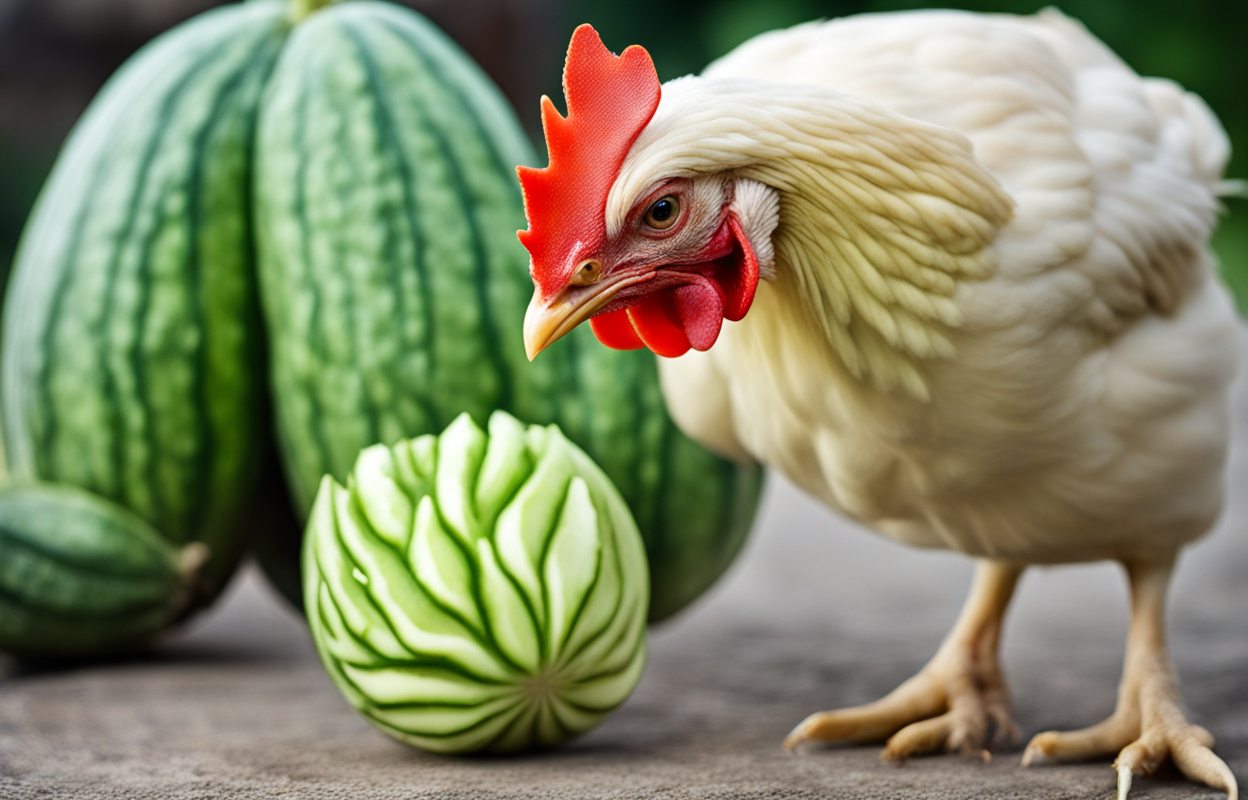
A fully ripe bitter melon splits open on its own and exposes bright red seed pulp that tastes nothing like the bitter flesh, and that is the part your chickens will actually eat, all at once, with zero self-regulation. I want to start there because almost every piece of advice online about feeding bitter melon to chickens treats the plant like it’s a single ingredient. It’s not. Not even close.
You’ve got five distinct things here: unripe green flesh, ripe yellow-orange flesh, the red seed aril, the bare seeds inside that aril, and the leaves and vine. Each one behaves differently in a chicken’s body. Collapsing all five into one answer, which is what every top Google result does, is the core error. It’s like asking “can chickens eat tomatoes” and getting one answer that doesn’t distinguish between ripe fruit, green unripe tomato, and the leaves. Those are different foods.
The bitter compounds in bitter melon — momordicins and cucurbitacins — are actually at their highest concentration in the green unripe fruit. They decrease as the fruit ripens to yellow-orange. So the ripe flesh is genuinely less bitter and lower in those compounds than the green stage. Ripeness changes the risk profile, but not in the direction most people assume. And if you’ve got a vine growing nearby, understand that bitter melon can hit 12 to 16 feet in a single season and will absolutely drape itself into a run if you plant it on the wrong side of the fence.
The red aril is the part that deserves its own conversation. Chemically and palatably, it is nothing like the green flesh. It’s sweet. It’s soft. From a chicken’s perspective it’s closer to a sugary berry than to any bitter vegetable. Evaluate it independently, because your flock will.
The Red Seed Pulp Problem: Why Ripe Bitter Melon Is the Real Risk
Here’s what actually happens. Green bitter melon sits in the run and your hens mostly ignore it. They’ll peck at it out of boredom, decide it’s not worth the effort, and move on. I’ve watched this with my own birds. They’re not interested. But leave a vine unattended for a few extra days, let one fruit split open, and suddenly you’ve got a problem.
A single fully ripe bitter melon contains 8 to 20 seeds, each one coated in that red aril. Multiply that by a few fruits and you’re looking at a significant sugar and compound load hitting your flock all at once. Backyard keeper accounts have documented chickens consuming the full aril load of three or four ripe fruits in under ten minutes. I believe it completely. Mine would do the same thing.
The “chickens won’t eat what’s bad for them” idea fails completely here. The sweetness of the aril overrides whatever self-regulation instinct people like to assume birds have. And it’s not just the bitter compounds. The seeds themselves contain vicine, a compound associated with oxidative stress in poultry at high doses and linked to favism in humans. When you let a hen gorge on the aril of four ripe fruits in one sitting, she’s ingesting a non-trivial seed load along with it.
The green flesh is not the danger. The red aril is. Keep that straight and you’ll make better decisions than most of what’s online will lead you to.
Safe Quantity: A Per-Bird Ceiling That Actually Means Something
The 10% treat rule gets repeated constantly and almost never applied with actual math. So let me do it.
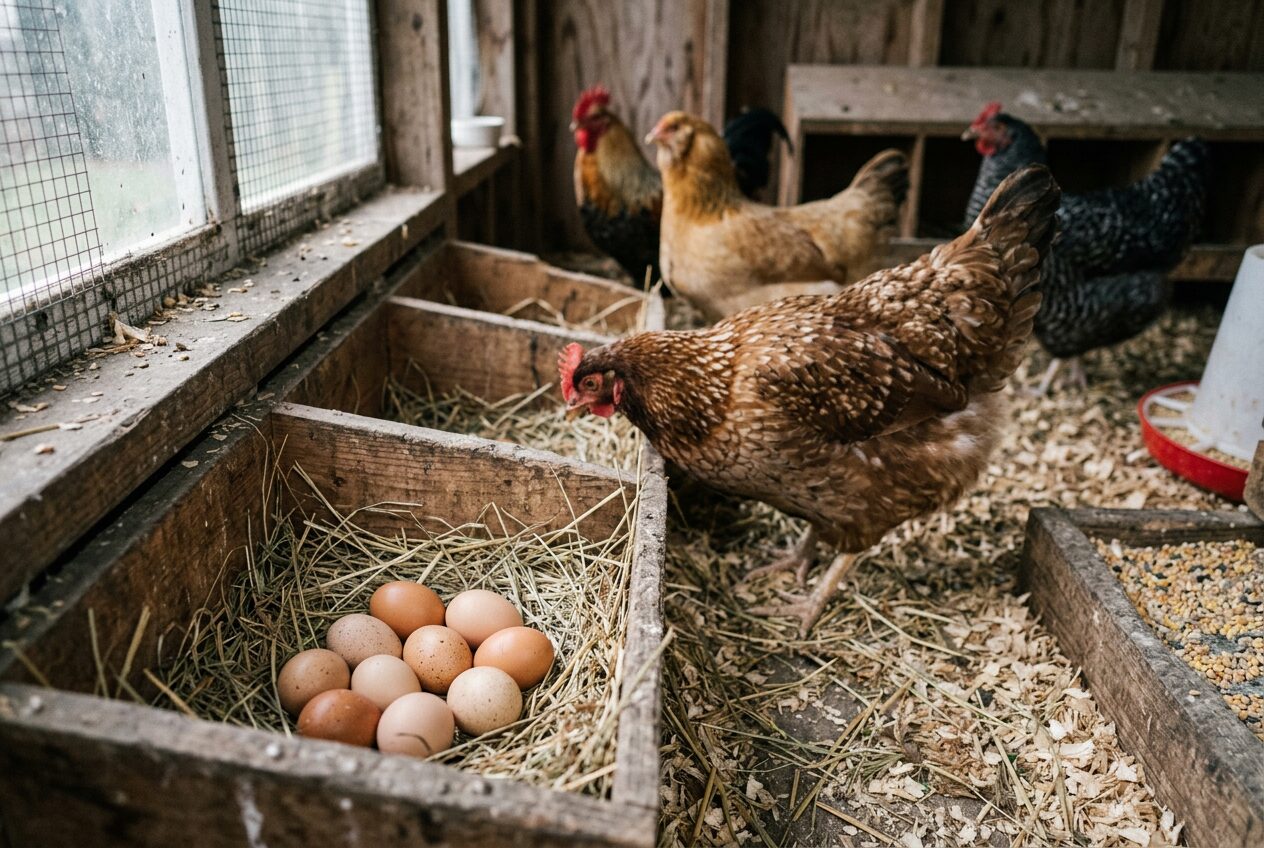
A standard laying hen eats roughly 0.25 lb of feed per day. Ten percent of that is about 0.4 oz of total treats. That’s the ceiling for everything, not just bitter melon. If she’s already getting kitchen scraps and scratch, bitter melon is competing for a very small slice of that budget. For a 5 to 6 lb laying hen, I’d put the practical ceiling at 1 to 2 tablespoons of chopped green bitter melon flesh per feeding, two to three times a week at most. That’s it. And honestly I’d start lower than that the first time just to see how your specific birds respond.
For bantams, cut those numbers in half. For a Jersey Giant, you’ve got a little more room. “Moderation” without a number is useless advice, and I’ve seen that phrase repeated in basically every article on this topic (I learned this the expensive way, having fed treats too liberally early on and spending a week watching a hen I liked produce nothing but loose droppings).
For the red aril, the practical recommendation is zero. Remove all ripe split fruit from the run immediately. Don’t ration it. Don’t offer it as an occasional treat. Just remove it on sight. The math on safe aril quantity gets complicated fast, and the downside of getting it wrong is not worth whatever enrichment value you think you’re providing.
Bitter Melon Leaves and Vine: The Overlooked Free Feed Source
This is the part nobody talks about, and it frustrates me because it’s genuinely useful.
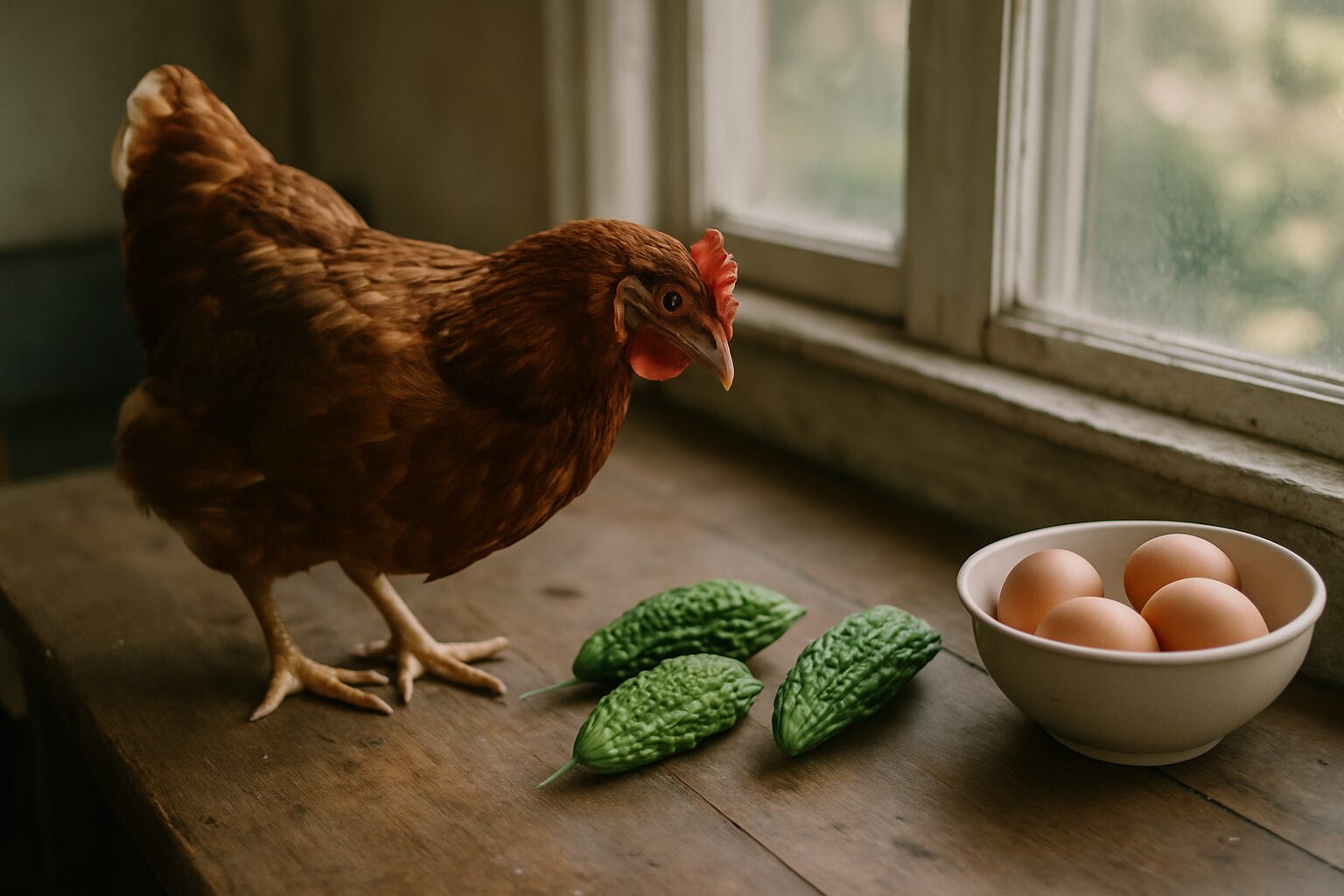
Bitter melon leaves clock in at approximately 100mg of vitamin C per 100g of fresh weight, which is higher than the fruit flesh itself. Tender shoot tips under four inches long are the best part to offer; mature leaves get tough and leathery and your hens will mostly ignore them, same as they ignore any coarse green. But those soft growing tips? My birds take those readily.
If you grow bitter melon anywhere near your property, you’re trimming it constantly. It’s an aggressive vine. Those trimmings are going in the compost pile or the trash while perfectly good supplemental greens for the flock get wasted. Grab the tender tips, chop them loosely, toss a small handful per bird into the run. You don’t need to ration it the way you would the fruit. It’s not zero risk, but it’s the most defensible part of the plant to offer and the top search results for this topic don’t mention it once.
Does Bitter Melon Actually Work as a Chicken Dewormer?
Short answer: yes in a lab, irrelevant in your backyard.
A 2018 Philippine study using Momordica charantia leaf extract showed a 62% reduction in Ascaridia galli egg counts in broilers. That’s a real result. But the dose was 2g of extract per kilogram of body weight. For a 5 to 6 lb hen, that extrapolates to roughly 10 to 12 grams of dried leaf powder per day to hit that threshold. You are not delivering that by tossing vine trimmings over the fence twice a week. Not even in the same ballpark.
No commercial poultry dewormer in the US or UK uses bitter melon as an active ingredient. There’s a reason for that. The folk claim gets repeated constantly in backyard chicken groups without any dose context attached, and that context is the whole point. Repeating “bitter melon is a natural dewormer” without the numbers is actively misleading. If your flock has a genuine worm load, use Valbazen or Safeguard. Don’t skip a proven anthelmintic because you read that a bitter melon vine does the same job. It doesn’t, not at quantities that are actually safe to feed.
Signs Your Flock Ate Too Much: What Overconsumption Looks Like at 24–48 Hours
Most keepers see loose droppings after introducing a new treat and assume it’s just a normal adjustment. Sometimes it is. With bitter melon, specifically the aril or ripe flesh, I’d pay closer attention.
Loose green or orange-tinged droppings within six to twelve hours of feeding are the first sign something’s off. That coloring comes from the pigment in the aril combined with digestive irritation. If you’re seeing it, note the time and what you fed. If the looseness resolves by the next morning and the birds are eating normally, you’re probably fine. If lethargy is still present past the 24-hour mark, or a bird stops eating entirely, that’s a vet call. Not a “wait and see another day” situation.
The effect I find most underappreciated is the egg production drop. A significant overconsumption event can cause a 15 to 20% dip in production in heavy layers within 48 hours, just from digestive stress. The problem is that two days later, most keepers have completely forgotten what they fed on Tuesday. They’re troubleshooting lighting, stress, water intake, and the answer is sitting in the compost bin where they threw the vine scraps. Keep a simple note for 48 hours after any new food introduction. Two minutes of writing, potentially saves you a week of confusion.
Growing Bitter Melon in or Near a Chicken Run: Layout Decisions That Prevent Problems
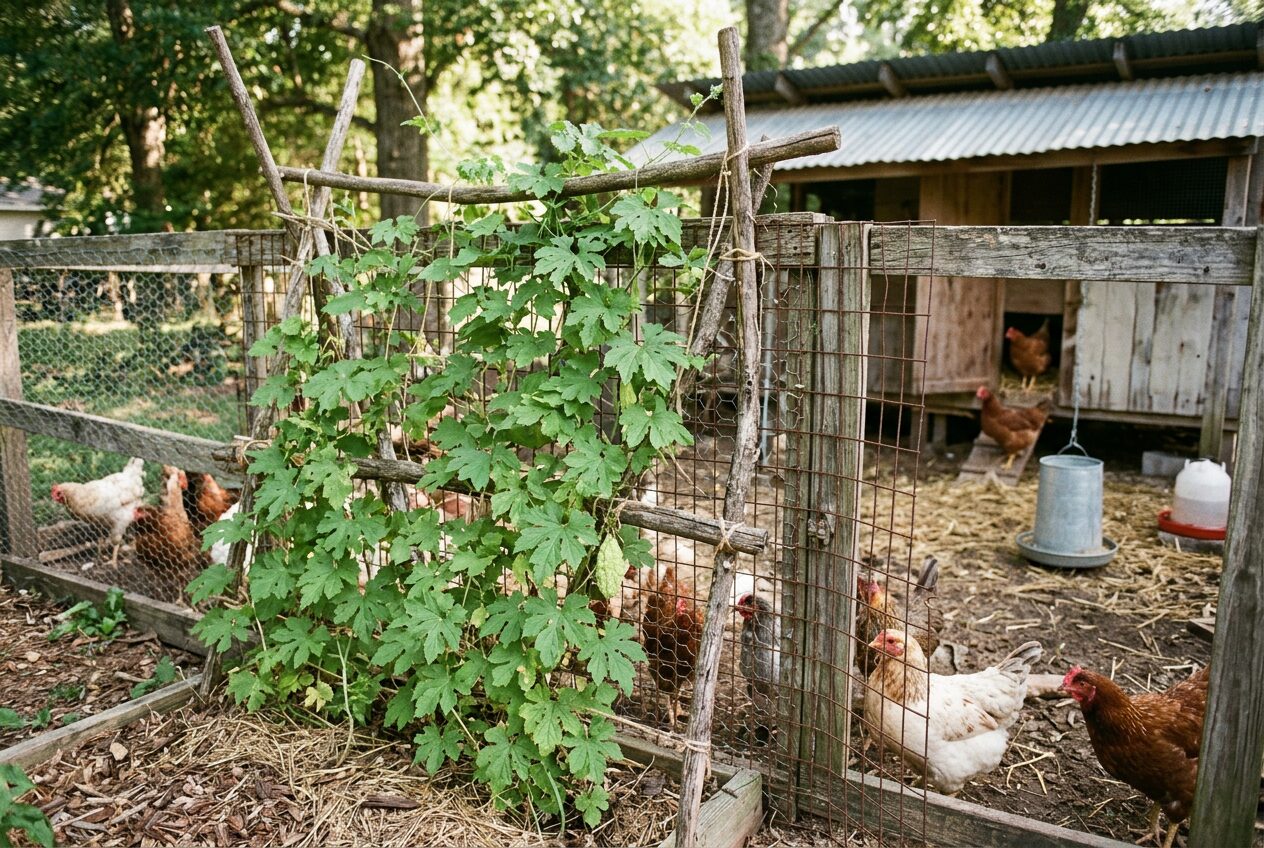
I’ve made the mistake of planting things inside the run that I thought would be good enrichment. Learned fast that “living enrichment” has a short shelf life when twelve hens and a disagreeable rooster are involved. Bitter melon inside the run is a bad idea, full stop.
Here’s the timeline problem. Bitter melon germinates best at soil temperatures between 75 and 85°F. Direct sow after last frost or start indoors about four weeks before. Once it’s flowering and setting fruit, the green harvestable stage arrives around 12 to 15 days after pollination. Leave it alone and it fully ripens and splits at roughly 25 to 30 days. That is a tight window, and most backyard keepers are not checking a vine every other day in the heat of summer.
The setup that actually works: run the vine on the outside of the run fence, trellis it on a 6-foot structure, and harvest every 10 to 12 days. You catch fruit at the green stage before it ever ripens and splits. The chickens get the benefit of the shade, maybe some leaf-tip access through the wire, and they never have unsupervised access to ripe fruit. The scenario you’re avoiding is simple. They’ll ignore the green fruit for three weeks, then one hot afternoon three fruits split open simultaneously, and you come home to lethargic hens with orange-tinged droppings and a 20% drop in your egg count by Thursday.
The Honest Summary: Green Flesh Fine, Red Aril Risky, Leaves Underrated
The binary “safe or unsafe” framing that dominates this topic is the wrong frame entirely. This plant requires a part-by-part answer. Here’s mine.
Green unripe flesh: up to 1 to 2 tablespoons chopped per bird per feeding, two to three times weekly. Low risk. Most chickens are indifferent to it anyway, which honestly solves the problem on its own.
Red seed aril: remove from the run on sight. Do not feed deliberately. The sweetness overrides self-regulation, and the vicine in the seeds makes the full aril-plus-seed package the highest-risk item on this plant per gram. Zero tolerance is the practical recommendation.
Leaves and tender shoot tips: offer freely in small handfuls as supplemental greens. Higher vitamin C than the flesh, and your birds will actually eat the soft tips. This is the part of the plant most worth your attention and least discussed anywhere online.
Bare seeds: withhold. Vicine content, oxidative stress risk at volume, not worth the exposure when the rest of the plant gives you safer options.
The keepers ending up in Facebook groups asking why their hens are lethargic usually got there by reading that bitter melon is “fine in moderation” and leaving it at that. That answer is incomplete enough to cause real problems. Now you’ve got the actual breakdown.
Related read: How to Raise Chickens for Eggs — Instant PDF download. Secure checkout by Stripe