Yes, chickens can eat elderberries, as long as they’re the ripe ones and nothing else from the plant comes along. That second part is where people get into trouble.
The dark, ripe berry is the only piece of the elder that any source I read calls food. The stems and leaves hold far more of the compounds that turn into cyanide, and so do the green berries. In some yards the elder out back is a red elderberry, which none of my sources calls safe. So the real risk to your flock isn’t the ripe berry. It’s everything that comes with it when hens get into the bush, or when somebody hands them a whole cluster.
I rewrote this page from 14 sources, and they’re all listed at the bottom. The plant facts come from NC State and Oregon State, West Virginia University’s extension service and a USDA plant guide. The cyanide numbers come from a 2021 University of Missouri study. The poisoning parts come from the CDC and the Merck Veterinary Manual, and the feeding rules come from state extension services. Where something is my own math or my own call, I’ll say so.
The short version.
- Ripe, fully dark elderberries are fine as a small treat, picked off the stems first.
- Stems and leaves carry far more of the cyanide-forming compounds than ripe berries do. Green berries do too.
- Red elderberry is a different species. Nothing I read calls it safe, so it doesn’t go to your hens.
- Food-safety guides tell people to always cook elderberries. I couldn’t find a test of raw ones on hens, so cooking is the careful choice.
- A hen’s whole treat share works out to about 1.1 to 1.7 tablespoons of elderberries a day.
- Don’t let the flock into an elder bush, and don’t plant one in the run.
Yes, but Only the Ripe Berries

Honestly, every source I read agrees on which part of the elder you can eat. The USDA plant guide for blue elderberry puts it flat. “Only the blue or purple berries of elderberry are edible”.
NC State’s plant page for the American elder describes “a purple-black drupe that is produced in drooping clusters from late summer to fall”. The same page says “The fruit is edible when cooked”. Its page for the European black elder says “The attractive black fruits are edible”.
And wild birds eat them right off the bush. NC State says the American elder’s “fruits are eaten by mammals and many species of songbirds”. The USDA guide adds that “The elderberries are important sources of summer food for many kinds of songbirds”.
That’s a decent sign. It isn’t proof. A songbird isn’t a laying hen, and I couldn’t find a single study that fed elderberries to chickens. So everything below leans on what’s known about the plant itself, plus the plain rules extension services give for treats.
Ripe means dark, and you can see it from across the yard. On most elders that’s purple-black, and on a blue elderberry it’s a dusky blue. West Virginia University’s extension page says the fruit develops and ripens “over a period of 6 to 8 weeks from July to the second part of September”. So a bush won’t be ready all at once, and that matters later on.
Know Which Elder You Have (Black, Blue or Red)

Oregon State University Extension sorts the elderberries people pick into four types. Here’s how its guide describes the berries, so you can tell yours apart.
- Blue elderberry (Sambucus nigra ssp. cerulea): “a dusky blue with a powdery appearance”.
- American elderberry (ssp. canadensis): “a dark purple”.
- European black elderberry (ssp. nigra): “dark purple, like the American elderberry”.
- Red elderberry (Sambucus racemosa): “easily distinguished by the bright red color of the ripe berries”.
The first three are the ones people cook into syrup and jam. But the red one is a different story. Oregon State says “Little research has been done on red elderberries, but they may have a higher toxin concentration, particularly in the seeds”.
West Virginia University goes further. Its page calls the European red elderberry “highly toxic to humans and not recommended for commercial fruit production,” and says “extreme caution is warranted due to its toxicity”. The USDA plant guide is the plainest of all. “The red berries of other species are toxic and should not be gathered”.
Even the dark ones aren’t rated the same. NC State gives the American elder “low severity poison characteristics” and the European black elder “medium severity poison characteristics”. Both still list the fruit as edible.
So here’s my call. If the berries on your bush ripen red, they don’t go to your hens, raw or cooked. If you aren’t sure what you’ve got, don’t guess. Take a sprig (berries and leaves both) to your county extension office and ask.
One thing to flag before the next section. The Missouri study talks about “whole red berries”. Those aren’t the red species. The researchers describe them as “almost-ripe” American elderberries, the stage just before they turn dark.
The Stems and Leaves Are the Problem, and So Are Green Berries

Elder plants contain cyanogenic glycosides. Oregon State explains what they do in one line. “During digestion, these compounds release cyanide”.
Turns out the amount isn’t the same everywhere on the plant. In 2021, a team at the University of Missouri measured the total cyanide potential of the American elderberry part by part. They tested the stems and the whole berries at three stages of ripeness, plus the juice, the seeds, the skin and the pulp, and whole ripe berries came out lowest of all. Whole green berries were second highest, at 25.6 micrograms of cyanide equivalent per gram. The stems were highest, at 37.43. By my math, that puts the stems at about one and a half times the green berries.
The same paper cites European work on the black elder. There, the leaves held 27.68 to 209.61 micrograms per gram of sambunigrin, one of these compounds, while the berries held just 0.08 to 0.77. Even the lowest leaf number is about 36 times the highest berry number in that study. A second European study the paper cites put fresh black elderberries higher, at 18.8 on average, and that’s still under the lowest leaf number. That’s my math, and the studies didn’t measure quite the same thing, so don’t line their numbers up against each other. The direction is what counts. Leaves carry far more.
NC State’s page on the American elder says it plainly. “Unripe fruits are much more toxic than fully ripe fruits”. Its list of poison parts covers the fruit and the roots, plus the leaves and stems.
The Missouri team’s advice for people is that “it is advisable to separate out the stems” along with the green berries and the leaves. They found the levels “generally low” in everything they tested, and no measurable trace at all in store-bought elderberry juice. That’s good news for people drinking juice. It doesn’t tell you much about a hen who’s been stripping leaves off a low branch.
There’s a real case that shows how the stems and leaves cause trouble. On August 26, 1983, 11 people at a gathering in California got sick from homemade elderberry juice, and the CDC’s report says the eight sickest “were flown by helicopter to a Monterey, California, hospital”. The juice came from bunches of berries “crushed with their leaves and branches in a stainless-steel press”. The people who drank more of it got sicker. All of them recovered quickly, and weirdly enough, their serum cyanide levels came back normal. The report’s lesson was that “leaves and stems should not be crushed in when making juice”.
It gets worse with livestock. They’ve died from the plant itself. The same report notes that “cattle and sheep have died after eating leaves and young shoots”. It calls the root “probably the most poisonous” part, one that “may be responsible for occasional pig deaths”.
Raw Versus Cooked, and Why the Sources Split

This is where the sources don’t line up neatly.
Oregon State’s food-safety guide is firm about it. “Because raw elderberry products may contain elevated levels of toxic compounds, you should always cook elderberries before eating them”. It adds that “cooking elderberries eliminates this risk and makes them safe for eating”. Even dried berries “should be rehydrated in water or juice and cooked before consuming to destroy the toxins”.
West Virginia University warns that “Eating too many raw berries can lead to build up of cyanide in the body”. NC State says “Cooking helps inactivate the cyanogenic glycoside”. The CDC report hedges a little. It says elderberries “may be safe to consume, particularly if cooked,” and notes that uncooked ones may cause nausea.
On the other side, birds eat raw elderberries off the bush every summer, and the USDA guide counts game birds among the animals that feed on elderberry’s fruit or foliage. The Missouri numbers for whole ripe berries were the lowest of anything they tested.
Every one of those cooking rules was written for people, not poultry. Does any of that settle it for hens? Nope. I couldn’t find anybody who’s tested raw elderberries on hens, one way or the other. So here’s where I land, and it’s my call, not a study’s. If you want to hold your flock to the same rule Oregon State gives people, cook the berries first. Simmer them plain in a little water until they’re soft, let them cool all the way, and feed them the same day.
Plain means plain. Oregon State’s blue elderberry syrup recipe calls for “3½ cups sugar” to “2½ cups strained elderberry juice”. Syrup and jam are people food. Neither one goes in the run.
If you’d rather give a few raw, ripe, fully stemmed berries, the sources above don’t say that will hurt a hen. They don’t say it won’t, either. Keep it to a few. Keep it to the ripe ones.
Pick Them Yourself and Strip the Stems

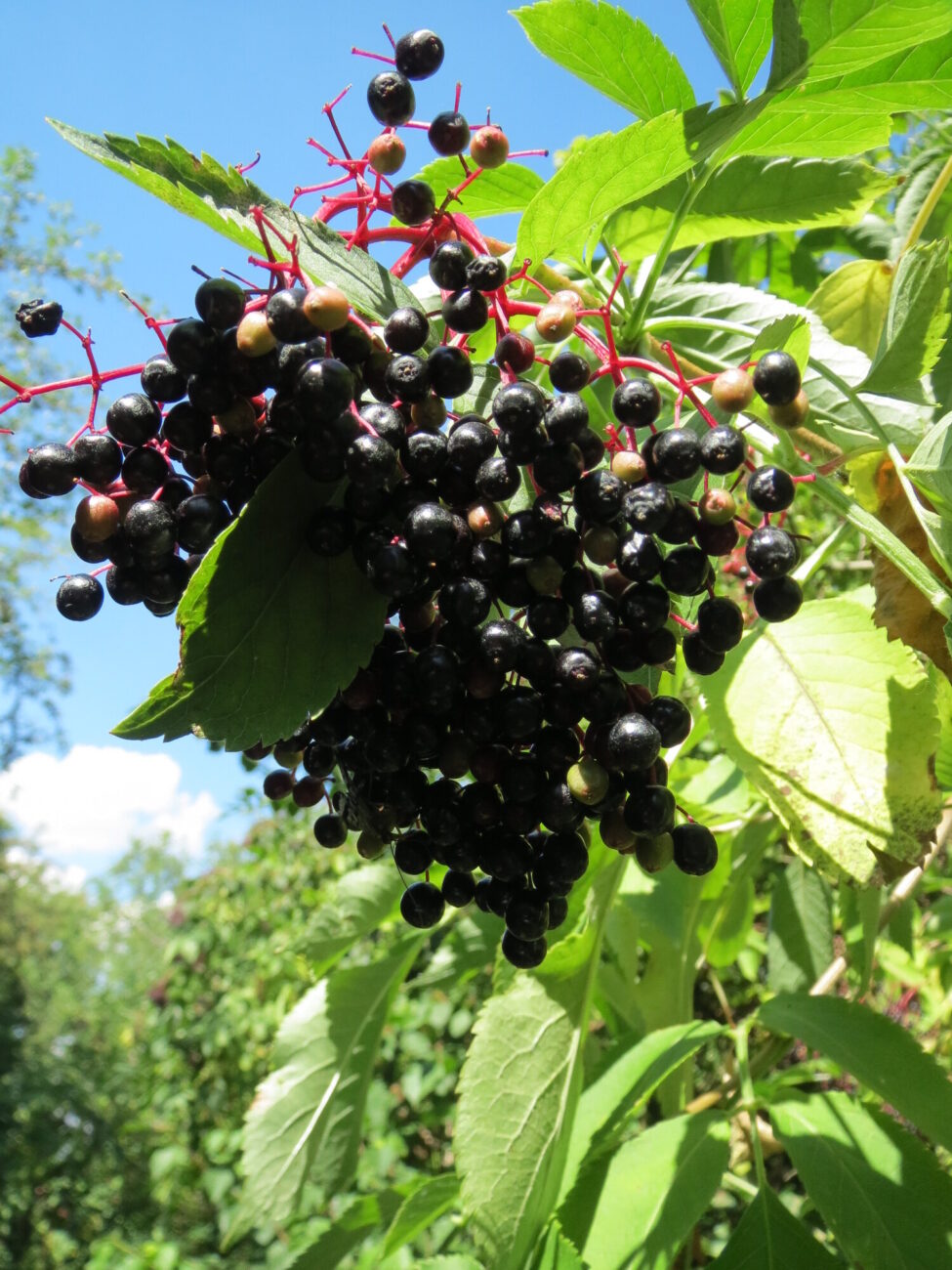
The photo above is one single cluster. Black berries, dark red ones and some pale pink ones, all hanging off the same red stalks.
Oregon State warns that “Not all berries on the plant will ripen at the same time”. That’s why you should never hand a hen a whole cluster. Not once. She’ll eat the green and red ones right along with the black ones, and the stalks come with them.
This page used to suggest stringing branches full of berries along dowels as a hanging treat. I’ve taken that out. It hands your hens the stems, and the stems are the part the Missouri study measured highest.
Oregon State’s guide has a tidy way for you to get the berries off. “Place a wire cooling rack over a baking pan and gently rub the berries over the rack”. The berries fall through into the pan, and the guide says “It can help to freeze the berries before screening”. It’s just as clear about the rest of the plant. “Stems and leaves contain higher levels of toxins, so it is important to remove these before processing”.
How I’d get elderberries ready for a flock.
- Pick the clusters yourself, only ones that look mostly dark. Keep the hens away from the bush while you do it.
- Freeze the clusters if you’ve got room (it makes the next step easier, and it’s worth it).
- Rub the berries off over a cooling rack set on a pan.
- Spread them on a plate and pick out anything that isn’t a dark, ripe berry. Green ones, red ones, bits of stem, any leaf.
- Cook them plain if you’re taking the careful route.
- Measure out the day’s share. Freeze the rest or toss it.
How Much Elderberry for a Hen

Elderberries are a treat, so they come out of the treat share, not on top of it. Colorado State University Extension says “Treats should make up no more than 10% of their daily diet”. Alabama Extension says “A laying hen will consume between 100 and 150 grams of feed per day or roughly 0.25 pounds”.
That puts a hen’s whole treat share at about 10 to 15 grams a day. USDA’s FoodData Central (FDC ID 171727) weighs a cup of raw elderberries at 145 grams. That makes a tablespoon about 9 grams, and a hen’s share about 1.1 to 1.7 tablespoons. One cup covers the treat share for about 10 to 14 hens. All of that is my math.
And that’s the whole share, not a bonus. If your hens already got kitchen scraps or a handful of scratch that day, the elderberries come out of that same small slice, and on a day like that I’d just skip the berries and save them for tomorrow.
Here’s what USDA measured in 100 grams of raw elderberries.
- Water: 79.8 grams.
- Energy: 73 kilocalories.
- Protein: 0.66 grams.
- Fiber: 7.0 grams.
- Calcium: 38 milligrams.
Scale that down to one hen’s 10 to 15 grams and it’s pretty much water with a little fiber. There’s about a tenth of a gram of protein in it, and 4 to 6 milligrams of calcium. Alabama says a layer ration should run “Protein 16% or more” and “Calcium 3% to 4%”. The same 10 to 15 grams of layer feed would carry 1.6 to 2.4 grams of protein and 300 to 600 milligrams of calcium. That’s my math again, and it’s why berries can’t stand in for feed.
The bag of layer feed from the feed store is meant to be the whole diet. Alabama says complete feeds “are designed to be the sole source of nutrients for your birds”. Then it reaches for a comparison any parent knows. “If children are offered ice cream at every meal, they will eat it with gusto”. The Merck Veterinary Manual agrees that “birds should receive most of their diet from a balanced, nutritionally complete ration”. UC Davis’s feeding guide puts it shortest, telling you to “treat the scraps like a treat not like the main course”.
Put the berries out after your hens have had their feed, and only as many as they’ll clean up fast. Colorado State says not to put out more than your birds can eat in 5 to 10 minutes, so it doesn’t draw nuisance animals. Jacquie Jacob’s guide for the Poultry Extension gives scratch grains a little longer, only as much as chickens can finish in 15 to 20 minutes, after they’ve eaten their complete feed. For soft fruit I’d go with the shorter one, because squashed berries left in the run are just the kind of thing Colorado State means.
If a Hen Got Into the Leaves or Stems

This is the part you’d want to know before you need it. So I’ll say it straight.
The Merck Veterinary Manual’s chapter on cyanide poisoning in animals lists elderberry, Sambucus nigra, in its table of cyanogenic plants that matter to vets. It says “Clinical signs of acute cyanide poisoning generally occur within 15–20 minutes to a few hours after animals consume toxic forage”. It also says survival after the signs start is rarely more than two hours.
You should know that most of that chapter is about cattle and sheep. It says this poisoning is “most commonly observed in ruminant species,” so I’m not going to hand you a list of signs and pretend they’re a hen’s.
Here’s what I’d do. If a hen ate elder leaves, stems, roots or a good amount of green berries, call a vet who sees poultry right away. Don’t wait to see whether she acts off, because by the time a bird looks sick, the two hours Merck talks about may already be running. Bring a piece of the plant with you. Merck lists “the suspected food source” first among the samples that help a vet pin down a poisoning.
Better to keep it from happening at all.
What I’d do about an elder near the run.
- Don’t plant elder inside the run or right up against the coop.
- If one already grows by the run, cut back any branch that hangs over the fence or pokes through the wire.
- Pick up fallen clusters and pruned branches before the flock gets out.
- Keep elder prunings off any compost pile your hens scratch through.
- If your birds free-range, fence off the elder or keep them away from that corner.
Elder isn’t the only plant worth a second look before your flock gets into it. We’ve written up ferns and hostas, and purslane is one weed they can have. There’s also our longer list of what not to feed chickens, and our can chickens eat it checker covers a long list of other foods.
Sources
- NC State Extension Gardener Plant Toolbox: Sambucus canadensis (American elderberry).
- NC State Extension Gardener Plant Toolbox: Sambucus nigra (European elder).
- Michelle Stevens, USDA NRCS Plant Guide: Blue Elderberry (plant symbol SANIC4).
- Nellie Oehler, Joy Waite-Cusic and Jared Hibbard-Swanson, Oregon State University Extension: Play It Safe When Preserving Elderberries (EM 9446).
- Mirjana Bulatovic-Danilovich, West Virginia University Extension: Elderberry.
- Michael K. Appenteng and co-authors, University of Missouri: Cyanogenic Glycoside Analysis in American Elderberry (Molecules, 2021).
- CDC Morbidity and Mortality Weekly Report: Poisoning from Elderberry Juice, California (1984).
- Scott Radke, Merck Veterinary Manual: Cyanide Poisoning in Animals.
- USDA FoodData Central: Elderberries, raw (SR Legacy FDC ID 171727).
- Colorado State University Extension: Raising Poultry the Organic Way: Disease Control and Feeding.
- Wilmer Pacheco, Joseph Gulizia and Kevin Downs, Alabama Cooperative Extension: Feeding the Laying Hen (ANR-2913).
- Maurice Pitesky and Nancy Reimers, UC Davis / UC Agriculture and Natural Resources: Feeding your Flock.
- Yuko Sato, Merck Veterinary Manual: Management of Backyard Poultry.
- Jacquie Jacob, Poultry Extension: Feeding Chickens for Egg Production in Small and Backyard Flocks.
Sources checked October 27, 2026. The tablespoon and per-hen numbers, the stem and leaf comparisons and the feed comparisons are my math from these sources. Cooking the berries for hens, the prep steps, the amounts and what to do about an elder near the run are my own calls. We aren’t vets. If a hen ate elder leaves, stems or roots, call a vet who sees poultry.
Related read: How to Raise Chickens for Eggs — Instant PDF download. Secure checkout by Stripe