
Updated September 26, 2026. This page used to open with “The answer is a resounding yes!” It shouldn’t have. I’ve rewritten it against the sources I now check every feeding answer on this site against, and the answer is the other way.
The short answer: no. Hot dogs are about as salty and as fatty as a scrap gets, and both are on the don’t list. So the leftover franks from the cookout go in the trash, not over the fence. Colorado State University Extension says scraps for a flock shouldn’t be salty. UC Davis says avoid fatty foods, and the Merck Veterinary Manual says fat scraps should be avoided because they promote fatty liver. For anything else left on the grill, the free Can Chickens Eat It? checker gives the verdict and the source.
What’s actually in a hot dog
USDA’s FoodData Central has a beef frankfurter, heated, at 852 mg of sodium and 29.4 grams of fat per 100 grams. For comparison, plain white bread, a scrap Colorado State lists as fine, is 490 mg of sodium and 3.3 grams of fat.
So a hot dog is nearly twice as salty as bread and about nine times as fatty. Pork and turkey franks move the numbers around a bit. They don’t change the picture.
Here’s the arithmetic that made it concrete for me. The University of Maine Extension says chicken feed carries sodium at about 0.15%. Alabama Extension puts a laying hen at 100 to 150 grams of feed a day, so her feed gives her roughly 150 to 225 mg of sodium. Colorado State caps treats at 10% of her daily intake, which is 10 to 15 grams. Fill that allowance with hot dog and she gets more than half again the sodium her whole day of feed was built to deliver — 57% on top, by those figures. That’s my arithmetic, not a published number, but every input to it is published.
Why the fat is the bigger deal
Salt gets the attention. The fat is worse.
The Merck Veterinary Manual’s chapter on managing backyard poultry says: “Fat scraps should also be avoided, because they promote the development of fatty liver and acute death from liver rupture.”
I’m not saying one bite of a frank will do that. Nobody has published a dose, and I won’t invent one. What I’m saying is that the whole category (hot dogs, bacon, sausage, burger grease, the fat you trimmed off a steak) is exactly what Merck’s sentence is about. It’s not a borderline call.
And on a frozen-water morning
Merck’s page on salt poisoning says chickens cope with salt as long as they’re drinking, and that trouble comes when water is restricted. It names frozen water sources among the causes. That’s a normal January morning in my run until I get out there with a kettle. The signs Merck lists in poultry include increased thirst, weakness and diarrhea. If a bird looks like that after getting into something salty, get fresh water in front of her and call an avian vet.
The rest of the cookout
Since the hot dog question usually comes with a paper plate of other stuff:
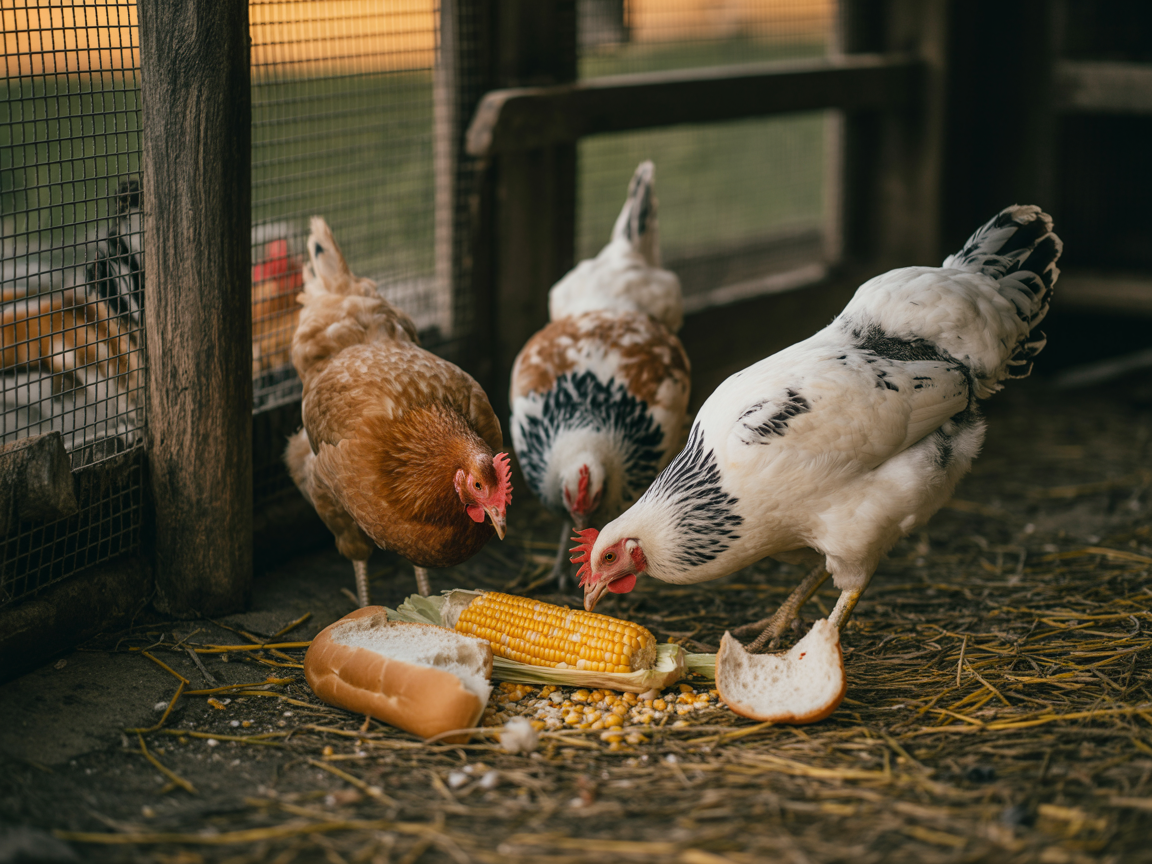
- The bun, plain: fine. Bread products are on Colorado State’s list of good scraps. Tear it up.
- Chili, relish with onion, anything with onions on it: no. Onions are a flat no.
- Chips and pretzels: no, same salt problem.
- Corn on the cob, watermelon rind, plain lettuce and tomato slices: good scraps. Ripe tomato is fine; the tomato plant’s leaves aren’t.
- Anything that sat out in the sun all afternoon: trash. UC Davis says no rotten food.
If you want to give them meat protein
Plenty of keepers want to hand over something meaty, especially in the molt when hens are regrowing feathers. Fair enough. Mealworms or black soldier fly larvae from the feed store do that without the salt and grease. Plain cooked egg does too. Scrambled, no butter, no salt. It’s the cheapest high-protein treat there is if you’ve got hens laying. It all still counts toward the 10%.
And honestly, if your layer feed’s the right one, protein isn’t what they’re short of. The feed calculator will tell you if they’re getting enough feed to begin with, which is usually the real question.
Sources
- Colorado State University Extension: Raising Poultry the Organic Way: Disease Control and Feeding (Howard Enos, December 2019, reviewed August 2025): scraps not salty; bread products; the 10% cap.
- UC Cooperative Extension / UC Davis School of Veterinary Medicine: Feeding your Flock (Dr. Maurice Pitesky and Dr. Nancy Reimers): avoid fatty foods; no rotten food.
- Merck Veterinary Manual: Management of Backyard Poultry (Yuko Sato, DVM; revised November 2024): fat scraps and fatty liver.
- Merck Veterinary Manual: Salt Toxicosis in Animals: water restriction, frozen water sources, the signs in poultry.
- University of Maine Cooperative Extension: Salt is an Important Nutrient for Poultry: sodium in feed at about 0.15%.
- Alabama Cooperative Extension System: Feeding the Laying Hen (Pacheco, Gulizia & Downs, August 2022): 100 to 150 grams of feed a day.
- USDA FoodData Central (SR Legacy): beef frankfurter, heated (174614) and white bread (174924). The percentage is my arithmetic from these figures.
Sources checked September 26, 2026. I keep chickens; I’m not a veterinarian.
Related read: How to Raise Chickens for Eggs — Instant PDF download. Secure checkout by Stripe