I wouldn’t feed your chickens comfrey. As far as I can tell one stolen leaf is no reason to panic, but this isn’t a plant to hand out on purpose. Comfrey carries pyrrolizidine alkaloids, a family of plant toxins that usually damage the liver slowly. The FDA advised supplement makers to pull it from the market in 2001 because of them. A German trial fed dried comfrey leaves to broilers for 32 days and found no signs of harm in its liver and bone checks. A USDA lab found a comfrey alkaloid extract more toxic to chicks than the pure alkaloids. And I couldn’t find one trial that fed the leaves to laying hens. So keep it in your compost bin, where it does real work, and out of your flock’s feed.
I rewrote this page from 20 sources, and they’re all listed at the bottom. The safety side comes from the FDA and the Merck Veterinary Manual, plus NC State Extension. The chicken evidence comes from a German broiler trial, a USDA lab study in chicks and a handful of papers on laying hens. Garden Organic, the British charity behind Bocking 14, covers the growing side. Where something is my own reading or my own call, I’ll tell you.
This page used to be a story. It opened on “a warm April morning” with hens mobbing a basket of leaves “like seagulls after spilled French fries on the Jersey shore!” Then came “My Red Star hen Buttercup”, a verdict reached “After almost 3 hours of additional reading”, then “My Leghorn lady Cluckabelle” and “twelve plump chickens”. There was a garden too, where “I chose Russian Bocking 14 comfrey”, and leaves picked from “wild stands near my home”. I can’t vouch for any of it, so it’s all gone.
Some claims went too. The old page concluded that “periodic, moderate amounts of comfrey should be fine for backyard chickens.” It said the leaves “aid digestion, liver function, egg production and feather quality.”
Liver function. From a plant whose alkaloids the FDA calls liver toxins in animals.
It also said comfrey “may soothe bumblefoot sores, bug bites, sprains or respiratory issues”, and it promised an “immune boost”. None of the sources I read backs any of that for comfrey leaves in chickens.
To its credit, the old page did warn that the alkaloids can hurt a liver. Then it said “problems are easily avoided by restricting treat amounts”, and no source I read says that either.
The amounts went as well. The old page said to “Offer just a few leaves per bird 1-2 times weekly at most”, and it aimed for “a 5-10% comfrey ratio” in the pellets. Chicken Rise doesn’t give doses, and neither figure came with a source. It also handed out “tender young leaves and root chunks”, and the roots carry far more alkaloids than the leaves, as you’ll see below. The sections that follow say what the sources do say.
The short version.
- Comfrey carries pyrrolizidine alkaloids. The FDA advised supplement makers to pull it in 2001, and its letter names Russian comfrey too.
- With this alkaloid family the damage usually builds slowly. Merck never names comfrey, but it says signs can take weeks or months to show, and young growing animals are most at risk.
- A 2020 broiler trial found no signs of harm in its checks over 32 days. A USDA lab found a comfrey alkaloid extract hurt chicks worse than the pure alkaloids did.
- I found no trial that fed comfrey leaves to laying hens. Alkaloids from other plants reached eggs, mostly the yolks, in one trial.
- Roots carry far more than leaves, and drying doesn’t clear it. Never feed root chunks, and skip the dried leaves too.
- Hens got into your patch? Don’t panic. Fence it off, keep an eye on them for months, and call a vet who sees poultry if a bird looks off.
The Plant the FDA Told Supplement Makers to Pull

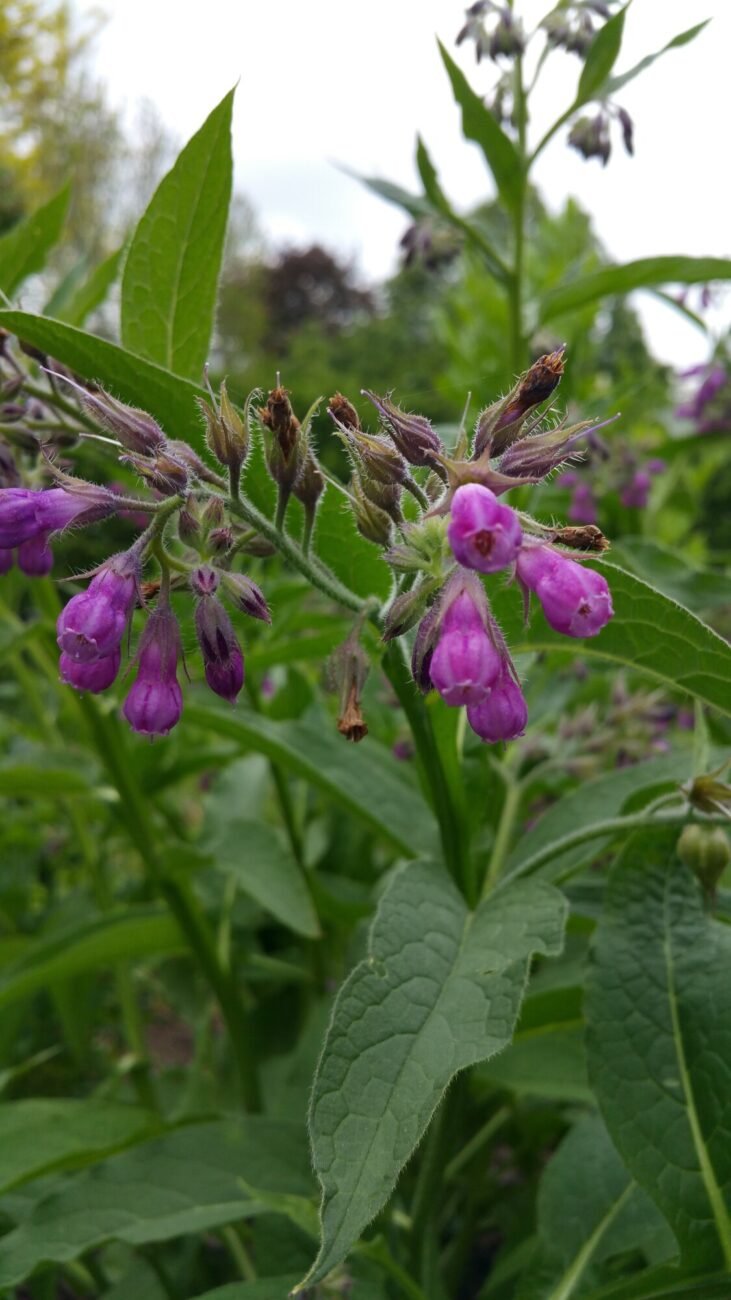
Comfrey is a big, coarse garden herb. NC State Extension describes “Bluebell-like purple flowers that grow in drooping clusters”, and that’s the plant in this photo. It has a long past as a folk remedy for “topical and internal injuries”, NC State says, “though it is no longer deemed as safe for consumption.”
Here’s why. On July 6, 2001, the FDA sent out a letter headed “FDA Advises Dietary Supplement Manufacturers to Remove Comfrey Products From the Market”. It named three comfreys, and Russian comfrey was one of them. The agency said these plants “are a source of pyrrolizidine alkaloids that present a serious health hazard to consumers when they are ingested.” It also said it couldn’t name a safe amount, citing “the lack of any valid scientific data that would enable the agency to determine whether there is an exposure, if any, that would present no harm to consumers”.
That letter is 25 years old and about people, not poultry, and I won’t stretch it further than that. NC State’s plant page, on common comfrey, is about people as well. It says “Ingestion can lead to liver damage, lung damage, and cancer.” It lists every part of the plant as poisonous, from the leaves down to the roots. That’s the kind of plant you’d be tossing into your run.
The old page got part of the leaf’s richness right. The German team behind the broiler trial below also fed them to pigs, and their 2021 paper says the leaves “show similar values in dry matter as soybean or blue lupine in crude protein content, but much higher levels of calcium and phosphorus.” So yes on protein and calcium. I couldn’t find the old page’s vitamin A or B12 in anything I read. Either way, a good protein number doesn’t cancel what else is in the leaf.
The Liver Damage Is Usually Slow, and Young Birds Take It Hardest

The Merck Veterinary Manual has a full page on these alkaloids in animals. It never names comfrey. It names ragwort and groundsel, among others. I’m carrying its description over to comfrey because the FDA and NC State both put comfrey’s trouble down to pyrrolizidine alkaloids. That step is mine, not Merck’s.
Merck calls the poisoning “typically a chronic toxicosis that results in hepatic failure.” In plain words, the liver slowly gives out. It also says “the liver reflects the cumulative and progressive effects of repeated ingestion of small doses of toxin.” That’s the line I’d want you to remember. A small dose can still do harm when you repeat it, and the old page’s plan was to repeat it “about once a week”.
The timing is what makes this hard to catch. Merck says “clinical signs may not occur for several weeks or months after initial exposure.” Then it adds, “Consumption of the offending plant may even have ceased months earlier.” So a hen that looks great after a summer of comfrey doesn’t prove a thing. Neither does a keeper telling you their birds eat it and they’re fine.
To be fair, chickens aren’t on Merck’s short list. It says “Cattle, horses, farmed deer, and pigs are most susceptible”. But poultry aren’t in the clear. Merck says alkaloid plant seeds harvested with grain have made livestock and poultry sick. On Crotalaria, the rattleweed group, its poultry page says “Backyard birds feeding through foraging behavior may develop chronic hepatic lesions.” And when Cheeke and Pierson-Goeger fed dried tansy ragwort in 1983, they wrote, “Both chicks and turkey poults were susceptible to chronic toxicity of dietary tansy ragwort.”
Age matters too. Merck says “young growing animals are most susceptible”, and on Crotalaria it says “Resistance to the toxin increases with age.” So if one bird in your flock should stay away from comfrey, it’s the chick or the half-grown youngster, like the one in this photo.
One Trial Says Fine, One Lab Says Careful

I found two studies that tested comfrey leaves or comfrey’s alkaloids in young chickens. Neither used birds like your layers. The broilers in this photo are on a Texas farm, by the way, and weren’t in either one.
The good news first. Oster and colleagues, at a German farm animal institute, published a broiler trial in 2020. One-day-old Cobb500 chicks got a standard diet, or that diet with dried comfrey leaves added, for 32 days. The authors wrote that “Performance traits indicate good acceptance”. Their checks of liver function and mineral balance, plus bones and gut, “revealed no signs of impairment.” Measured alkaloids were “below the detection limit in liver and breast muscle”. They did report changes in gene activity in the blood cells of the male comfrey birds, without calling that harm.
That’s the best result I found for comfrey, and I’m not going to wave it away.
But look at what it covers. These were meat birds, and the trial stopped at 32 days. Merck’s damage can take “several weeks or months” to show. Your laying hen is around for years. The authors said using the leaves in a high-performance broiler line “seems feasible”, and they said more work should look at possible benefits as well as “the safe use of chicken products for human consumption.” I’m leaving the trial’s amount out on purpose, because this page doesn’t give doses.
Now the other side.
Brown and colleagues at the USDA’s Poisonous Plant Research Laboratory in Utah gave male chicks daily oral doses for 10 days, then checked them 7 days later. Some got a crude alkaloid extract made from comfrey, and others got one of two pure alkaloids found in it. Their finding was that “the reduced comfrey extract was more toxic than lycopsamine and intermedine.” They warned that “safety recommendations based on purified compounds may underestimate the potential toxicity of comfrey”.
That study has limits as well. It tested a concentrated extract, not a leaf pecked off in your run, so it can’t tell you how many leaves would hurt a chick. Nothing I found can. Here’s what I take from the two together: leaves in a month-long broiler diet looked fine, and comfrey’s alkaloids can hurt chicks.
Some keepers let their birds at it anyway. A 2011 paper on organic parasite control for poultry in British Columbia lists comfrey among the herbs that “Birds were also allowed to self-medicate with”. That’s a record of what those keepers did, not a test of whether it’s safe.
No Trial I Found Fed Comfrey Leaves to Laying Hens

If you keep layers, this is the section that counts, and it’s mostly a hole. I found no trial that fed comfrey leaves to laying hens, and none that looked for comfrey’s alkaloids in eggs.
What I did find were two papers from a team in Jilin, China, that fed hens comfrey polysaccharides. Those are long-chain sugars extracted from the plant, not the whole leaf. Zhou and colleagues reported in 2022 that “the egg production rate increased by 5.97 %” in one group. Shang and colleagues said in 2025 that the same kind of extract “could improve the antioxidant status and fatty acid composition of egg yolks.” I read the abstracts, and neither one mentions alkaloids. So those results belong to the extract, and I wouldn’t carry them over to a leaf. That’s why the old page’s “egg production” line is gone.
So the closest evidence comes from other alkaloid plants. Mulder and colleagues in the Netherlands fed laying hens feed with dried ragwort or other alkaloid herbs for 14 days. Comfrey wasn’t one of them. They found “PAs were transferred to eggs, in particular yolk”. PAs are these same alkaloids. After the hens went back to clean feed, “levels in eggs gradually decreased, but after 14 days were still above detection limits in the hens exposed to higher PA levels.” Their conclusion was that eating such herbs “may result in levels in eggs and meat that could be of concern for consumers, and as such should be avoided.”
A Turkish team ran a longer trial, and it’s the one that worries me most. Eröksüz and colleagues fed Senecio vernalis, another alkaloid plant, to laying hens for 210 days. They saw “no mortality or clinical signs”. But at the higher rates the hens laid fewer eggs and ate less and lost weight, and they had “mild to moderate chronic liver changes”.
The authors recorded no clinical signs in those birds, and their livers were taking damage anyway.
One result went the other way. That same trial says “No free pyrrolizidine alkaloids were detected in eggs”, and the authors said that means either no residues at a level they could detect, or alkaloids “bound irreversibly to egg proteins”. So the two egg studies don’t fully agree. Merck, for its part, lists eggs “from affected animals” among the places these alkaloids are found.
None of that is comfrey, and I won’t pretend it is. But it’s the same family of toxins, the one the FDA and NC State blame for comfrey’s trouble.
If you eat your hens’ eggs, I wouldn’t run that test on your own breakfast. That’s my call.
Roots Carry Far More Than Leaves, and Drying Won’t Clear It

Roots are the last part I’d hand a hen. Kimel and colleagues tested comfrey roots and leaves from Polish sources in 2023. The four main alkaloids in the leaves were “approximately 6 to 14 times lower than their content determined in the roots”. They also found that the level in roots, “depending on the origin, can vary up to 25 times”. So there’s no way to guess what’s in a root you dug up, and the old page’s root chunks are out.
Lower doesn’t mean clean, though. Those leaves still carried alkaloids, and so did the dried leaves in the German pig paper. Stegemann and colleagues looked at comfrey’s flowers and fruit in 2019 and wrote that “High levels of PAs are detectable in the fruit”. I read that as a reason not to let the green seed heads in this photo pass for a snack either.
Drying doesn’t solve it. The old page dried its surplus “into leaf meal to store”, but Merck says “At least some of the toxic compounds are known to survive drying.” Storing it in a jar doesn’t turn it into a safer plant.
Buying it doesn’t help either. The old page used “dried comfrey purchased from my local herb store”. Oberlies and colleagues made tea from comfrey leaves bought from three sellers. The alkaloids “varied considerably between teas prepared from leaves purchased from the different vendors of plant material.” They concluded that “consumption of herbal teas made from comfrey leaves may be ill-advised.” That’s a paper about people drinking tea, and Kimel’s team found “a much more stable profile” in leaves than in roots. I still read it as a sign that a bought bag of leaves won’t tell you its alkaloid level.
Bocking 14 Belongs in the Compost Bin

Comfrey earns its place in a garden, and I’m not telling you to rip yours out. Garden Organic says it “makes an excellent plant feed and compost activator”. Its advice is to “Place cut or bruised comfrey leaves in alternate layers throughout your compost heap”. NC State agrees that “Its foliage is a good addition to a compost pile.” You can soak the leaves for a liquid fertilizer too. Garden Organic warns you what you’ll get after 4 to 6 weeks: a “noxious (very) smelly brown liquid”.
The old page’s case for Bocking 14 was shaky. It said “Bocking 14 is sterile”, but Garden Organic says it “produces very little viable seed”. Very little isn’t zero, but it’s why Bocking 14 stays put. Wild comfrey “seeds freely”.
The old page also said the variety was “developed specifically for agricultural use as livestock forage”, with “higher protein levels than other strains”. I couldn’t confirm either one. Garden Organic’s history says its founder was drawn to comfrey’s “use as a high protein fodder crop for livestock”, and that Bocking 14 won its trials with “high yields of nutritious leaves”. Today the charity rates Russian comfrey “best for producing garden fertiliser”. I found nothing saying Bocking 14 is lower in alkaloids than other comfrey, and Bocking 14 is a Russian comfrey, the kind the FDA’s letter names. So choosing it doesn’t get you out of the problem.
Two warnings if you plant it. Garden Organic says “pieces of root re-grow very readily”, and NC State says common comfrey “will sprout from any root pieces left behind”. Garden Organic grows new plants from root pieces as short as 2.5 cm. And comfrey “can live for 20 years or more”. So once it’s in, it’s in. Put it where your hens can’t reach, outside the run with a fence around it. I also found nothing on whether the alkaloids break down in a heap. So if your flock has the run of your compost, I’d keep comfrey in a bin they can’t scratch through. The pallet bin in this photo is just garden trimmings, by the way, not comfrey.
If Your Hens Already Got Into It

So your hens found the patch. Don’t panic. Nothing I read says a few pecks at a leaf will hurt a healthy grown hen. This photo shows comfrey the way you’d meet it in a garden, with rough leaves and cream bells instead of purple ones, so you can check what they got into.
Then stop it happening again. Merck’s rule for any animal is blunt: “Further intake of toxic plant material must be prevented.” For your flock, that means a fence. Keep your chicks well clear of it. If you’d rather pull the plant, remember those root pieces, because a quick dig can leave you with more comfrey than you started with. Garden Organic says a cut root grows back within 2 to 3 months.
Watch your birds over the next few months, not the next few days. I couldn’t find a list of signs for chickens eating comfrey. The nearest thing is Merck’s poultry page on Crotalaria, which says “Affected birds may pass yellow urates.” It also lists lesions a vet would look for, including a swollen liver and “ascites”, which means fluid in the belly. Keep an eye out for what the Turkish hens did as well: fewer eggs, less feed eaten, lower weight. Any of those can have a dozen other causes, so don’t assume it’s comfrey.
If a bird looks off, call a vet who sees poultry and say the word comfrey. Don’t sit on it.
Merck says “Animals showing clinical signs rarely recover”, which is why the fence matters more than anything you do afterward. There’s no home remedy on this page, and I won’t invent one.
As for your eggs, nobody I read can say whether comfrey’s alkaloids reach them, or how long they’d stay. If your flock has been eating it regularly, stop, and ask your vet about the eggs.
If you’re after greens your hens can have, our purslane page covers a garden weed that passes, with one lookalike to watch for. Our ferns page tells a similar story with a different plant. Our yarrow page shows how to tell a plant you want from poison hemlock. And our what not to feed chickens page keeps the short list. Our can chickens eat it checker doesn’t rate comfrey, because none of its official sources rules on it. So for comfrey, this page is my answer.
So, can chickens eat comfrey? They’ll eat it, and my call is that one stolen leaf is no reason to panic. But damage from this family of alkaloids adds up in a liver, no trial I found tested the leaves in laying hens, and nobody I read can name a safe amount for a hen. You’ve got plenty of better treats. Give the comfrey to your compost heap and fence it off from your flock.
Sources
- FDA (July 6, 2001): FDA Advises Dietary Supplement Manufacturers to Remove Comfrey Products From the Market (archived copy).
- Merck Veterinary Manual: Pyrrolizidine Alkaloidosis in Animals.
- Merck Veterinary Manual: Poisonings in Poultry.
- NC State Extension Gardener Plant Toolbox: Symphytum officinale.
- Garden Organic: Our history with comfrey.
- Garden Organic: Comfrey.
- Garden Organic: Growing comfrey.
- Garden Organic: Propagating comfrey.
- Oster and colleagues, Science of the Total Environment (2020): Comfrey as an alternative field crop contributing to closed agricultural cycles in chicken feeding.
- Oster and colleagues, Science of the Total Environment (2021): Comfrey as a feed supplement in pig nutrition contributes to regional resource cycles.
- Brown and colleagues, Journal of Applied Toxicology (2016): The comparative toxicity of a comfrey alkaloid extract and pure comfrey alkaloids in chicks.
- Cheeke and Pierson-Goeger, Toxicology Letters (1983): Toxicity of Senecio jacobaea and pyrrolizidine alkaloids in various laboratory animals and avian species.
- Mulder and colleagues, Food Additives and Contaminants Part A (2016): Transfer of pyrrolizidine alkaloids from various herbs to eggs and meat in laying hens.
- Eröksüz and colleagues, Veterinary and Human Toxicology (2003): Toxicity of Senecio vernalis to laying hens and evaluation of residues in eggs.
- Zhou and colleagues, International Journal of Biological Macromolecules (2022): Comfrey polysaccharides modulate the gut microbiota and its metabolites SCFAs and affect the production performance of laying hens.
- Shang and colleagues, Poultry Science (2025): Dietary comfrey polysaccharides and the oxidative stability and fatty acid composition of egg yolks in laying hens.
- Kimel and colleagues, Molecules (2023): LC-MS/MS Evaluation of Pyrrolizidine Alkaloids Profile in Relation to Safety of Comfrey Roots and Leaves from Polish Sources.
- Stegemann and colleagues, Journal of Chemical Ecology (2019): Specific Distribution of Pyrrolizidine Alkaloids in Floral Parts of Comfrey.
- Oberlies and colleagues, Public Health Nutrition (2004): Analysis of herbal teas made from the leaves of comfrey.
- Lans and Turner, Journal of Ethnobiology and Ethnomedicine (2011): Organic parasite control for poultry and rabbits in British Columbia, Canada.
Sources checked October 30, 2026. The calls on what to feed and what to fence are mine, and so is carrying Merck’s ragwort and Crotalaria findings over to comfrey. We aren’t vets. If a bird looks sick or hurt, call a vet who sees poultry.
Related read: How to Raise Chickens for Eggs — Instant PDF download. Secure checkout by Stripe