I’d keep star fruit away from your chickens, at least as a treat. I can’t tell you a bite would hurt a hen, because nobody has tested that. And that’s exactly my reason. Star fruit is loaded with oxalic acid, and it carries a nerve toxin called caramboxin. In people, it has caused kidney failure and seizures. You’ve got so many fruits that are known to be fine for a flock, so I’d leave this one in your fruit bowl.
I rewrote this page from 20 sources, and every one is listed at the bottom. The fruit facts come from the University of Florida and from Julia Morton’s book on tropical fruit, and the nutrition numbers are USDA’s. For the poison side, I read three chapters of the Merck Veterinary Manual and ten papers from doctors and researchers. The feeding rules come from extension guides at Colorado State and UC Davis, plus one from the University of Kentucky. This page used to tell a story about bringing star fruit home from a farmers market to a flock that gobbled it up. I can’t vouch for any of it, so it’s gone. So are the calorie and vitamin numbers that didn’t match USDA’s.
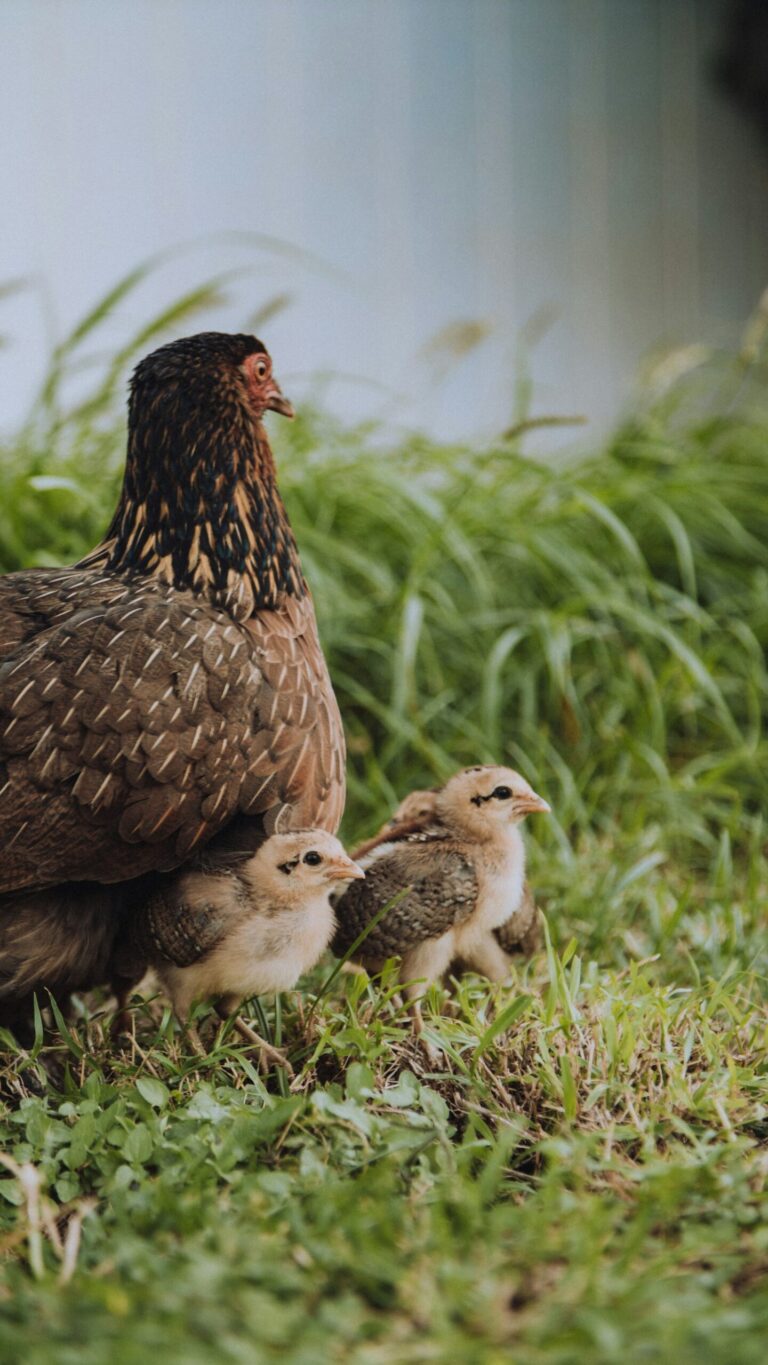
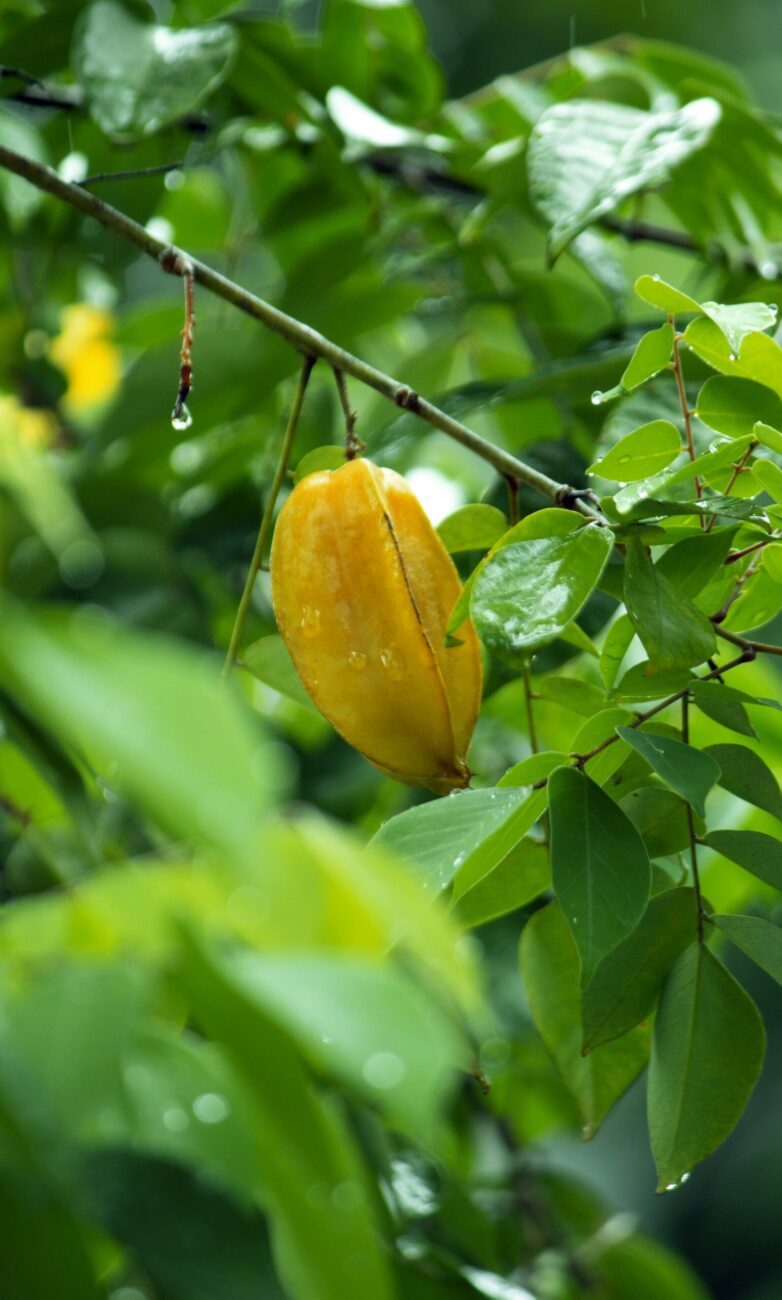
A word on the photos. None of them shows a chicken eating star fruit, and given what follows, I wouldn’t want one. The ripe fruit at the top was shot in Kerala, India. The green ones further down hang in a botanical garden on Tenerife, and the bagged ones come from Malaysia. The hens at the end are walking through an apple orchard, which is where I’d point you instead.
The short version.
- Don’t feed it on purpose. There’s no study of star fruit in laying hens, and the only chicken trial I found used an extract of the leaves.
- Star fruit has about as much oxalic acid as spinach. Morton’s book puts one sweet variety at 5 to 9.58 milligrams per gram.
- It also has caramboxin. Researchers in Brazil found it, and it’s behind the seizures star fruit can cause in people with weak kidneys.
- Most of the people it has hurt had kidney trouble already, but not all of them. Some drank a lot of juice at once.
- Skip the vitamin C pitch. The Merck Veterinary Manual says poultry make enough of their own in normal conditions.
- A tree over the run means picking up the fallen fruit, or keeping the hens out from under it while it’s dropping.
- If a hen ate a lot, or she’s wobbly or trembling, call a vet who sees poultry. We aren’t vets.
Nobody Has Tested Star Fruit on Chickens

Star fruit grows on a tree called Averrhoa carambola, and you’ll see it sold as carambola or starfruit too. UF says it comes from Southeast Asia, and that in the US it’s grown commercially in southern Florida and Hawaii. If you slice one across, you get a star, usually with five points. Julia Morton calls it “A curious, attractive fruit of the Oxalidaceae”, which is the wood sorrel family. That family is named for oxalic acid, and that’s not a coincidence.
The shamrock plant on a lot of windowsills is a cousin. UF lists oxalis among the carambola’s relatives, and the ASPCA’s poison control center lists shamrock as toxic to dogs and cats. The toxic part, the ASPCA says, is “Soluble calcium oxalates”.
I went looking for any test of star fruit in chickens so you wouldn’t have to, and I came up nearly empty. In my PubMed search, the one chicken study on this plant came out of Indonesia in 2025. Binti Ma’rifah and her colleagues at Universitas Diponegoro mixed an encapsulated extract of the leaves into broiler feed, at 500 to 1,500 milligrams per kilogram, from day 15 to day 35. The birds grew better than the control group, and the authors call the blood results positive.
That’s a good result, but it’s not your question. It was an extract of the leaves, not the fruit, in meat birds that were 5 weeks old at the end. It says nothing about a laying hen eating fresh fruit for years. So for the fruit itself, I had to go on what’s known from people and rats.
It isn’t reassuring.
Why Star Fruit Comes With a Warning for People

You don’t have to dig into medical journals to find the warning. It’s printed right in the University of Florida’s guide to growing the tree. People with kidney disease, it says, “should not eat carambola (star fruit) unless their doctor says that it is safe for them to eat”.
A 1998 report described six people who were stable on dialysis until they ate 2 to 3 star fruits, or drank 150 to 200 milliliters of the juice. Then they got sick, with symptoms running from hiccups and sleeplessness up to confusion.
One of them died.
In 2003, doctors at the University of Hong Kong wrote up seven more dialysis patients and concluded that “uraemic patients should totally abstain from star fruit”. Uraemic just means their kidneys weren’t clearing waste.
Healthy kidneys aren’t a free pass, though. A 2021 review from Sri Lanka gathered 136 people from published case reports, and 94 of them (69.1 percent) had kidney trouble before the star fruit. That leaves about 3 in 10 whose kidneys had been fine, by my math. One was a 56-year-old woman in Kandy, Sri Lanka, who drank a large amount of the juice at once as a home remedy for diabetes. She had “normal renal function” before, and then her kidneys were acutely injured, according to her doctors’ 2015 report in BMC Research Notes.
A Taiwan team reported the first two cases of this kidney injury in 2001. Both patients had drunk “large quantities of sour carambola juice”, and both needed dialysis for a while. Their kidneys recovered 4 weeks later. Their warning: “An empty stomach and dehydrated state may pose an additional risk”.
Nobody knows how much is too much, and that bothers me most.
If you’re hoping for a safe amount, there isn’t one on record. A 2021 review in Food Science and Nutrition says “the toxic dose of star fruit in humans has not been defined”. It adds that “from half to as many as 50 fruits at a time have been reported to cause toxic effects”.
There are two culprits. “Oxalate and caramboxin are considered the main substances causing nephrotoxicity and neurotoxicity”, says the 2021 Sri Lanka review. That’s kidney damage and nerve damage. A Brazilian team discovered caramboxin in 2013, and they said its action on nerve cells “explains its convulsant and neurodegenerative properties”.
The rat studies point the same way. In a 2002 Taiwan study, “Lethal doses of carambola juice were rendered harmless by the oxalate removal procedure”. (That juice was injected into the rats’ bellies, not eaten.) In 2021, a Brazilian team gave star fruit juice by stomach tube to 25 rats split into five groups. Only the rats whose kidneys had been damaged on purpose had seizures. Healthy rats got star fruit juice too, and they didn’t.
That last part is the good news.
Healthy kidneys seem to handle some star fruit, in those rats and in most people who eat it. But no one has checked your hen’s kidneys. And Merck’s chapter on poisonous plants puts “sour star fruit” right next to shamrock and rhubarb as plants with soluble oxalates. That chapter is written for pets, and rhubarb is already on our short list of foods to keep from chickens.
How Much Oxalic Acid Is in a Star Fruit

Not all star fruit is equally sour. UF says “There are two main types of carambolas, sweet and tart”. Morton goes further. She describes “the smaller, very sour type, richly flavored, with more oxalic acid” and a bigger “sweet” type that’s milder, “with less oxalic acid”. Even the sweet ones aren’t very sweet. She says they “rarely contain more than 4% sugar”.
She gives numbers for one sweet variety, Golden Star. Picked mature but still green, it had “5 mg oxalic” per gram of fruit. Ripe and yellow, it had “9.58 mg oxalic”. Per 100 grams, that’s 500 to 958 milligrams (my math). You’d think ripening would bring it down, but the ripe fruit had more, not less. Puerto Rican technologists found ripe fruit averaging half a gram per 100 milliliters of juice, and “They likened the juice to rhubarb juice”, Morton writes.
Those numbers will look familiar if you’ve read our page on kale and spinach for chickens. Spinach runs from 400 to 900 milligrams per 100 grams, depending on the variety. So a sweet star fruit sits right in spinach’s range, and the sour kind is higher still.
Let me run the same numbers I ran for spinach, so you can see how big this is. Merck says an adult laying hen “should eat no more than 0.1 kg (0.25 pound) of feed per day”. Colorado State says treats “should make up no more than 10% of their daily diet”. So her whole treat share is about 10 grams a day. Ten grams of Golden Star carries 50 to 96 milligrams of oxalic acid, which could tie up roughly 22 to 42 milligrams of calcium. Star fruit itself has only 3 milligrams of calcium per 100 grams, per USDA, so nearly all of that calcium would come from her feed.
Layer feed has plenty to spare. “Laying mashes typically contain 2.5% to 3.5% calcium”, says Jacquie Jacob of the University of Kentucky. In 100 grams of feed, that’s 2,500 to 3,500 milligrams. A 10-gram piece of star fruit could tie up under 2 percent of it (all of this is my math, from the sources above).
So if you’re worried about eggshells, a small piece of sweet star fruit won’t ruin them, any more than a handful of spinach would. The oxalate isn’t really what keeps me from feeding it. What keeps me away is the caramboxin, which nobody has measured in a bird, and the fact that no one knows what dose starts the trouble.
The Vitamin C Pitch Doesn’t Fit Hens

The old version of this page sold star fruit on its vitamins, so here are the real numbers. USDA lists raw star fruit at 31 calories per 100 grams. That same 100 grams has 34.4 milligrams of vitamin C, and 133 milligrams of potassium. A medium fruit, about 3 and 5/8 inches long, weighs 91 grams. That works out to roughly 28 calories and 121 milligrams of potassium a fruit, by my math. The old page said 35 calories and 234 milligrams.
Vitamin C is the bigger miss. You and I have to eat ours, but a chicken doesn’t. The Merck Veterinary Manual says “Vitamin C can be synthesized by poultry at adequate amounts in normal conditions”. It says there may be a benefit to adding some in very hot weather. Even then, I’d leave that to the feed company, not to a fruit with a question mark on it.
The old page also mentioned a study that found hens fed star fruit laid eggs with more vitamin C. I looked for it and couldn’t find it. And with 91.4 grams of water in every 100 grams of fruit, per USDA, there isn’t much nutrition in a slice anyway.
One more fix, in case you eat the fruit yourself. The old page said to peel off the “tough skin” and cut out the seeds. UF says the skin is “thin” and “smooth, with a waxy cuticle”, and that the seeds are edible. Thin isn’t tough, and edible seeds don’t need cutting out.
If a Star Fruit Tree Grows Over Your Run

This is where star fruit gets real for a lot of chicken keepers in warm places. If you live in southern Florida or somewhere like it, you may have a tree in the yard already. And that tree makes a lot of fruit.
UF says to expect 10 to 40 pounds of fruit a year from a tree during the first two to three years. Mature trees 7 to 12 years old “may produce 250 to 350 lbs (112 to 160 kg) of fruit or more per year”. In Florida, “The harvest season is generally from June through February”, UF adds. That’s most of the year with fruit hitting the ground under your tree.
A hen pecking at a 10-gram treat once in a while is one thing. A hen with a pile of soft, ripe fruit under her feet every day is another. And that’s the kind of exposure Merck flags. It says the serious signs from soluble oxalate plants are “more readily seen in livestock grazing large quantities”.
If you’ve got a tree like that, here’s what I’d do. In season, I’d rake up the dropped fruit every day, before the hens get to it. If that’s not doable, I’d fence off the ground under the tree while it’s dropping. Colorado State says not to give more scraps than the birds finish in 5 to 10 minutes, “to not attract nuisance animals”. A carpet of rotting fruit invites rats and raccoons, so you’ve got two reasons to clean it up (that part’s my call).
If One of Your Hens Already Ate Some

If your hen grabbed a peck or two, don’t panic.
The best guide I found is Merck’s chapter on poisonous plants, written for pets, not birds. It says “Small ingestions, including a taste or nibble, may result in GI upset”, and that “more serious signs are not expected”.
Big amounts are a different story. With large ingestions, Merck says, soluble oxalates bind to calcium, and blood calcium drops. Beyond vomiting, the early signs it lists for pets are “lethargy, ataxia, tremors, and seizures”. Ataxia is a wobbly, drunk-looking walk, the kind you’d notice from across the yard. Merck also warns that calcium oxalate crystals can settle in the kidneys.
So here’s how I’d sort it out. A hen that pecked at a slice probably just needs you to keep an eye on her for a day or so. A hen that ate a whole fruit or more needs a vet who sees poultry, today. So does one that’s wobbly or trembling. Take a piece of the fruit with you. “Flock owners must have an identified veterinarian in their area that can diagnose and treat chickens”, Colorado State says. If you’ve got a star fruit tree, find that vet before the fruit drops.
One thing might be working in your hen’s favor. The 2021 review in Food Science and Nutrition explains why an empty stomach matters in people: “As magnesium and calcium ions bind to oxalate in the gastrointestinal tract, their absence when on an empty stomach may lead to increased absorption of oxalate”. A hen eating layer feed all day rarely has an empty gut. That might protect her some, but it’s only my guess, and nobody has tested it. I wouldn’t bet a bird on it.
Better Fruit for Your Flock

You’ve got plenty of fruits that are known to be fine. Our Can Chickens Eat It? checker rates apples and pears as treats, with the core and seeds cut out. Blueberries and strawberries are treats too, and so is watermelon. If you type in star fruit, it says “Not rated here”. It also tells you that if you’re not sure, don’t.
Watermelon is a summer favorite, and our page on watermelon for chickens covers how much to give. If you’ve got a loquat tree, the ripe flesh is fine but the seeds aren’t, and our loquat page explains why. Raising young birds? Our page on fruits and veggies for baby chicks says when to start. And if you grow odd gourds too, here’s our take on bitter melon.
Whatever fruit you pick, keep it small. UC Davis’s guide on feeding a flock says to “treat the scraps like a treat not like the main course”. Merck’s backyard poultry chapter agrees that “birds should receive most of their diet from a balanced, nutritionally complete ration”. So give each hen about 10 grams of treats a day, all of them together, and keep your feeder full for the rest.
Sources
- Jonathan Crane, University of Florida IFAS Extension: Carambola Growing in the Florida Home Landscape (HS12).
- Julia F. Morton, Fruits of Warm Climates: Carambola (on Purdue’s NewCROP site).
- USDA FoodData Central: Carambola, (starfruit), raw (SR Legacy 171715).
- Renee D. Schmid, Merck Veterinary Manual: Houseplants and Ornamentals Toxic to Animals.
- Merck Veterinary Manual: Nutritional Requirements of Poultry (Doug Korver).
- Yuko Sato, Merck Veterinary Manual: Management of Backyard Poultry.
- ASPCA Animal Poison Control: Shamrock Plant.
- Binti Ma’rifah and colleagues: Effect of encapsulated Averrhoa carambola L. leaf extract on the growth performance, haemato-biochemical parameters, gut health, and antioxidant activity in broiler chickens (Veterinary and Animal Science, 2025).
- M. M. Neto and colleagues: Intoxication by star fruit (Averrhoa carambola) in six dialysis patients? (Preliminary report) (Nephrology Dialysis Transplantation, 1998).
- K. C. Tse and colleagues: Star fruit intoxication in uraemic patients: case series and review of the literature (Internal Medicine Journal, 2003).
- Pamodh Yasawardene and colleagues: Nephrotoxicity and neurotoxicity following star fruit (Averrhoa carambola) ingestion: a narrative review (Transactions of the Royal Society of Tropical Medicine and Hygiene, 2021).
- R. A. Abeysekera and colleagues: Star fruit toxicity: a cause of both acute kidney injury and chronic kidney disease: a report of two cases (BMC Research Notes, 2015).
- C. L. Chen and colleagues: Acute oxalate nephropathy after ingestion of star fruit (American Journal of Kidney Diseases, 2001).
- Kasun Lakmal and colleagues: Nutritional and medicinal properties of Star fruit (Averrhoa carambola): A review (Food Science and Nutrition, 2021).
- N. Garcia-Cairasco and colleagues: Elucidating the neurotoxicity of the star fruit (Angewandte Chemie, 2013).
- C. L. Chen and colleagues: Neurotoxic effects of carambola in rats: the role of oxalate (Journal of the Formosan Medical Association, 2002).
- Layla Alves Rodrigues da Silva and colleagues: Standardization of experimental model regarding star fruit intoxication in Wistar rats suffering with nephropathy (Acta Cirúrgica Brasileira, 2021).
- Colorado State University Extension: Raising Poultry the Organic Way, Disease Control and Feeding.
- Maurice Pitesky and Nancy Reimers, UC Davis: Feeding your Flock.
- Jacquie Jacob, University of Kentucky, on Poultry Extension: Feeding Chickens for Egg Production in Small and Backyard Flocks.
Sources checked October 28, 2026. The per-fruit numbers and the calcium math are mine, from these sources. So is the “3 in 10”, and so are the calls on fallen fruit and on when to see a vet. We aren’t vets. If a hen ate a lot of star fruit or acts off, call a vet who sees poultry.
Related read: How to Raise Chickens for Eggs — Instant PDF download. Secure checkout by Stripe