As an Amazon Associate I earn from qualifying purchases. This post contains affiliate links. If you buy through them we may earn a commission at no extra cost to you.
Product prices and availability are accurate as of the date and time indicated and are subject to change. Any price and availability information displayed on Amazon at the time of purchase will apply to the purchase of this product. Certain content that appears on this site comes from Amazon. This content is provided "as is" and is subject to change or removal at any time.
The Pen I Built First Was Beautiful and a Raccoon Defeated It in Eleven Days
Three hundred and forty dollars. Cedar posts, painted hardware, the whole thing looked like something from a magazine. Then a raccoon found the single-action latch on night eleven and I lost two hens before I heard the noise and got outside. After that I stopped thinking about what a pen looked like and started thinking about what it actually had to do.
Most pen advice online organizes everything by aesthetic. Woodland style. Cottage style. Whatever. Zero measurements, zero cost breakdowns, and nothing about the specific decisions that get birds killed or keep them healthy. This is the other kind of post.
The Math Before the Build: Square Footage Rules That Actually Protect Your Flock
You’ve probably seen the 4 sq ft per bird rule cited everywhere. That number is real, but it’s the coop interior figure, not the pen figure. Mixing those two up is the single most common reason backyard flocks end up stressed, picked on, and laying poorly. They’re different numbers for different spaces and treating them as interchangeable causes chronic overcrowding.
For a permanent enclosed pen, the minimum is 10 sq ft per bird. Below 8 sq ft per bird you’ll see pecking order aggression increase measurably within three weeks. I watched this happen my second year when I squeezed nine birds into a pen sized for six. Feathers started disappearing off backs within the month.
So a flock of 6 standard hens needs at minimum 60 sq ft of pen space. That’s roughly 6×10 ft. Not huge. But the number matters more than the shape. Before you sketch anything, do this math first. Everything else is secondary to it.
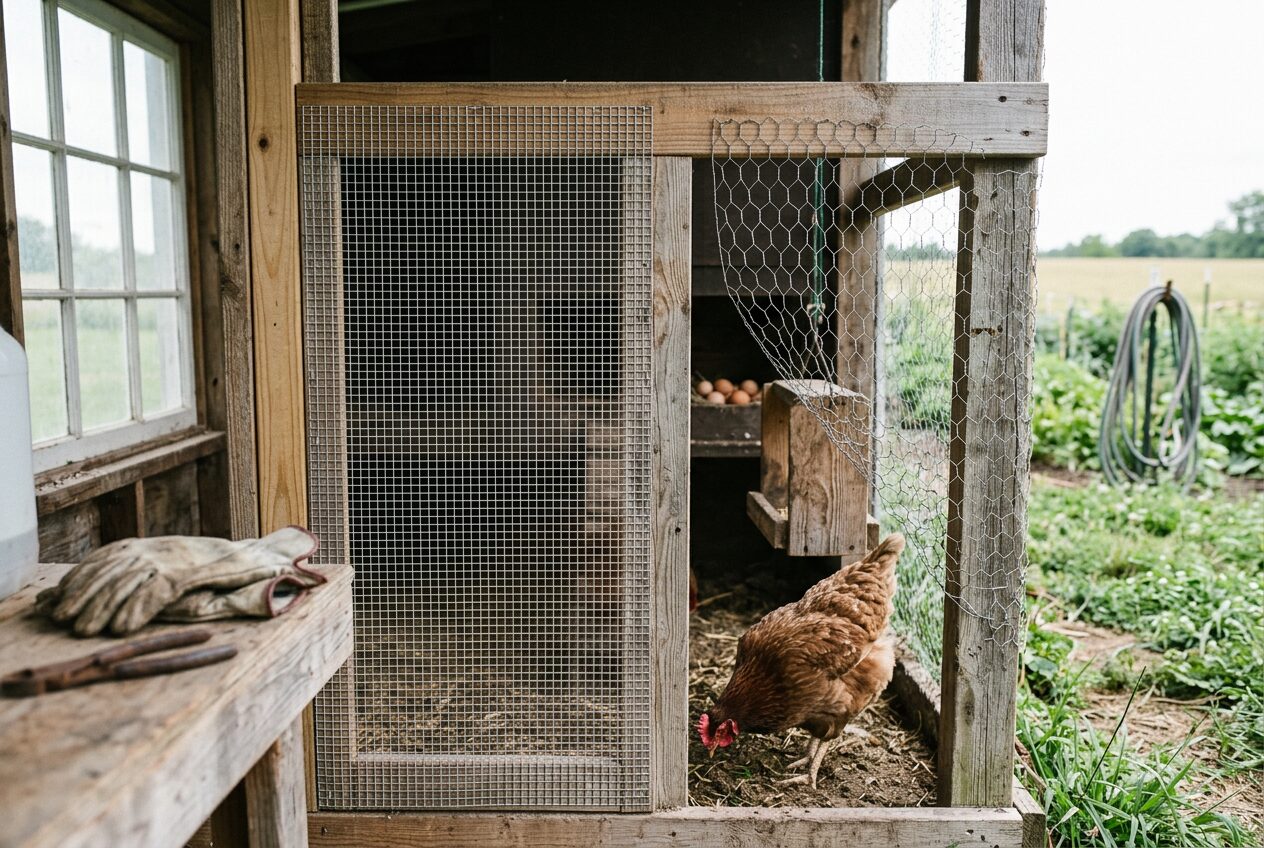
Predator-Proof Means Hardware Cloth, Not Chicken Wire — Here’s the Spec
Chicken wire keeps chickens in. That’s it. It does not keep predators out. Raccoons can reach through 1-inch mesh and kill birds without ever entering the pen. I know someone who lost a hen that way. Found her against the wire in the morning with injuries that made no sense until he understood what happened. The wire failed her while she was sleeping six inches from it.
What you want is 16-gauge, 1/2-inch mesh hardware cloth. That gauge and that mesh size stops raccoon hands and stops weasels, which can compress through openings that seem impossibly small. One-inch welded wire is not a substitute. It provides containment, not protection. There’s a difference.
Yes, it costs more. Hardware cloth runs roughly $0.50–$0.80 per sq ft. Chicken wire is $0.15–$0.25. On a 6×10 pen you’re looking at maybe $80 more to do it right. That’s the highest-return decision in any pen build. Spending $80 more on hardware cloth is cheaper than one emergency vet visit, and it’s certainly cheaper than replacing birds.
For the ground, you’ve got two options: bury an apron 12 inches down, or run it 12 inches outward along the ground surface and stake it flat. The outward apron is easier to install and works just as well. Digging predators, mostly foxes and dogs, hit the fence line and encounter wire when they start excavating. They don’t dig out two feet from the fence first. Use that against them.
Small-Yard Pens Under 100 Sq Ft: What You Can Actually Fit and What Gets Sacrificed
Tight lots force real trade-offs. A 4×12 ft pen at 48 sq ft works for 4 bantams or 3 standard hens, maximum. Push past that and you’re back into the overcrowding math from section one.
PVC-frame pens with hardware cloth stretched and zip-tied over the frame run approximately $150–$220 for a 4×8 structure. They’re light and easy to reconfigure but they’re not my first choice for permanent installation in areas with serious predator pressure. A 6×10 pen with a covered roof in 2×4 lumber and hardware cloth comes in under $280 in materials if you’re buying from a big-box store and not a specialty supplier. That’s what I’d build.
One thing that genuinely helps in a tight footprint: vertical space. Perch height of 18–24 inches inside the pen gives birds a second level to occupy and reduces ground-level crowding pressure. It’s not a replacement for floor space but it does something real.
Here’s the position I’d defend to anyone: a small pen built right, with correct mesh, a solid apron, and a covered top, is safer than a large pen slapped together with chicken wire and no roof. Size is not a substitute for build quality. Aerial predators are real, and an uncovered large pen just gives hawks a bigger target.
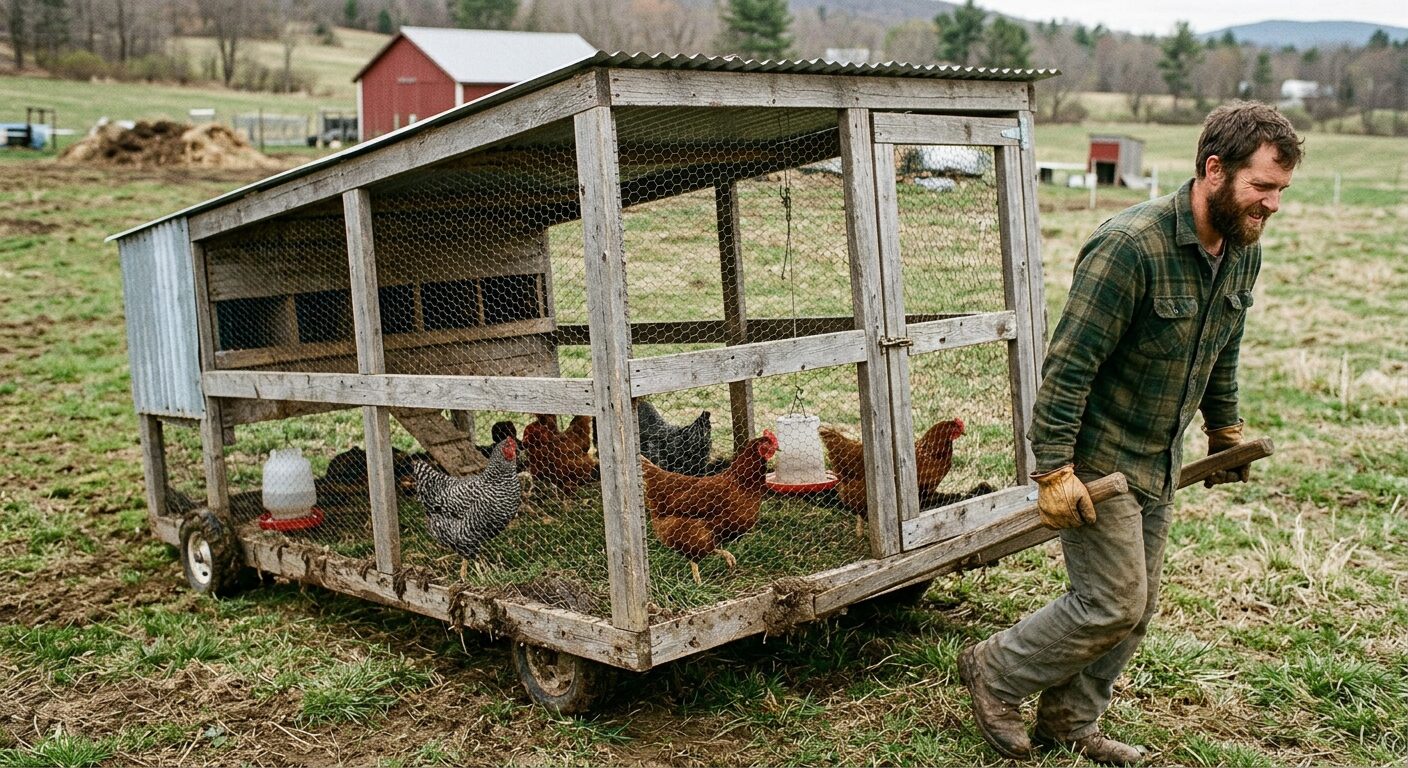
Mobile Pens (Tractors): Actual Dimensions That Work and the Weight Problem Nobody Mentions
A chicken tractor only works if you actually move it. Obvious, but it’s where most of them fail.
A tractor for 4–6 hens needs at minimum a 4×8 ft floor space. Smaller than that and the grass underneath is destroyed in under two days, especially in summer. You need to move it every 2–3 days on healthy pasture and every single day in summer heat or on thin grass. Let it sit and you get a muddy rectangle, a parasite load, and birds standing in their own waste. The mobility is the whole point.
Here’s what most DIY tractor plans don’t mention: weight. A lumber-and-hardware-cloth tractor weighs 60–90 lbs. Add a nest box and you’re past what one person can realistically move solo every morning before coffee. I tried it. I moved mine once a week instead of daily because it was genuinely difficult to shift alone. That means it wasn’t a tractor anymore. It was a fixed pen with handles I ignored.
PVC-frame tractors cut weight down to 25–40 lbs, which is manageable, but they flex in wind and they’re less predator-resistant than lumber frames. The Omlet Eglu Cube tractor runs about $895 USD, holds up to 10 hens, and solves the weight and predator problem at once. Not cheap. But it’s a real product built around the actual constraints of the thing.
Do not build a tractor with a solid wood floor for easy cleaning. It adds 20–30 lbs and it blocks the direct-on-grass grazing that makes a tractor worth having in the first place. Defeat the purpose twice over.
Shade and Heat Management: The Temperature Numbers That Determine Whether Your Pen Kills Birds in Summer
Shade is not a nice-to-have. In any climate with summers above 85°F it is load-bearing infrastructure, and treating it as optional is exactly how people lose birds in July.
Chickens show heat stress above 85°F (29°C). Mortality risk rises sharply above 104°F (40°C). Those numbers are real and they’re closer together than most people think. A hen showing open-mouth panting at 95°F is already struggling. A few hours more without relief and you’re losing birds.
Seventy to eighty percent shade cloth reduces surface temperature under the cloth by 10–15°F compared to direct sun. That gap matters enormously in July. The cloth itself runs $0.12–$0.25 per sq ft for 70% density polypropylene at most farm supply stores. It’s cheap. There’s no excuse to skip it.
For a 10×10 pen you need at minimum a 6×10 ft shaded zone. Shading half the pen sounds like it should be enough. It isn’t, not in USDA zones 7 and above. When half the pen is shade, all ten birds try to occupy the shaded half and you’ve recreated your overcrowding problem in real time.
Orient the long axis of your pen east-west. The south-facing side gets afternoon shade that way, which is when heat peaks. One small decision at layout time that costs nothing.
One corner covered with a tarp is not handled. Birds cluster there, crowd it, and stress each other. I’ve seen the injuries from it. Cover most of the pen or plan to lose birds on a 100°F afternoon.
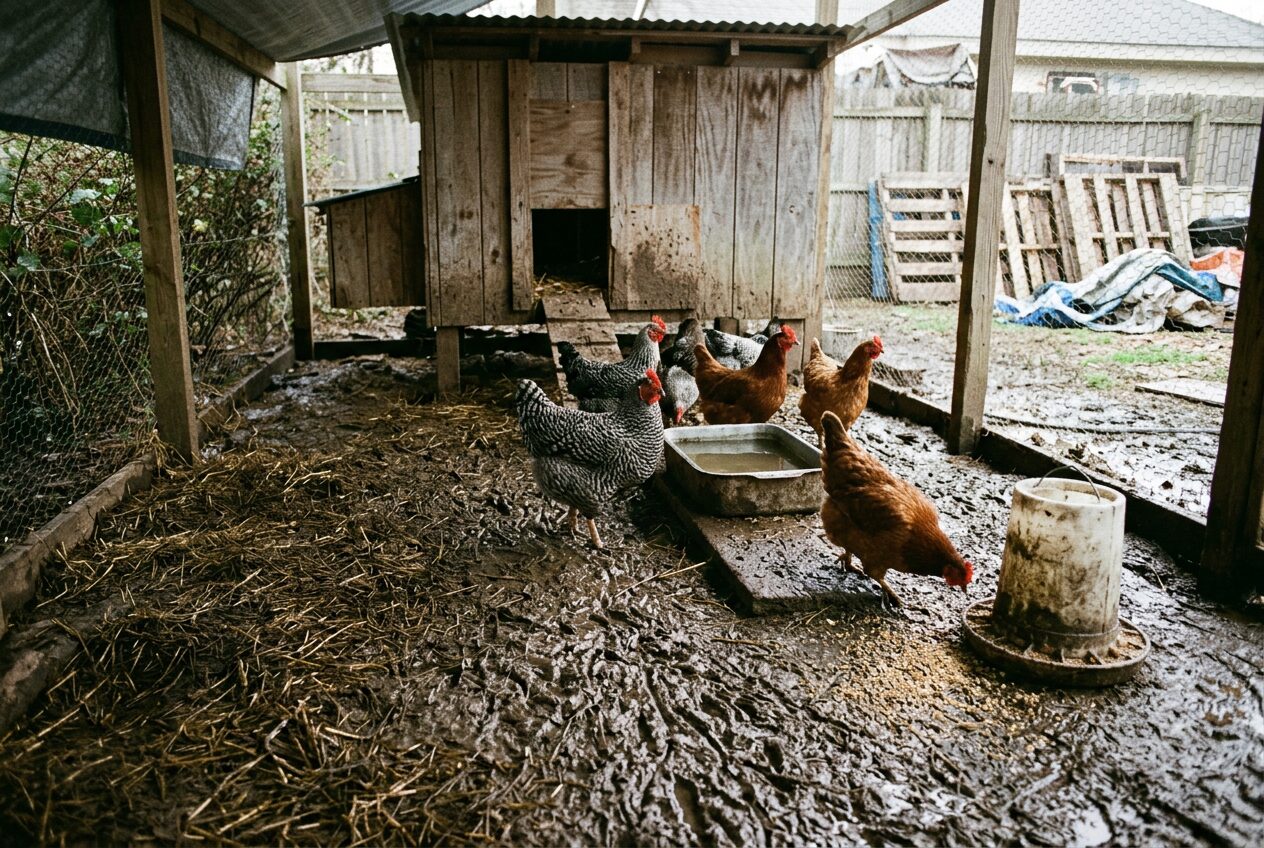
Drainage and Mud: The Pen Floor Problem That Wrecks Health and Smells Up the Neighborhood
A beautiful pen on compacted clay will have sicker birds than a rough pen on well-drained gravel. Mud causes bumblefoot. That’s a Staphylococcus infection in the foot pad that requires treatment and recurs in bad conditions. It also creates the warm, moist environment coccidiosis oocysts love. Respiratory issues follow from birds spending time in damp litter. None of this is subtle. You’ll smell it and then you’ll start seeing the symptoms.
The base layer fix is 4–6 inches of coarse construction sand or pea gravel. It drains standing water, resists compaction, and stays workable. Do not use pine shavings outside. They compact and mold. Wood chips work. Arborist chips are ideal if you can get them free or cheap from a tree service, and plenty will drop them off if you ask.
For deep litter in a covered pen area, start with a minimum 4-inch layer of wood chips or straw and top it up monthly. The composting action generates heat and suppresses pathogens when managed right. Straw as a long-term outdoor floor covering is a mistake. It mats within a couple of weeks, holds moisture, and becomes a warm incubator for coccidiosis oocysts. I used it the first two winters. Stopped after my third round of cocci treatment.
For a 10×10 pen with drainage problems, a French drain trench (6 inches wide, 12 inches deep, running along the pen perimeter and filled with gravel and perforated pipe) costs roughly $30 in materials. That’s thirty dollars to stop a chronic health problem. Worth it every time.
Attached Run vs. Standalone Pen: When the Connection to the Coop Becomes a Vulnerability
Predators are methodical. They work the perimeter. They test every latch, every seam, every junction. The spot where your pen connects to the coop is the spot a raccoon finds first.
Pop-hole openings need to be 10×10 inches minimum for standard breeds. Large breeds like Brahmas need 12×12. Size it too small and you get traffic jams at dusk that create injury and stress.
The coop-to-pen door needs a two-step latch. A carabiner plus a sliding bolt, or a sliding bolt plus a secondary clip. Raccoons defeat single-action latches. This is documented, it’s common, and it’s fixable for under three dollars in hardware. The latch that came with my first coop kit was a single barrel bolt. Gone by week two of raccoon visits. (I learned this the expensive way.)
Covered connecting tunnels, sometimes called chicken highways, between the coop and pen cost $40–$100 in materials for a 4-foot run. They nearly eliminate aerial predator access at the transition point and are worth considering if your coop and pen sit more than a few feet apart.
Automatic pop-hole door openers from Omlet or ChickenGuard run $150–$220. They close at dusk and open at dawn regardless of whether you remembered, whether you’re sick, whether you came home late. Human error is the primary cause of overnight predator access in small flocks. One prevented event pays for the device. The math is genuinely obvious and still most small-flock keepers don’t buy one until after something goes wrong.
Enrichment That Actually Reduces Vet Bills vs. Enrichment That Just Looks Good on Instagram
Swings and hanging CDs and painted signs that say “Fresh Eggs” are enrichment theater. I’m not saying don’t do them. I’m saying they don’t do anything for flock health. What does something real is harder to photograph.
Dust bathing. That’s the one that matters most and gets left out of almost every pen design I’ve seen. A dust bath area of 12×18 inches per 3–4 birds, filled with a mix of sand, wood ash, and food-grade diatomaceous earth at roughly 1 cup DE per gallon of material, reduces external parasite load measurably. Mites and lice, mostly. Skipping it doesn’t mean your birds won’t dust bathe. They’ll use whatever dry patch of dirt they can find. It means you’ll eventually deal with a parasite problem you could have largely prevented.
Hanging a cabbage head or a suet block at beak height costs under $2 per week and reduces feather-pecking incidents. It’s not magic, but birds that are busy don’t peck each other as much. Simple as that.
Inside the pen, perch height of 18–24 inches with 8–10 inches of perch space per bird reduces ground-level crowding. It’s cheap lumber. Do it.
Protein-based treats (dried mealworms, black soldier fly larvae) run $8–$15 per pound and birds go absolutely sideways for them. Keep them to 10% of diet or less. More than that and you’re creating a calcium-to-phosphorus imbalance that affects shell quality over time. A little goes a long way and they’re genuinely useful for redirecting pecking behavior or getting birds back in the pen at dusk when they’d rather argue about it.

$46.88 In Stock
Paid link · price checked October 13, 2026 18:27