Yes, chickens can eat a little plain coconut cream. But it’s the fattiest thing you’ll scoop out of a coconut can, and the sweetened stuff sold as cream of coconut isn’t hen food at all. Half a level tablespoon a hen is plenty, served in a dish of its own after she’s eaten her feed.
Coconut Cream, Cream of Coconut, or the Top of the Can?

Three things go by nearly the same name, and the labels are easy to mix up. Two of them are fine for your flock in small amounts. The third isn’t.
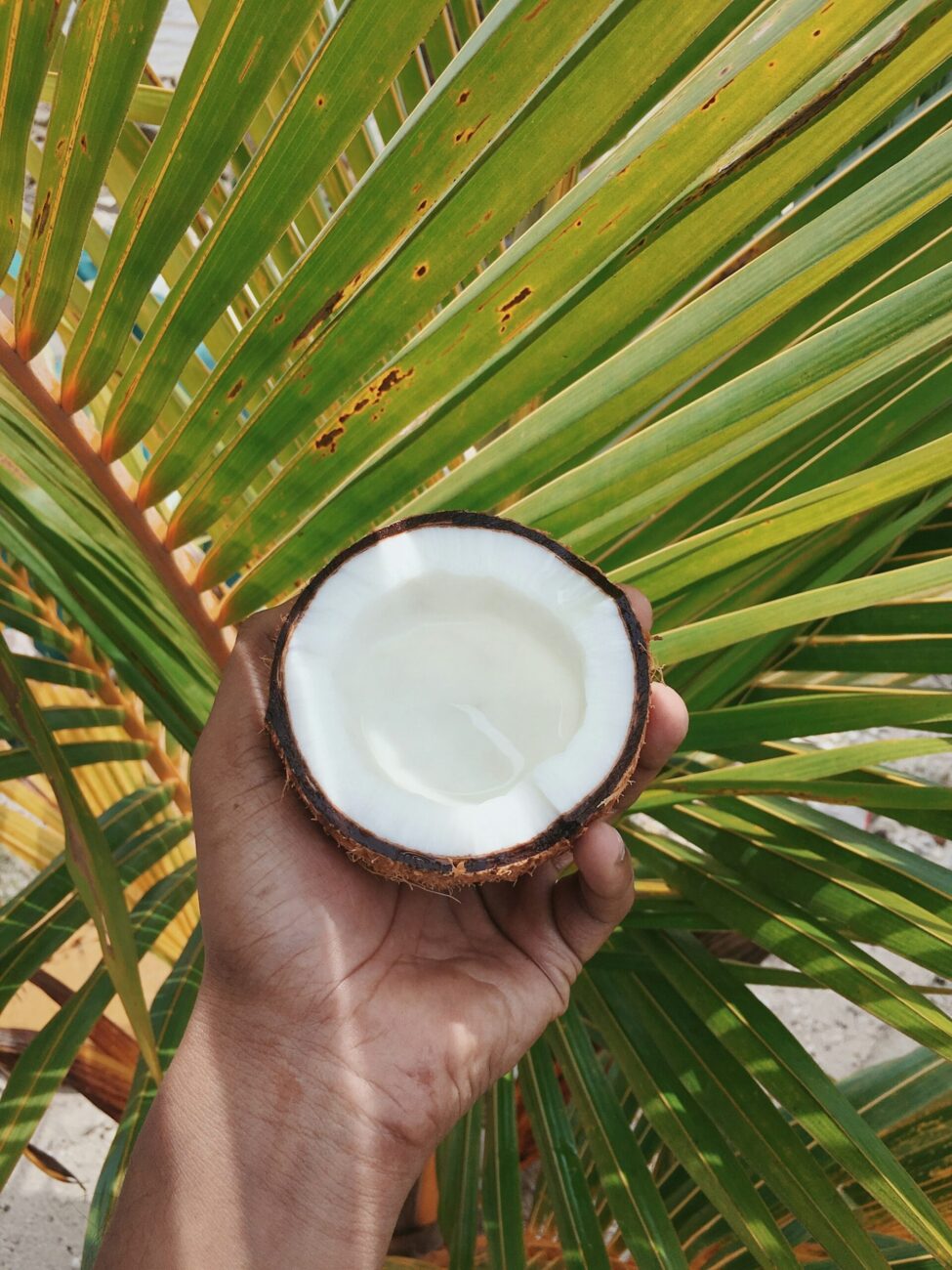
Coconut cream is made the same way as coconut milk, just with more coconut. Coconut milk comes from steeping shredded coconut meat in warm milk or water, then pressing and straining it, and for coconut cream, the ratio of coconut meat to liquid is higher, about 4 to 1. The thick layer at the top of a can of coconut milk counts too, because if coconut milk is left to sit, the rich fat separates and rises to the top, where it can be easily siphoned off.
Cream of coconut is the one to keep away from the run. It starts as coconut cream, but it’s sweetened and has extra thickeners and emulsifiers, and sugar is the main flavor. That’s the stuff for sweet drinks and baking.
Raw coconut cream has 53.9 grams of water and 34.7 grams of fat per 100 grams. Canned, sweetened coconut cream, the nearest thing to cream of coconut, has 51.5 grams of sugar per 100 grams, with 16.3 grams of fat on top.
Check the label twice before any of it goes near your hens. If the label says sweetened, or cream of coconut, it stays in the kitchen.
None of these is coconut water, by the way. That’s the thin liquid found inside the coconut itself. And if the tub in your fridge is coconut yogurt, that’s a different food again.
Why the Fat Is What Matters

Raw coconut cream is about a third fat by weight, at 34.7 grams per 100 grams, and 30.8 grams of it is saturated. A tablespoon weighs 15 grams, so that’s about 5.2 grams of fat and 50 calories in one level tablespoon. The Nutrition Facts on your can will show your brand’s own number.
Keep fat scraps away from your hens. Too much fat can bring on fatty liver, one of the leading noninfectious causes of death in backyard chickens, and hens can die suddenly from it, especially when they don’t get much exercise. It comes down to too much energy, whatever the source, so calories from a coconut count like any others.
The risk factors include being female, high-energy diets and restricted exercise, and it occurs most often in warm summer months. That’s your laying hen in July. Shut in a small run, eating rich treats.
Too much of a fatty treat also crowds out her real food. A hen typically eats to meet her energy needs, so as the energy in a diet goes up, feed intake goes down. Given too many extras, birds will fill up on them and not eat enough complete feed to keep laying or growing. That layer feed from the feed store is where her protein and calcium come from, and excess energy can lead to fat deposition, too.
Coconut cream won’t make up for the feed she skips. Not even close. Raw coconut cream is about 3.6 percent protein, and your layer feed should have 16 percent or more. It has 11 milligrams of calcium per 100 grams, about 0.01 percent, and layer feed should have 3 to 4 percent.
Half a Tablespoon a Hen Is Plenty

Start with the cap on every treat. Treats should make up no more than 10 percent of your hen’s daily diet, and a laying hen eats between 100 and 150 grams of feed a day, roughly 0.25 pounds. That’s 10 to 15 grams of treats a hen a day, and that covers every treat she gets, not just the coconut cream.
A level tablespoon of raw coconut cream weighs 15 grams, the very top of your hen’s treats on a day she gets nothing else. It’s the same tablespoon cap as canned coconut milk, but the cream is thicker and richer, with about 5.2 grams of fat in a tablespoon against about 3.2 in the milk.
So go with half a level tablespoon a hen, tops. For a flock of six, that’s 3 level tablespoons in all, on a day with no other treats. Don’t open a can just for your hens, either. Save it for when you’ve got leftovers.
Go lighter in summer, and lighter again if your hens get little exercise. On a hot July day, skip it. Fatty liver can be controlled by watching feed intake and body weight, so if one of your hens is getting heavy, she doesn’t need coconut cream at all, and her treats are the first thing to cut.
Think of coconut cream as ice cream for your hens. They’d eat it at every meal if you let them, and too many treats like this one can cut into your egg count.
A mature rooster doesn’t need nearly the nutrients a laying hen does, but in most small flocks, roosters eat the same diet as the hens, so hold yours to the same half tablespoon.
If you’ve got chicks, they wait. Feed only starter ration for at least the first two weeks. After that, small treats can start, but your pullets should stay on a complete starter or grower diet from 1 to 6 weeks of age as their sole source of nutrition. Wait the full 6 weeks for something as rich as coconut cream.
Serve It in a Dish of Its Own, After the Feed

Give it in the afternoon, once your hens have had their fill of layer feed.
Spoon it into a shallow dish, not your feeder. Your hens’ complete feed is made to be all they need, and stirring anything in only waters it down.
Never put it in your waterer. A film of coconut fat is one more thing to scrub off, and you want your drinkers free of slime and mildew.
Give your hens only what they’ll clean up in 5 to 10 minutes, so you don’t attract nuisance animals, or 20 at the very outside. Don’t let scraps rot, because botulism might result. Pick up the dish when your hens walk off, and wash it.
Half a tablespoon a hen doesn’t look like much in a dish. That’s kinda the point.
Pie, Piña Coladas and Curry Stay in the Kitchen

Plain cream from the can is one thing. The dishes made with it are another, and honestly, those are the leftovers to keep.
Cream of coconut is the one to worry about most. A tablespoon of canned, sweetened coconut cream weighs 19 grams, with about 9.8 grams of sugar in it. That’s pretty much half sugar by weight, with some fat stirred in. A pie filling or a drink mix made with it is sweet for the same reason.
A pot of curry made with coconut cream is out too. Scraps should never be salty, citrusy or moldy, too much salt can quickly lead to dehydration and kidney damage in chickens, and large amounts of onions can damage red blood cells. A curry can carry salt, onion and lime all at once.
Plain cream from the can is the only kind that goes out to your hens. If the spoonful you’ve got has sugar, salt, onion or citrus in it, it goes in the trash or your own fridge, not the run.
What to Do With the Rest of the Can

If a recipe used only part of the can, the rest is on a clock once it’s open. Bacteria can get in and start growing, so any unused portion has to go in the fridge in a clean container. The can itself will do in a pinch, though a glass or plastic storage container is better for quality and flavor.
Opened cans get two different fridge times, by how acidic the food is. Low-acid ones, like beans and stews, get 3 to 4 days, and high-acid ones, like tomatoes and pineapple, get 5 to 7. Keep an opened can of coconut cream to the shorter 3 to 4 days. Don’t leave it sitting out, either. Throw away anything perishable left at room temperature for more than 2 hours, or 1 hour if it’s over 90°F.
If food is moldy enough that you wouldn’t eat it yourself, don’t feed it to your chickens. Foods with a lot of moisture can be contaminated below the surface, and raw coconut cream is more than half water by weight. Toss the whole container. Not just the fuzzy spot.
Freezing keeps the rest safe for your own cooking later. You can freeze almost any food once it’s out of the can, so scrape the cream into a lidded container and freeze it as fast as you can. Give it a good stir once it’s thawed. Thawed, your hens’ share is still half a tablespoon each.
Sources
- USDA FoodData Central: Nuts, coconut cream, raw (liquid expressed from grated meat) (FDC ID 170580).
- USDA FoodData Central: Nuts, coconut cream, canned, sweetened (FDC ID 170171).
- USDA FoodData Central: Nuts, coconut milk, canned (liquid expressed from grated meat and water) (FDC ID 170173).
- America’s Test Kitchen: Coconut Products.
- Julia Arwine, America’s Test Kitchen: Coconut Cream vs. Coconut Milk (May 13, 2022).
- Yuko Sato, Merck Veterinary Manual: Management of Backyard Poultry (November 2024).
- Rocio Crespo, Merck Veterinary Manual: Fatty Liver Hemorrhagic Syndrome in Poultry (last updated September 2024).
- Maurice Pitesky and Nancy Reimers, University of California Agriculture and Natural Resources: Feeding Your Flock.
- Jacquie Jacob (University of Kentucky) for Cooperative Extension’s poultry site: Feeding Chickens for Egg Production in Small and Backyard Flocks.
- Wilmer Pacheco, Joseph Gulizia and Kevin Downs, Alabama Cooperative Extension System, ANR-2913: Feeding the Laying Hen (August 2022).
- Howard Enos, Colorado State University Extension: Raising Poultry the Organic Way – Disease Control and Feeding (December 2019, reviewed August 2025).
- Kalyn Waters, UF/IFAS Extension Holmes County: 10 Foods You Should Never Feed Chickens (May 25, 2026).
- Cackle Hatchery: What to Feed Baby Chicks.
- USDA Food Safety and Inspection Service: Shelf-Stable Food Safety.
- USDA Food Safety and Inspection Service: Leftovers and Food Safety.
- USDA Food Safety and Inspection Service: Molds on Food: Are They Dangerous?
- USDA Food Safety and Inspection Service: Freezing and Food Safety.
Related read: How to Raise Chickens for Eggs — Instant PDF download. Secure checkout by Stripe