A hen can have a little plain, unsweetened coconut yogurt, but I’d stop at a level tablespoon, and that spoonful is her whole treat for the day. Anything sweetened or chocolate I’d leave in the fridge. The catch is that two different foods sell under the name coconut yogurt, so you’ll want to read the tub before you share it. Nobody has tested coconut yogurt on hens, either, so the call here is mine. I built it from label numbers and feeding rules I can show you.
I rewrote this page from 11 sources, and every one is listed at the bottom. The label numbers are USDA’s, from its FoodData Central database. The feeding rules come from the Merck Veterinary Manual and from extension guides at three universities, and I’ll name each one as it comes up. Five research papers cover the lactose question and the probiotic one. This page used to open with a smoothie story and a hen named Peepers. I can’t vouch for any of it, so it’s gone. So are the claims I couldn’t find in a source, like coconut yogurt giving hens extra protein or quick energy.
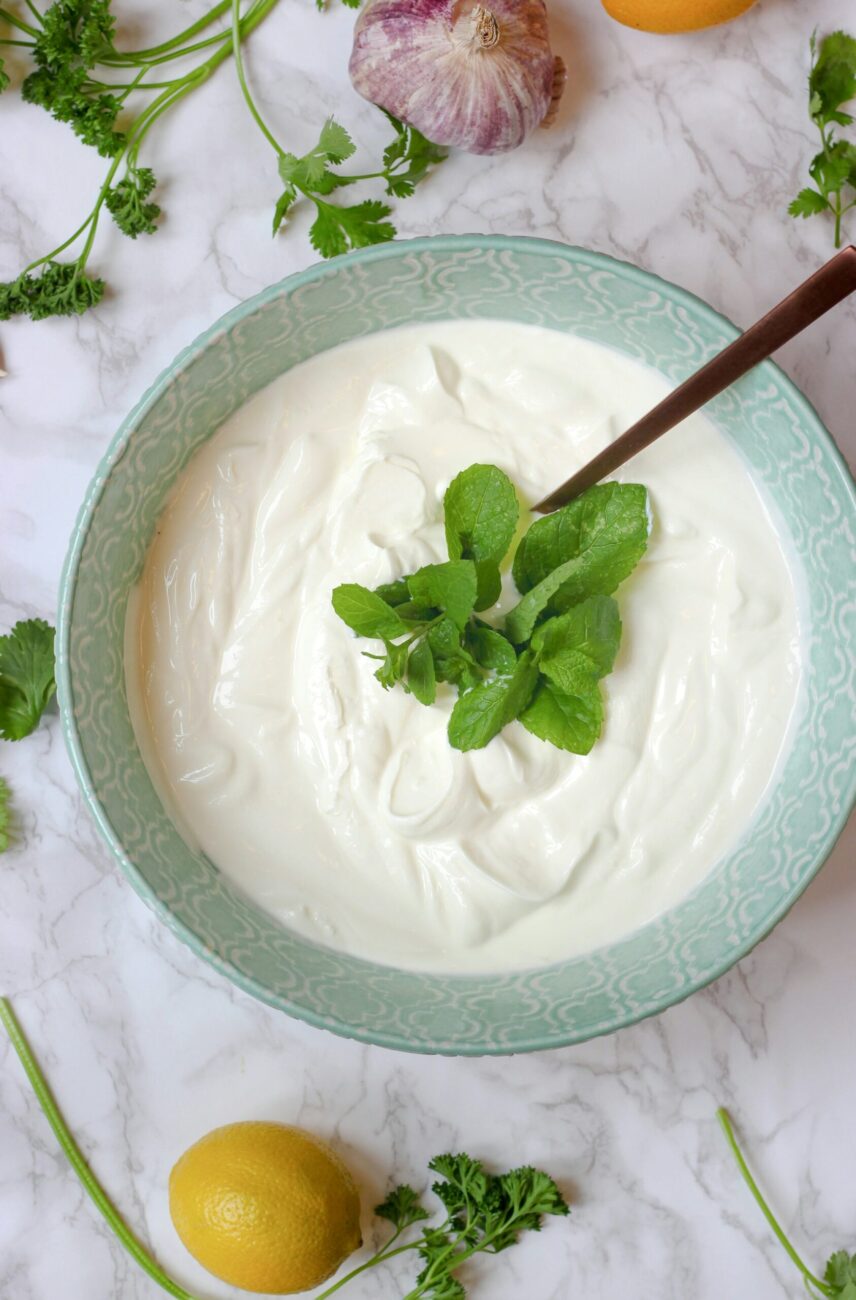
A word on the photos. None of them shows a hen eating coconut yogurt, because I couldn’t find a real one I’d trust. The bowl up top was photographed in Rotterdam, and nothing about it tells you whether it’s dairy or coconut. That’s pretty much the point of this page. The cracked coconut was shot on Réunion. The hens include a Sex Link and an 8-year-old laying hen, going by their photographers’ own titles.
The short version.
- Read the first ingredient on the tub you’ve got. Coconut milk means a dairy-free tub, and milk or nonfat milk means cow’s-milk yogurt with coconut flavor.
- If you share any, make it plain and unsweetened, a level tablespoon at most. A tablespoon weighs about 14 grams, and a laying hen’s whole treat share is 10 to 15 grams a day.
- Skip the sweet ones. A vanilla tub in USDA’s database has 10 grams of sugar per 100 grams, while the same brand’s unsweetened plain has 0.556 grams.
- Never chocolate. UC Davis puts chocolate on its list of foods to avoid.
- The live cultures aren’t a reason for you to feed it. The two hen studies I found mixed a yogurt probiotic into the feed, not a spoonful from a store tub.
- Chicks get starter feed, not yogurt. If a hen ate a lot of it or acts off, call a vet who sees poultry. We aren’t vets.
Two Foods Wear the Same Name

Walk down the yogurt aisle and you’ll find coconut yogurt in two kinds of tub. One is a dairy-free yogurt made from coconut milk. The other is plain old cow’s-milk yogurt with coconut flavor stirred in. They can sit side by side on the shelf, and for a hen they aren’t the same food.
USDA’s database has both kinds. The 2023 entry for So Delicious plain lists organic coconut milk first, and that coconut milk is just filtered water and organic coconut cream. A Liberté coconut Greek yogurt starts with pasteurized nonfat milk instead. Its coconut comes in a sweet layer on the bottom, with cane sugar in it, going by USDA’s entry.
So the first thing I’d do is turn the tub around. If milk is the first ingredient, skip down to the dairy section, because that’s a different answer. If it’s coconut milk, keep reading. That’s the whole trick with this food.
What’s Actually in the Dairy-Free Tub

USDA’s general entry for coconut milk yogurt lists 108 calories per 100 grams. It has 5.61 grams of fat and 8.88 grams of sugar in that same 100 grams. The protein is low, at 2.37 grams.
Brands swing a lot from there, which is why you’ve got to trust the label over the name. The So Delicious plain I mentioned isn’t unsweetened at all. Its ingredients list organic cane sugar second, right after the coconut milk, and USDA puts its added sugar at 5.9 grams per 100 grams. The same brand’s Unsweet plain has no sugar in its ingredients, and its label works out to 0.556 grams of sugar per 100 grams. Their vanilla comes in at 10 grams, by USDA’s numbers.
Plain doesn’t mean unsweetened.
You want the word unsweetened on the front, or no sugar anywhere in the ingredients. A store brand from ShopRite, for one, lists only coconut milk and starch, plus salt and the cultures, with 0 grams of sugar.
None of these is a protein food, either. The So Delicious plain lists 0.59 grams of protein per 100 grams, and the vanilla lists none. That’s under 1% protein, by my math, and a layer diet should carry 16% protein or more, according to Alabama Extension. Colorado State warns against loading a flock up on scraps, because hens “need to get enough protein to meet daily requirements”. A spoonful of coconut yogurt won’t help you there, and a bowlful would crowd out feed that does.
Where the Fat Comes In

Coconut is a fatty food, and the yogurt carries some of it along. USDA lists raw coconut milk at 23.8 grams of fat per 100 grams, and 21.1 grams of that is saturated. Thinned and cultured into the general yogurt entry, it comes down to 5.61 grams. That’s still more than whole-milk plain yogurt, which USDA puts at 3.25 grams.
Then you’ve got the thick cream-style tubs. The Coconut Cult’s coconut cream flavor lists 16.1 grams of fat per 100 grams, which is about 5 times whole-milk yogurt’s fat, gram for gram. That’s my math, from USDA’s numbers. A level tablespoon of it carries about 2.3 grams of fat and 30 calories, or close to 3 times the fat of a spoonful of the thin kind.
Here’s why you should care about fat in a hen’s diet. Merck’s chapter on backyard poultry says “Fat scraps should also be avoided, because they promote the development of fatty liver and acute death from liver rupture.” UC Davis puts it more plainly in its guide on feeding a flock: “Chickens don’t require high amounts of fat, so avoid fatty foods.”
Fatty liver isn’t a made-up worry. Merck describes fatty liver hemorrhagic syndrome as a disorder “typically causing sudden death of birds fed high-energy diets with limited exercise”. A laying hen shut in a small run all winter fits that picture a little too well, if you ask me.
A level spoonful of the thin, unsweetened kind isn’t a fat scrap. The cream style is a lot closer to one, and I’d skip it. Our page on durian for chickens runs into the same fat question with a fruit, and it lands in a similar spot.
The Probiotic Label Isn’t a Reason

Most coconut yogurts list live cultures, and some list a lot of them. So Delicious’s Unsweet plain names 8 strains, and The Coconut Cult names 15 strains. It’s tempting to read that as health food for your flock. I wouldn’t, honestly.
A 2020 review from the University of Hawaii defines probiotics as live microbes that do some good “when administered in adequate amounts”. On the best dose, the same review says “no conclusive recommendation can be made”. Turns out even the researchers can’t pin one down. The labels in USDA’s database name the strains, but they don’t tell you how many live cells a spoonful holds.
I did find hen studies, and they’re worth a look. A team at Padjadjaran University in Indonesia made a probiotic from fresh cow’s milk and four yogurt cultures. They mixed it into the feed of 35 Isa Brown laying hens, 40 weeks old, at 2 to 4% of the ration, and each hen got 120 grams of feed a day. After 35 days, the hens on 4% powder had lower neutrophil and lymphocyte counts, and lower alkaline phosphatase and cholesterol, the team reported in 2024. That study measured blood.
A 2023 study with one of the same researchers fed 40 laying hens probiotic yogurt powder at 2 or 3% of the diet. It found an effect on feed conversion, but the powder “has no significant effect on the production of laying hens during the peak period”, the authors wrote.
Neither study was about coconut yogurt, and neither one handed hens a spoonful from a tub. When I searched PubMed for coconut yogurt in chickens, the only two hits were about people’s diets. So I can’t tell you the cultures in your tub do a hen any good, because nobody has checked. If you share a spoonful, share it as a treat, not as medicine.
If the Tub Is Dairy

If milk is the first ingredient, you’re holding cow’s-milk yogurt with coconut flavor, and that brings milk sugar along with it. Chickens don’t handle milk sugar well. Researchers at North Carolina State put it flatly: “Chickens do not possess the necessary enzymes to efficiently hydrolyze lactose into glucose and galactose.” A French lab study from 1988 says chickens “are devoid of” the gut enzyme for it, lactase.
USDA lists a Chobani coconut-blend Greek yogurt at 2.08 grams of lactose per 100 grams. That doesn’t make dairy yogurt poison to a hen, mind you. It’s one more reason to keep the spoon small, though. Our page on cheese for chickens walks through the same lactose problem, with the salt and fat math added.
Most coconut-flavored dairy tubs you’ll find are sweet, too. The Liberté coconut Greek in USDA’s database has 10 grams of sugar per 100 grams, with cane sugar in its fruit layer. I’d pass on that one for a hen.
And if you buy dairy-free for your own reasons, read the whole list. The Coconut Cult’s coconut cream flavor is made with dried coconut that contains sodium caseinate, which its own label calls milk protein. A tub sold as coconut yogurt can still carry some dairy.
How I’d Share It

If you’ve got a plain, unsweetened tub and want to share, here’s the math I’d use. Alabama Extension says “A laying hen will consume between 100 and 150 grams of feed per day or roughly 0.25 pounds.” Colorado State says “Treats should make up no more than 10% of their daily diet.” So her treat share is about 10 to 15 grams a day, with every treat counted together.
A level tablespoon of yogurt weighs about 14 grams, if you go by the labels’ own weights. The Coconut Cult lists 2 tablespoons at 28 grams, and USDA weighs a cup of coconut milk yogurt at 226 grams, which is 16 tablespoons.
So one level tablespoon is her whole treat for the day.
From USDA’s general entry, that tablespoon is about 15 calories and 0.8 grams of fat, by my math. A single 5.3-ounce cup, which USDA weighs at 150 grams, would cover the treat share of 10 hens or more.
Here’s how I’d do it.
- Pick plain and unsweetened, with coconut milk first and no sugar anywhere in the ingredients.
- Put a level tablespoon per hen in a shallow dish, and keep the feeder full. The feed is the diet, and the yogurt is the extra.
- Pick up what’s left. Colorado State says not to feed more than your birds will eat in 5 to 10 minutes, so you don’t draw nuisance animals. I’d rather not leave a dish out after dark for a raccoon to find.
- Skip it on a day she’s already had other treats, and skip it for chicks.
Alabama Extension compares treats to ice cream. Kids offered it at every meal “will eat it with gusto”, the guide says, and they still won’t get what they need to grow. Give a flock too much of the fun stuff and “their egg production is likely to suffer”. For another tub from the fridge with the same math, see our page on hummus for chickens.
Our Can Chickens Eat It? checker doesn’t rate coconut yogurt, or plain yogurt either. Type it in and it says “Not rated here”, because none of the sources it uses rules on it, and it won’t guess. It also tells you that if you’re not sure, don’t. I’d go by that too. A level spoonful is fine by my reckoning, but your hens lose nothing if you skip it.
When to Skip It
Some tubs you’d honestly be better off leaving in the fridge.
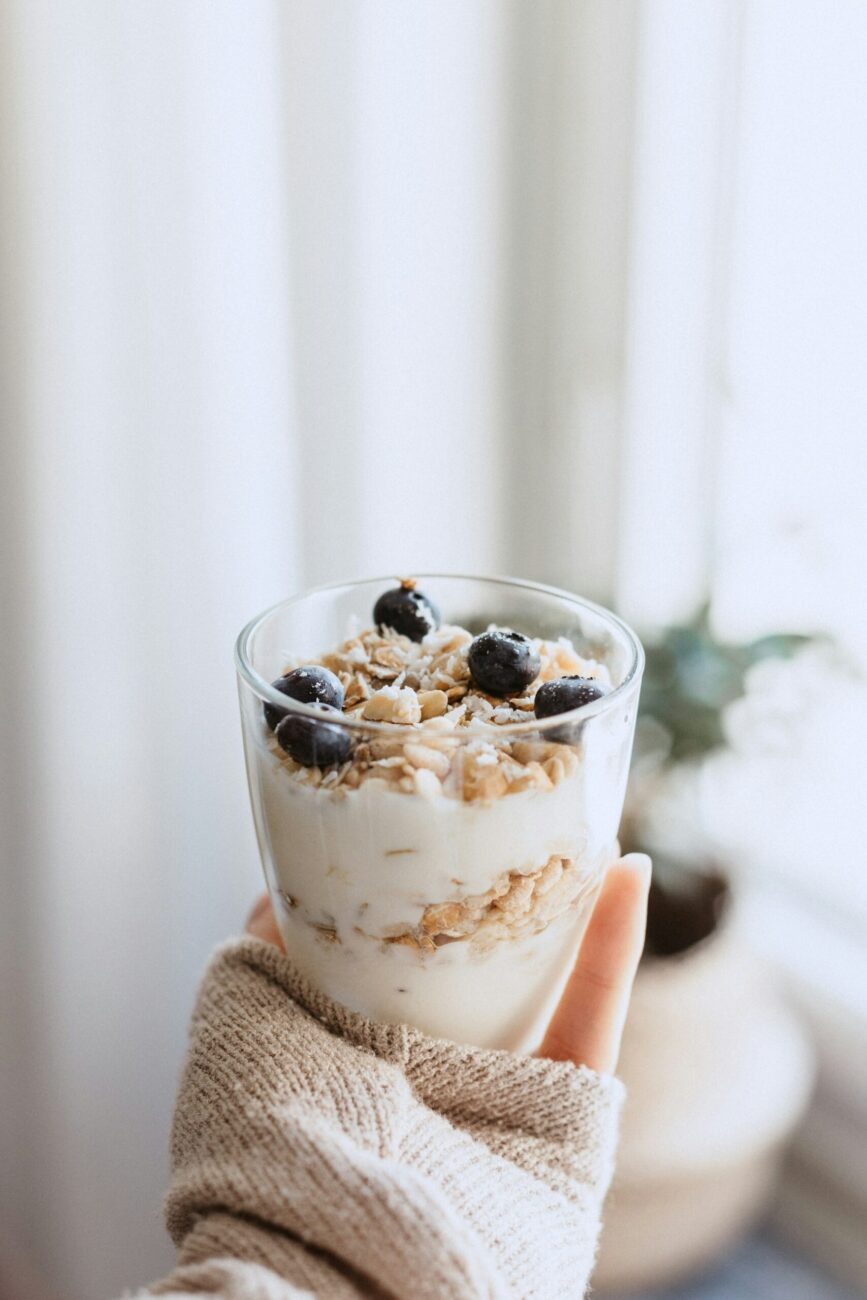
- Anything sweetened, whether it’s a flavor or a plain with cane sugar in the ingredients. A cup like this one, layered with granola and berries, is a people breakfast.
- Anything with chocolate. UC Davis lists chocolate among the foods to avoid, and our checker rates it Never. For the short list of foods that should never reach a flock, see what not to feed chickens.
- The thick coconut-cream style, at 16.1 grams of fat per 100 grams. The one in USDA’s database also lists orange juice, and Colorado State says to make sure scraps are “not salty or have citrus or are moldy”.
- Anything past its date or with mold on top. That same Colorado State line covers it.
Chicks get starter feed and water, not yogurt. If you’re raising young birds, our page on fruits and veggies for baby chicks covers when they can start on treats at all.
If a hen got into a whole tub, or she’s acting off afterward, call a vet who sees poultry. Colorado State says flock owners “must have an identified veterinarian in their area that can diagnose and treat chickens”. It’s worth finding one before you need one.
We aren’t vets, and nothing here replaces one.
Sources
- USDA FoodData Central: Yogurt, coconut milk (FNDDS 2707569), with Chobani’s coconut-blend Greek yogurt (SR Legacy 171260), whole-milk plain yogurt (171284) and raw coconut milk (170172) for the comparisons, plus the branded label entries for So Delicious (2639804, 2756467, 2756910), ShopRite (2175279), The Coconut Cult (2315053) and Liberté (2212558).
- Yuko Sato, Merck Veterinary Manual: Management of Backyard Poultry.
- Merck Veterinary Manual: Fatty Liver Hemorrhagic Syndrome in Poultry.
- Colorado State University Extension: Raising Poultry the Organic Way, Disease Control and Feeding.
- Maurice Pitesky and Nancy Reimers, UC Davis: Feeding your Flock.
- Wilmer Pacheco and colleagues, Alabama Cooperative Extension System: Feeding the Laying Hen (ANR-2913, 2022).
- P. E. Mozdziak and colleagues: Transgenic chickens expressing beta-galactosidase hydrolyze lactose in the intestine (Journal of Nutrition, 2003).
- O. Szylit and colleagues: Production of volatile fatty acids as a result of bacterial interactions in the cecum of gnotobiotic rats and chickens fed a lactose-containing diet (Reproduction Nutrition Development, 1988).
- Salma Gracela Gurning and colleagues: Effect of yogurt probiotic liquid and powder supplementation on hematology and biochemistry blood levels of layer-phase laying hens (Journal of Advanced Veterinary and Animal Research, 2024).
- A. S. Rosiyanti and colleagues: Effect of Lactic Acid and pH of Probiotic Yogurt on Peak Production of Laying Hens (Pakistan Journal of Biological Sciences, 2023).
- Rajesh Jha and colleagues: a systematic review of probiotics (direct-fed microbials) in poultry nutrition (Animals, 2020).
Sources checked October 28, 2026. The per-hen math and the fat and protein comparisons are mine, from these sources. So are the calls on which tubs to skip and when to see a vet. We aren’t vets. If a hen ate a whole tub, or she acts off, call a vet who sees poultry.
Related read: How to Raise Chickens for Eggs — Instant PDF download. Secure checkout by Stripe