You’d think a plant this common would come with a clear answer for chickens. It doesn’t. I couldn’t find a single poultry source that says yes or no. The ASPCA lists yarrow as toxic to dogs and cats, and to horses as well, but its list doesn’t cover birds. Two trials in Scotland mixed yarrow into broiler chicks’ feed, and in the first one it was among the best supplements for growth. Nothing I read says a few sprigs from your garden will hurt a healthy hen. So my call is a nibble now and then, counted as part of her treats. But yarrow isn’t a medicine. And the bigger risk here isn’t yarrow at all. It’s picking poison hemlock by mistake.
I rewrote this page from 18 sources, and they’re all listed at the bottom. The plant facts come from NC State Extension’s plant pages and the USDA Forest Service. Penn State Extension adds poison hemlock, and the ASPCA covers pets. The chicken numbers come from two broiler trials in British Poultry Science, plus Alabama and Colorado State extension. For the nest box idea I read four studies of wild birds’ nests. For hemlock I read two reports from Avian Diseases. Where something is my own math or my own call, I’ll tell you.
This page used to be full of stories. It opened with the writer pulling yarrow “to use in a herbal remedy for my seasonal allergies”, and the hens making “a beeline right for me”. Then came “Panicked visions of sick or even dead chickens” and a search of “dozens of backyard chicken forums and agricultural sites”. Later the hens got to “free range in a fenced backyard area”, and the yarrow got dried “in my garage or shed on screens”. I can’t vouch for any of it, so it’s all gone.
Some claims went too. The old page said “fresh yarrow is 100% safe and non-toxic for chickens”, and that “Yarrow contains no toxic compounds or substances that could cause illness or harm”. The ASPCA names yarrow’s toxic compounds, so that second line was simply wrong. The page also said flocks “self-medicate” with yarrow and that it would “fight off pathogens”. It said some keepers “swear by increased egg output” and see “richer orange yolks”. None of the sources I read backs any of that up.
The amounts went as well. The old page said to limit yarrow “to no more than 10% of their total feed ratio per day”. Then it worked that out as “up to 2-3 ounces of fresh yarrow leaves/flowers” for chickens eating a cup of feed a day. It also put dried yarrow in nest boxes, and suggested “probiotics or electrolytes” if a bird got an upset stomach. Chicken Rise doesn’t give doses, and none of that came with a source. The sections below say what the sources do say.
The short version.
- No poultry source rules on yarrow. The ASPCA calls it toxic to dogs and cats. Horses too. Its list doesn’t cover birds.
- The only chicken trials put yarrow in broiler chicks’ feed, for 3 to 6 weeks. No trial I found fed it to laying hens, and none looked at eggs.
- A nibble fits in your hen’s treats. The old page’s 2 to 3 ounces is about four to eight times her whole treat allowance for a day. That’s my math.
- Herbs in the nest box come from wild starlings, and the studies split. Yarrow didn’t cut parasites in starling nests.
- Poison hemlock and water hemlock can kill, and both grow where yarrow does. If you aren’t sure what you picked, don’t feed it.
- Pick yarrow you planted or know, and wear gloves when you cut it. NC State warns it can give you a skin rash.
No Poultry Source Rules on Yarrow

The first thing I looked for was anything a vet or a poultry scientist had written about yarrow and chickens. I didn’t find it. Merck’s veterinary page on poisonings in poultry doesn’t mention yarrow at all. Neither of NC State’s two yarrow pages mentions birds. The ASPCA’s plant list does have yarrow, but it rates plants for pets and horses, not for your chickens.
Here’s what the ASPCA does say. It lists yarrow, Achillea millefolium, as toxic to dogs and cats, and to horses as well. It names the toxic compounds too: “glycoalkaloids (achillein), monoterpenes, sesquiterpene lactones (achillin)”. And it lists the signs it can cause in those animals, from vomiting and diarrhea to drooling and a skin rash.
The USDA Forest Service’s plant database helps explain why you rarely hear about yarrow poisoning on farms. It says yarrow “is generally unpalatable, although domestic livestock and wildlife occasionally consume the flowers.” Cattle and horses mostly leave it alone. It carries volatile oils and alkaloids, among other things, but it “is not generally considered a toxic plant because it is so seldom consumed by livestock.” So when the Forest Service says it isn’t counted as toxic, that means animals rarely eat enough to find out. That’s my reading, and it isn’t the same thing as safe.
One wild bird does eat it, though. The same database says yarrow “is an important food of 4- to 8-week-old sage grouse chicks”. Sage grouse aren’t chickens. But it’s the only bird I found that eats yarrow out in the wild on a regular basis.
So here’s where I land. If your hens nibble the yarrow in your flower bed, nothing I read says to panic. I wouldn’t call it “safe and non-toxic” either, because no study I found has tested that in laying hens. The closest thing you’ve got is two trials in meat chicks, and that’s the next section.
The Only Chicken Trials Were in Broiler Feed

The chicken research I found comes from one team at the Scottish Agricultural College in Edinburgh. Cross and colleagues wrote up the first trial in British Poultry Science in 2007. They fed female broiler chicks from 7 days old to 28 days. One group got plain feed. Ten more got that same feed with one of five herbs or one of their essential oils added, and yarrow was one of the herbs.
Here’s the result in their words: “dietary thyme oil or yarrow herb inclusion had the most positive effects on chick performance, while oregano herb and yarrow oil were the poorest supplements.” So the herb itself did well, and the oil made from it did poorly. The paper also says the diets made no difference to the chicks’ gut bacteria.
In 2011 the same team ran a longer trial, from hatch to 42 days. Yarrow was one of eight diets again, and it changed the share of two fatty acids in the chicks’ ceca. But when the authors named the supplements that “appear suitable” for broiler feed, they picked garlic and a grapeseed extract. Yarrow wasn’t one of them.
So that’s the evidence for chickens. Two trials, both in meat birds raised for 3 to 6 weeks, with yarrow mixed into their feed at a set rate. No trial I found fed yarrow to laying hens, and none looked at eggs. That’s why the old page’s egg and yolk claims are gone. If you keep layers, you’re past what these trials can tell you. I’m leaving the trials’ amounts out on purpose, because this page doesn’t give doses.
A Nibble Fits, Two Ounces Doesn’t

Even a harmless green has to fit inside your hen’s treat budget. Alabama Extension says “A laying hen will consume between 100 and 150 grams of feed per day or roughly 0.25 pounds.” Colorado State says “Treats should make up no more than 10% of their daily diet.”
10 percent of 100 to 150 grams is 10 to 15 grams a day. That’s her whole treat allowance. Yarrow shares it with every scrap and mealworm you hand out.
Now the old page’s number. It allowed “up to 2-3 ounces” of fresh yarrow a day. Two ounces is about 57 grams, and three is about 85 grams. That’s roughly four to eight times her whole treat allowance, from one plant. My math, from Alabama’s and Colorado State’s numbers.
Alabama also says why it matters. Treats “should be used sparingly or not at all”, because “the birds will fill up on these incomplete feeds and not consume enough of the complete feed to sustain egg production or growth.” A hen full of greens has less room for the layer feed you bought for her.
So my call is a nibble. A sprig or a flower head now and then, from a plant you know, shared across your flock. Not a daily bundle, and not a pile left in the run. Colorado State’s rule for any treat is “Do not feed more than can be consumed in 5 – 10 minutes”, and that’s a good rule for yarrow too.
Our honey page runs the same treat budget for a sweeter extra. And if you want to check a kitchen food, our can chickens eat it checker covers a long list of them. It doesn’t rate yarrow, so for yarrow this page is my answer.
The Nest Box Idea Came From Starlings

The old page suggested dried yarrow as “nest box filler”. That idea didn’t start with chickens. It comes from wild birds, mostly European starlings, which tuck fresh green sprigs into their nests. Researchers have been testing why since the 1980s.
Clark and Mason reported in 1988 that starlings pick “fresh sprigs of particular plant species”. They found that wild carrot, one of the starlings’ picks, “effectively reduced the number of hematophagous mites” in nests. Those are the blood-sucking kind. The chicks in those nests had more hemoglobin in their blood, but they didn’t weigh any more.
Then the results split. Fauth and colleagues tested green nest material in starling nests in 1991, and wrote: “These results do not support the hypothesis that starlings use green nesting material to control nest ectoparasites.” They suggested the greenery is about winning a mate instead. In 2000, Gwinner’s team swapped 148 starling nests for artificial ones, half with herbs and half with grass. The parasite loads “in herb and control nests were indistinguishable”, though the chicks in herb nests weighed more.
Yarrow itself came up in a 2025 study of great tits in Poland. Glądalski and colleagues put a mix of herbs, yarrow among them, into the birds’ nests. Looking back at the earlier work, they wrote that “the use of common yarrow Achillea millefolium had no effect in European starling nests”. They also wrote that “the large body of research on the influence of fresh plant material on nest ectoparasites generally does not strongly support the nest protection hypothesis”. In their own tit nests, ticks turned up less often and the chicks’ blood counts were higher. But just as many chicks made it out of the nest.
Every one of those studies was in wild birds’ nests. None was in a hen’s nest box. So I can’t tell you yarrow keeps mites off your hens. If you’re worried about mites or lice, our lice page explains how you tell them apart with a flashlight after dark. It also covers what the vet guides say to treat them with.
Yarrow or Poison Hemlock? Check Before You Pick

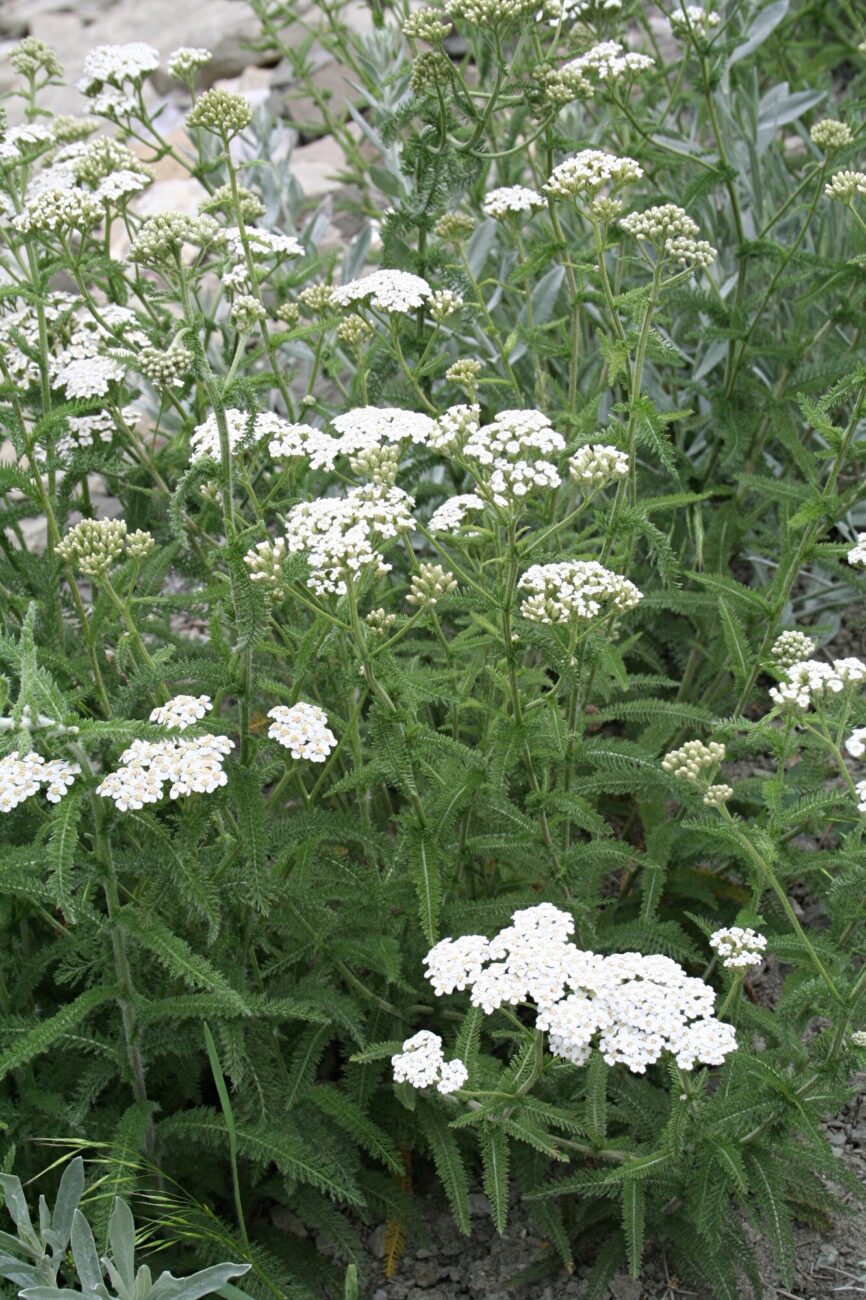
This is the part I’d want you to read twice. Both plants have white flowers in clusters over finely cut leaves. Both grow on rough ground by the road, too. NC State says yarrow “is found in disturbed areas as fields and roadsides”. It says poison hemlock “is found growing in disturbed areas, at roadsides”, and along fences and ditches as well. So the two can grow side by side. That’s my reading of NC State’s two pages, and it’s the reason for this section.
Here’s how NC State tells them apart.
- Height. Yarrow “will grow 1 to 3 feet tall”, and the Forest Service puts it at 11 to 40 inches. Poison hemlock “grows 6 to 10 feet tall”.
- Flowers. Yarrow’s tiny whitish flowers sit in “flat-topped corymbs in dense heads”. Poison hemlock’s white flowers come in “terminal umbrella-like clusters”. You can see the spokes in the photo above.
- Leaves. Yarrow’s are “fern-like in appearance”, soft and feathery. Poison hemlock’s “resemble parsley”.
- Stems. Poison hemlock’s stem is hollow and spotted. Penn State calls its purple spots “very distinctive”. Crush it and NC State says you’ll get a “foul odor”.
The tricky time is spring. NC State says poison hemlock “emerges from the soil with a basal rosette of fine-textured ferny leaves.” Yarrow keeps a low clump of leaves too, and the Forest Service says it “may remain green throughout the winter”. Before either one flowers, you’re comparing two low clumps of ferny leaves. That’s my reading, and it’s why I wouldn’t pick a leafy clump I hadn’t seen in flower.
And poison hemlock is a real danger to poultry. Penn State says “All parts of poison hemlock are toxic to humans and other animals.” Back in 1987, Frank and Reed described a flock of range turkeys with a history of drooling and tremors. Some birds were paralyzed, and more were dying than usual. Poison hemlock seeds turned up in the turkeys’ crops and gizzards. The birds got better once they were moved off the range, which was full of hemlock.
In a 1990 follow-up, the same two researchers gave coniine, a poison from hemlock, to young chickens. At the highest of their three doses, all ten chickens died. So my rule is simple. If a plant is head-high, it isn’t yarrow. If its stem is spotted, it isn’t yarrow either. And if you can’t tell, don’t feed it to your hens.
Common Yarrow and Woolly Yarrow Aren’t the Same Plant

The old page said “chickens can safely consume all types of yarrow due to their similar chemical makeup”. It gave no source. And the names make that harder than it sounds.
Common yarrow, Achillea millefolium, goes by a lot of names. NC State lists milfoil and thousandleaf among them, plus soldier’s woundwort. The Forest Service lists western yarrow, and “wooly yarrow” too. NC State says the species name “comes from the featherlike leaves”.
But NC State’s Woolly Yarrow is a different plant, Achillea tomentosa. It’s “native to southern Europe and western Asia”. It’s short, too: it “reaches 6-8 inches high”, and its flowers are yellow. So if your plant tag says woolly yarrow, you’ll want to check the Latin name. The ASPCA’s page is about common yarrow, and I found nothing at all on woolly yarrow and chickens.
Even common yarrow isn’t one tidy thing. The Forest Service says North America has “both native and introduced phases” of it, and they “are difficult to distinguish morphologically”. That means you can’t tell them apart by looking. NC State’s page tags it with white and pink flowers, plus red and yellow ones, so color won’t tell you much either.
My take is this. If you share any yarrow with your hens, make it plain Achillea millefolium that you know by name, from a plant you put in yourself.
Pick From Your Garden, Not the Ditch

The old page said wild and garden yarrow were both “safe options”, as long as nobody had sprayed them. I’d go further than that. Pick yarrow from your own garden, not from the roadside.
Here’s why. Roadsides and ditches are where the deadly look-alikes grow. Spotted water hemlock is in the photo above. NC State’s page on it says “HIGHLY TOXIC, MAY BE FATAL IF EATEN!” It lists its sites as “Wet meadows, thickets, fresh water swamps, roadside ditches, floodplains”. It says every part is poisonous, with the roots the worst. And its stems are hollow, striped or mottled with purple.
Water hemlock’s flowers are white umbrellas too. Its leaflets have teeth, nothing like yarrow’s soft feathery leaves. That’s my comparison, from NC State’s two plant pages. But in a ditch full of weeds, I wouldn’t trust a quick look. And on a roadside you usually can’t know what’s been sprayed.
A couple more things for you. NC State says to “wear gloves to prevent contact dermatitis” with yarrow, so keep gloves on when you cut it. And if one of your birds starts drooling or trembling, or can’t stand, after time out where hemlock grows, don’t wait. That’s what the poisoned turkeys looked like. Call a vet who sees poultry.
For another wild plant you might find in your run, our fern page covers bracken. And our list of what not to feed chickens covers the kitchen side.
So, can chickens eat fresh yarrow? Nothing I read says a nibble from a plant you know will hurt a healthy hen, though no study I found tested it in layers. Count it as a treat, not a remedy. And make sure it’s yarrow before it goes anywhere near your flock.
Sources
- ASPCA Animal Poison Control: Yarrow.
- NC State Extension Gardener Plant Toolbox: Achillea millefolium.
- NC State Extension Gardener Plant Toolbox: Achillea tomentosa (Woolly Yarrow).
- Aleksoff, USDA Forest Service Fire Effects Information System (1999): Achillea millefolium.
- Merck Veterinary Manual: Poisonings in Poultry.
- Cross and colleagues, British Poultry Science (2007): herbs and their oils in broiler chicks from 7 to 28 days.
- Cross and colleagues, British Poultry Science (2011): herbs as supplements for broilers to 42 days.
- Alabama Cooperative Extension System: Feeding the Laying Hen (ANR-2913).
- Colorado State University Extension: Raising Poultry the Organic Way.
- Clark and Mason, Oecologia (1988): plants in starling nests and nest mites.
- Fauth and colleagues, Oecologia (1991): green nesting material in the European starling.
- Gwinner and colleagues, Animal Behaviour (2000): green plants in starling nests.
- Glądalski and colleagues, Behavioral Ecology (2025): aromatic plants in great tit nests.
- NC State Extension Gardener Plant Toolbox: Conium maculatum (Poison Hemlock).
- Penn State Extension: Poison Hemlock.
- NC State Extension Gardener Plant Toolbox: Cicuta maculata (Water Hemlock).
- Frank and Reed, Avian Diseases (1987): poison hemlock in a flock of range turkeys.
- Frank and Reed, Avian Diseases (1990): coniine in young chickens and other poultry.
Sources checked October 30, 2026. The treat math is mine, from the Alabama and Colorado State numbers above. So are the calls on how much to share and where to pick it. We aren’t vets. If a bird looks sick or hurt, call a vet who sees poultry.
Related read: How to Raise Chickens for Eggs — Instant PDF download. Secure checkout by Stripe