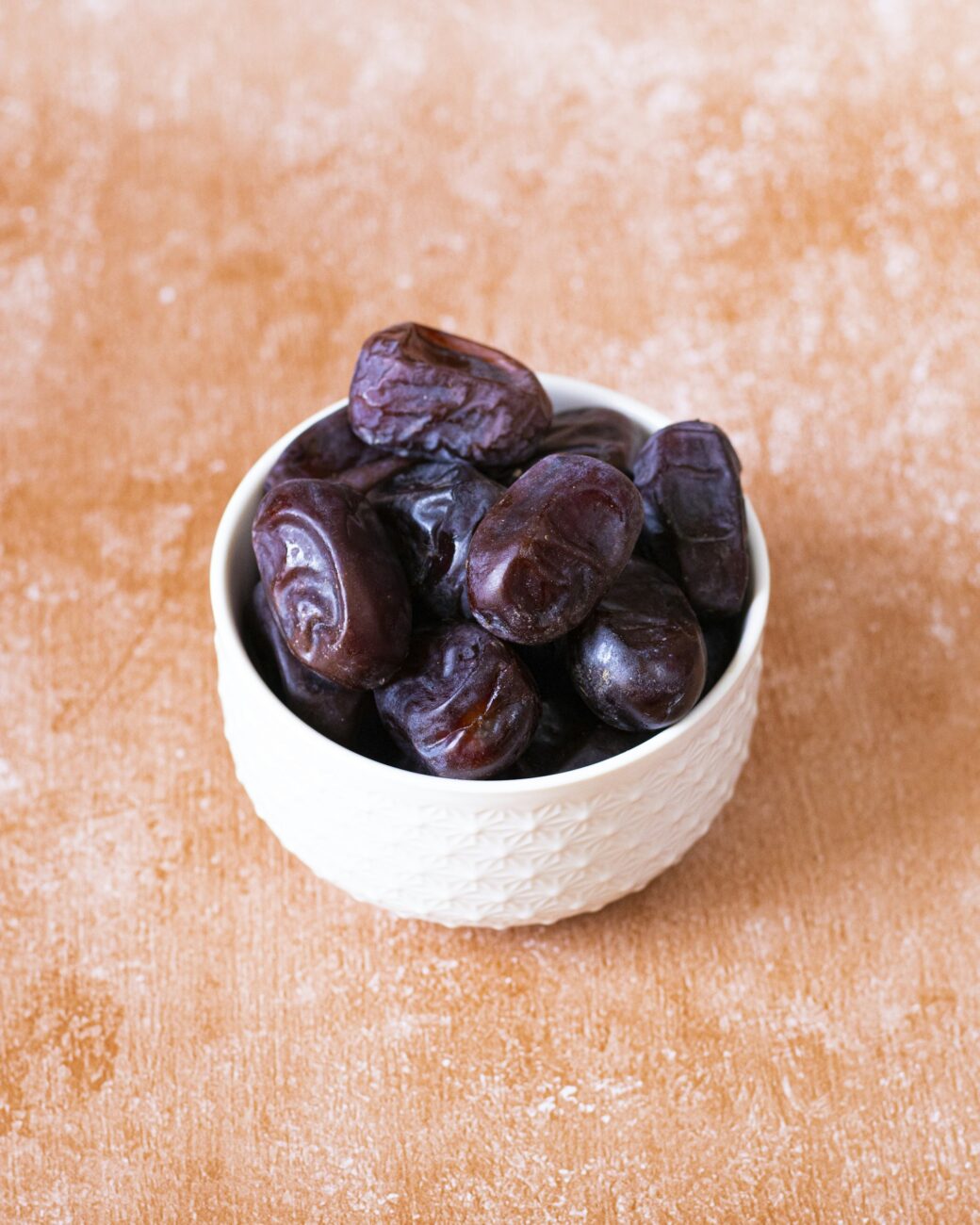
Yes, your hens can have a few diced dates from a bag rolled in rice flour. That white dusting? It’s just ground rice. It keeps the sticky date pieces from clumping in the bag, and it’s only a small share of what’s inside. So you can treat the bag like plain dates. A pinch, not a scoop. I’d skip any bag coated in dextrose, though, since dextrose is a sugar.
Bars and cookies made with dates and rice flour are a different story. I’d keep those well away from your flock.
- The coating is ground rice. Nearly everything you pour out of the bag is date.
- Read the ingredients line. Some bags are rolled in dextrose instead, and some may use either coating.
- Rice flour is thin on protein and calcium. White rice flour has about 6 grams of protein and 10 milligrams of calcium in 100 grams. Layer feed should have 16 percent protein or more and 3 to 4 percent calcium.
- A tablespoon goes a long way. A level tablespoon of diced dates weighs about 9 grams, most of one hen’s treats for a whole day.
- Keep the bakes out. A bar or cookie with butter, oil, sugar or chocolate in it is people food.
Why Diced Dates Come Rolled in Rice Flour

Dried dates are sticky. Really sticky. Chop them into bits and the bits want to glue themselves right back into one lump. So packers roll the pieces in a light coat of rice flour to keep them apart, and then the bits pour freely into a recipe. That’s the white dust you see on date bits from the baking aisle or the bulk bin.
Flip the bag over. The label usually reads just “dates, rice flour,” whether the dates are Deglet Noor or Medjool. Where the split is printed, dates make up 90 to 95 percent and the flour the rest. So nearly everything you pour out is date.
Not every bag uses rice flour, though. Some fine-cut date bits are coated with dextrose instead. Others list “dextrose powder or rice flour,” so the bag alone won’t tell you which one you got. Dextrose is purified glucose. Plain sugar. When it’s made from corn, it can go on a label as corn sugar.
Dates are already mostly sugar, so a dextrose coat just piles on more. If you’ve got the choice, I’d grab the bag that lists only dates and rice flour.
What Rice Flour Brings to a Hen

Rice flour is rice ground fine, and it’s mostly starch. White rice flour has about 80 grams of carbohydrate in 100 grams, with about 6 grams of protein, 1.4 grams of fat and 10 milligrams of calcium. Brown rice flour is a bit richer, at about 7 grams of protein and 11 milligrams of calcium.
Now hold that up against your hen’s feed. A complete layer feed should have 16 percent protein or more, plus 3 to 4 percent calcium. Rice flour comes in at about 6 to 7 percent protein. Its calcium? A few hundred times lower than the feed’s. A laying hen needs plenty of calcium from her feed, since her eggshell is about 96 percent calcium carbonate.
None of that makes rice a bad food for chickens, mind you. Broken rice, which also gets milled into rice flour, is a real energy feed for poultry. It’s typically more than 80 percent starch on a dry basis, and it seems to come close to corn in energy, though it’s less studied in poultry than other grains. Laying hens have done about as well with broken rice in place of corn, though their yolks came out paler.
So the dusting on a date bit won’t hurt your hen. There’s so little of it that it barely counts anyway.
Hens Pick Coarse Bits Over Fine Flour

Flour is about as fine as anything you could offer a chicken, and laying hens are choosy about texture. They go for the bigger particles in their feed first. That pickiness gets stronger as they age. When feed has too many fines, those tiny bits slip through the gizzard fast with no grinding needed, and that kind of feed is linked to a smaller gizzard and a shorter gut.
That’s why I wouldn’t set out a dish of rice flour for a flock, or stir any into the feeder. Mash is generally a mix of coarse and fine bits. The fine part usually carries the added amino acids, phosphorus, vitamins and trace minerals, and a hen that fills up on the big pieces can come up short on those. Too many fines is a known fault in layer feed. Extra flour just makes it worse.
The flour stuck to a few date bits is a different matter. It rides along on the fruit, and your hen eats it with the date.
How Much of the Bag Is One Hen’s Share

Treats, all of them together, should make up no more than 10 percent of what your hen eats in a day. A laying hen eats 100 to 150 grams of feed a day. So her treat room is about 10 to 15 grams. That’s not much.
A cup of chopped Deglet Noor dates weighs about 147 grams. A tablespoon is a sixteenth of a cup, so a level tablespoon of date bits comes to about 9 grams. That’s most of one hen’s treats for the day, before you’ve tossed out any greens or scratch. I’d split a tablespoon among three or four birds and call it done.
The rice flour in that tablespoon? Only about half a gram to a gram. It’s the date that counts. A dried date is mostly sugar and carries little protein or calcium, and our dried dates page walks through what that means for your laying hen. If your bag is coated in dextrose, I’d give even less.
Date Bars and Other Bakes Made With Rice Flour

Diced dates rolled in rice flour are made for mixing into recipes. Once they’re baked into something, though, you’re dealing with a whole different food.
Chickens don’t need much fat, so I’d skip fatty foods. Fat scraps in particular are tied to fatty liver, which can end in sudden death when the liver ruptures. That’s no small thing. Among the causes of death in backyard chickens that aren’t infections, fatty liver hemorrhagic syndrome is a leading one. It goes with eating more energy than a bird burns, from any source, in birds that don’t get much exercise.
Chocolate belongs on the never list for chickens. Salty and moldy scraps are out too. So if a bar or cookie has butter, oil, sugar, salt or chocolate in it, it’s people food. Give your birds the plain bits from the bag and keep the plate of bars for yourself.
How to Serve Diced Dates

Shake a small pinch into your palm or onto a plate, and scatter it in the run. The bits come pitted and small, so you don’t need to chop a thing. A bag can still hold a stray bit of pit, though, so give your pinch a quick look. Give only what your birds will clean up in 5 to 10 minutes, then pick up whatever’s left. Leftover treats can draw nuisance animals to the run. Damp leftovers can grow mold, too.
Don’t mix date bits into the feeder. Complete feed is made to be your flock’s whole diet. Even scratch grains mixed into it only dilute the nutrients your birds need, and date bits would do the same thing.
Keep the bag sealed and dry, and toss any pieces with mold on them. Moldy feed and bedding are a known route for mycotoxins in poultry.
Chicks wait. Give them starter and nothing else for at least the first two weeks, and better yet, keep pullets on complete starter alone until they’re 6 weeks old. Foods flavored with sugar stay out of the brooder either way, and a dextrose-coated bag is sugar on sugar. I’d save date bits for your grown birds. If you want a plain grain for pullets that are old enough for extras, our page on rice for baby chicks covers it.
Wondering about something else from your pantry? Try our food checker, or see our list of what not to feed chickens.
Sources
- Country Life Natural Foods: Dates, Chopped, Rice Flour.
- Bulkfoods.com: Chopped Dates.
- Nuts.com: Diced Medjool Dates.
- Yupik: Organic Deglet Nour Diced Dates.
- Yupik: Diced Dates.
- Honest to Goodness: Organic Diced Dates.
- Morrisons: Whitworths Chopped Dates 250g.
- Nuts in Bulk: Product Specification, Chopped Dates.
- Shields Date Garden: Fine Diced Dates With Dextrose.
- 21 CFR 168.111, Dextrose monohydrate (Cornell Legal Information Institute).
- 21 CFR 101.9, Nutrition labeling of food (Cornell Legal Information Institute).
- USDA FoodData Central: Rice flour, white, unenriched (FDC ID 169714).
- USDA FoodData Central: Rice flour, brown (FDC ID 168898).
- USDA FoodData Central: Dates, deglet noor (FDC ID 171726).
- Wilmer Pacheco, Joseph Gulizia and Kevin Downs, Alabama Cooperative Extension System: Feeding the Laying Hen (ANR-2913).
- Heuzé V., Thiollet H., Tran G., Edouard N., Lessire M. and Lebas F., Feedipedia: Broken rice and polished rice.
- Hendrix Genetics: The importance of feed particle size in laying hen diets.
- Hy-Line International, The Poultry Site: Feed granulometry and the importance of feed particle size in layers.
- Howard Enos, Colorado State University Extension: Raising Poultry the Organic Way, Disease Control and Feeding.
- Maurice Pitesky and Nancy Reimers, UC Davis and UC Cooperative Extension: Feeding your Flock.
- Merck Veterinary Manual: Management of Backyard Poultry.
- Merck Veterinary Manual: Fatty Liver Hemorrhagic Syndrome in Poultry.
- Merck Veterinary Manual: Mycotoxicoses in Poultry.
- Cackle Hatchery: What to Feed Baby Chicks.
Sources checked November 17, 2026. We aren’t vets. If a bird looks sick, call a vet who sees poultry.
Related read: How to Raise Chickens for Eggs — Instant PDF download. Secure checkout by Stripe