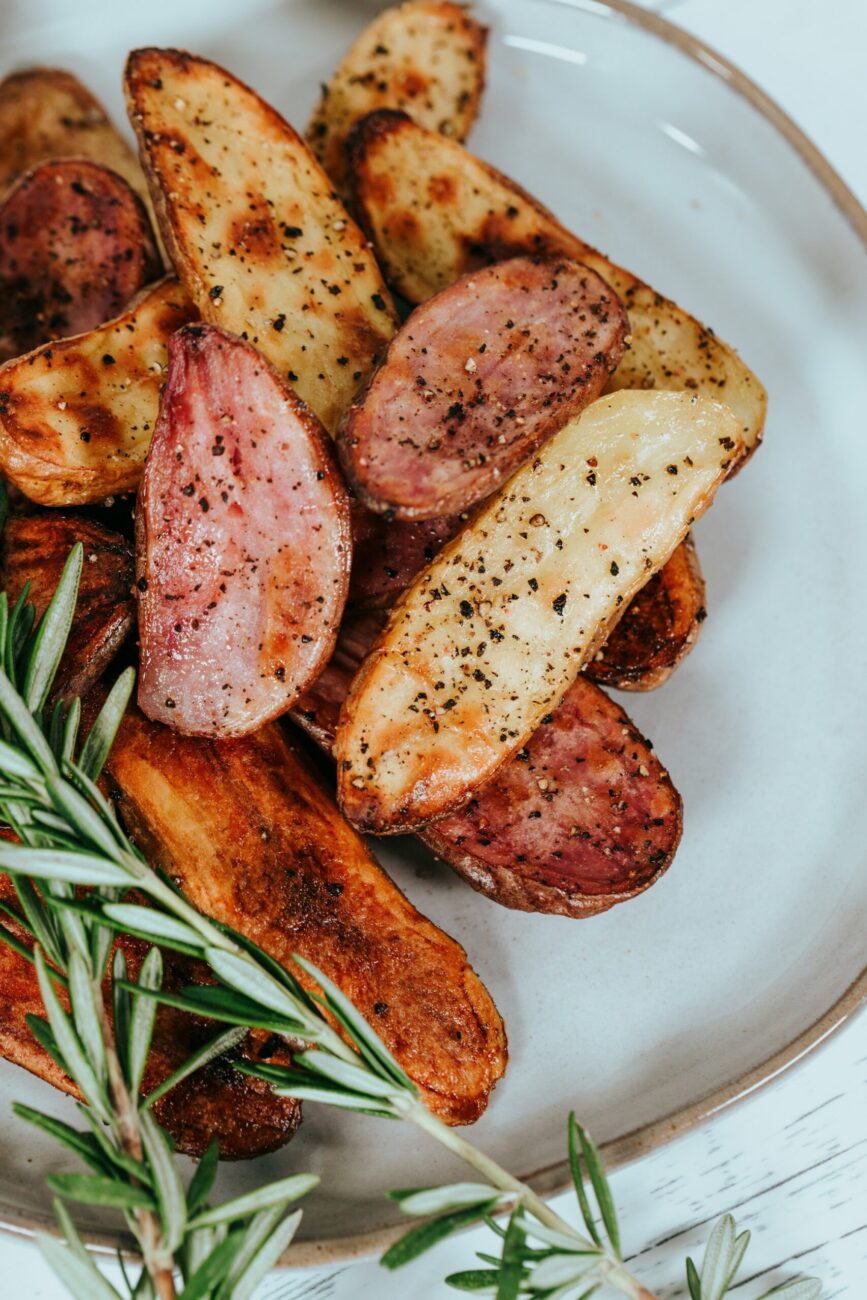
Skip the seasoned ones. Seasoned fries and wedges come coated in salt and oil, and most of those bagged seasonings throw in garlic or onion on top of that. Your grown hens can have a little plain cooked potato, though, as long as it’s peeled and has nothing green on it. So set a few plain pieces aside for them before you season the pan. And if a hen snatches one fry off the patio? With water nearby, that’s not an emergency.
What’s Really on a Bag of Seasoned Fries

Turn over a bag of frozen seasoned fries and you’ll see the potato is only the first word. Vegetable oil comes right behind it, then a flour or starch coating, with salt further down.
And the seasoning itself? That’s usually where the garlic hides, as garlic powder, dehydrated garlic or granulated garlic, with onion often riding along. Market Pantry’s shoestring fries even have cocoa powder in the “2% or less” part of the label.
Then there’s the sodium. A 3-ounce serving from those bags has 310 to 590 milligrams before anybody shakes on more. That’s 369 to 694 milligrams in every 100 grams.
Roasting your own doesn’t get you off the hook once you salt the pan. Salted roasted potatoes come in around 156 to 166 milligrams of sodium per 100 grams. Salted potato chips come in at 527, fast-food fries at 210.
The oil adds up the same way. Those bags carry 3 to 9 grams of fat in a serving, fast-food fries are about 15 percent fat by weight, and salted chips are about a third fat.
The inside of a plain baked potato? Five milligrams of sodium per 100 grams and a tenth of a gram of fat. Next to nothing.
What the Salt and Oil Mean for One Hen

Start with what your hen eats. A grown laying hen should eat no more than about a quarter pound of feed a day, roughly 100 grams, and all of her treats put together should stay at 10 percent of her diet or under. Call it about 10 grams of treats a day.
Her feed already carries salt. The usual recommendation for a chicken ration is half a percent salt, and table salt is a little under 39 percent sodium, so 100 grams of feed at that rate holds about 190 milligrams of sodium.
Now say you hand her the whole 10 grams as wedges from the saltiest of those bags. That piles about 69 more milligrams onto her day, a third on top of what her feed already gives her. Salted chips would add about 53. And you’d get there fast: in the bags that count their pieces, one fry weighs about 4 to 6 grams.
Two fries and she’s done for the day.
None of that is going to poison her if she’s got water, mind you. Salt poisoning is unlikely as long as her body can regulate sodium and fresh water’s there, and chickens can even handle up to a quarter percent salt in their drinking water. Where it often goes wrong is when your water runs short. Think of a waterer that froze overnight in winter, a broken one, or too many birds crowding one drinker.
That doesn’t make salty fries good feed, though. More than 2 percent salt in a ration is usually considered dangerous, and the saltiest bag works out to about 1.8 percent once you count all its sodium as salt, so a hen that filled up on those wedges would be eating pretty close to that line. The oil’s no better. Fat scraps can give a hen a fatty liver, and a fatty liver can rupture and kill her suddenly. Keep both out of the treat bucket.
Chicks are touchier still. Birds under 3 weeks old can’t get rid of sodium as well as older ones (their kidneys aren’t fully developed yet), so keep every bit of this out of your brooder.
Too much salt shows up as extra thirst and hard breathing, with watery droppings and wet litter. If you see that after your hens got into something salty, take the food away and call a vet who treats poultry. There’s no specific treatment, and the water has to come back slowly, a little at a time.
Garlic and Onion Ride Along in the Seasoning

Onion and garlic are close cousins, both alliums. Eat enough of either and an animal’s red blood cells start breaking down, which leaves it anemic. Farm animals fed onions have gotten sick this way. Raw, cooked or dried down to a powder, any form can do it. In dogs and cats, the concentrated stuff, like dried flakes and powders, is the most common culprit. Garlic is the stronger of the two, about 3 to 5 times as toxic as onion.
For your hens, a lot of onion can damage red blood cells and may cause anemia. Too much may even change how the eggs taste.
A dusting of powder on a couple of fries is a small amount, and a little onion usually isn’t harmful. Garlic hits harder, though, and there’s just no reason to hand either one out. So the garlic-and-herb wedges stay on your plate, and the rest of the onion question is in our post on onions and tomatoes for chickens.
Green Spots and Sprouts Don’t Cook Out

Under all that seasoning, the potato has a catch of its own. Potatoes make natural toxins called glycoalkaloids, mostly solanine and chaconine. The flesh of a normal potato carries a little. The peel holds about 3 to 10 times as much.
Light pushes it up. A potato left in the light long enough can turn green, and while the green itself is chlorophyll, the toxins climb right along with it. Sprouts and green peel load up a lot more when they sit in the light somewhere warm. Animals have been poisoned eating peelings and sprouts from old potatoes left in the sun; they trembled and staggered, had diarrhea, and some went into convulsions or died suddenly.
Here’s why that matters for your leftovers. Cooking doesn’t fix it. Baking, frying, the microwave: none of them break glycoalkaloids down. Boiling lowers them by about a fifth, and some of that ends up in the water, so pour the water off. It won’t save a green one, though. A roasted wedge with a green edge is still a green potato.
The plant is worse.
Its sprouts and stems carry solanine, and so do its leaves and berries and any green skin on the tubers. So don’t toss the vines over the run fence when you dig the bed.
The flesh of a plain cooked potato is a different story, and it’s generally safe for a grown hen in moderation. Cook it first, though. Raw potato carries a protease inhibitor that makes its protein hard to digest, and heat takes care of that.
How to Share Potatoes With Your Flock

Pull a few pieces out for your hens before the oil and seasoning go on. Boiled or baked, either one works. If you boil them, tip out the water.
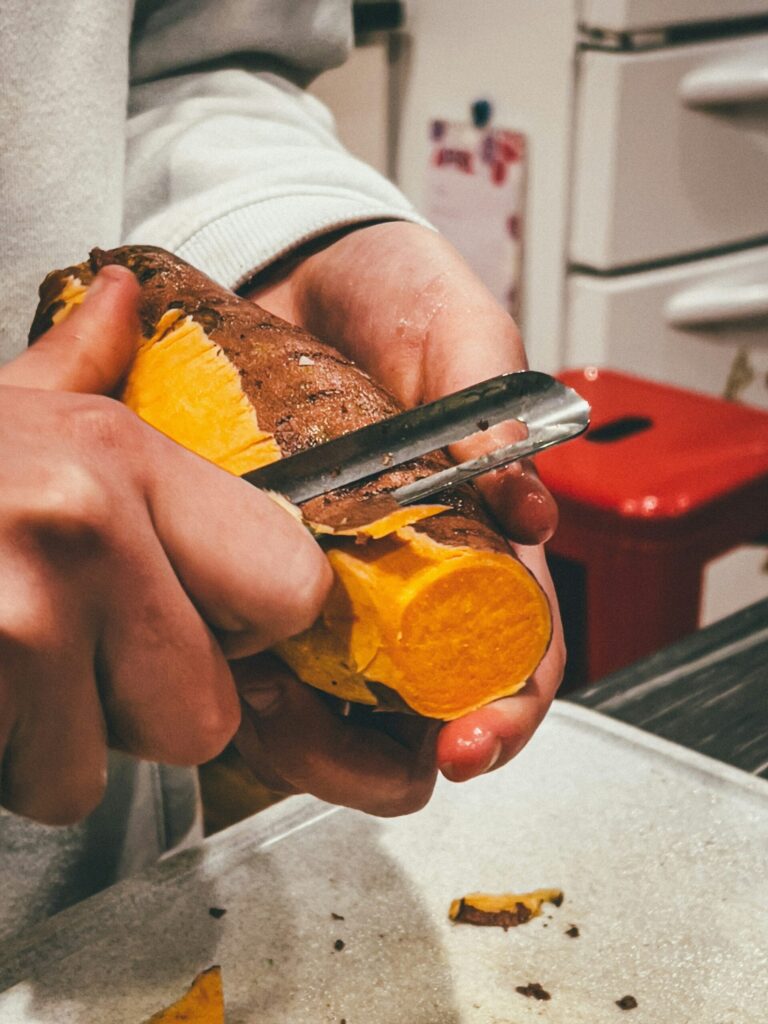
Peel them, and if there’s any green under the skin, skip that potato. Same goes for one that’s sprouted or gone soft, and anything moldy. Honestly, if you wouldn’t eat it, they don’t get it either.
Keep it small. The flesh of one baked potato about 2⅓ inches across and 4¾ inches long weighs around 156 grams, and that’s the whole day’s treat share for about 15 hens. That’s every treat they get that day (the mealworms count too), not extra on top.
Put out only what your flock cleans up in 5 to 10 minutes, so you don’t draw nuisance animals to the run.
For the rest of your scrap bucket, our list of what not to feed chickens has the short version. Got sweet potatoes instead? They have their own page.
Sources
- USDA FoodData Central: Checkers Rally’s Famous Seasoned Fries (branded label).
- USDA FoodData Central: McCain Savory Herbs & Spices Seasoned Potato Wedges (branded label).
- USDA FoodData Central: Ore-Ida Bold & Crispy Roasted Garlic & Herbs Homestyle Wedges (branded label).
- USDA FoodData Central: Meijer Seasoned Fries (branded label).
- USDA FoodData Central: Market Pantry Shoestring Seasoned Fries (branded label).
- USDA FoodData Central: Red Robin Seasoned Steak Fries (branded label).
- USDA FoodData Central: Potato, roasted, from fresh, peel eaten, no added fat.
- USDA FoodData Central: Potato, roasted, from fresh, peel eaten, made with oil.
- USDA FoodData Central: Potato, roasted, NFS.
- USDA FoodData Central: Snacks, potato chips, plain, salted.
- USDA FoodData Central: Fast foods, potato, french fried in vegetable oil.
- USDA FoodData Central: Potatoes, baked, flesh, without salt.
- USDA FoodData Central: Salt, table.
- Merck Veterinary Manual (Yuko Sato, DVM): Management of Backyard Poultry.
- Merck Veterinary Manual (Carmen Jerry, DVM): Poisonings in Poultry.
- Merck Veterinary Manual (Larry J. Thompson, DVM, PhD): Salt Toxicosis in Animals.
- Merck Veterinary Manual (Cristine Hayes, DVM): Garlic and Onion (Allium spp) Toxicosis in Animals.
- UF/IFAS Extension Holmes County: 10 Foods You Should Never Feed Chickens.
- Colorado State University Extension: Raising Poultry the Organic Way: Disease Control and Feeding.
- Purina Animal Nutrition: Chicken Treats: Are They Good for My Laying Hens?.
- Feedipedia: Potato (Solanum tuberosum) tubers.
- WHO Food Additives Series 30: Solanine and chaconine.
- NC State Extension Gardener Plant Toolbox: Solanum tuberosum.
Sources checked November 15, 2026.
Related read: How to Raise Chickens for Eggs — Instant PDF download. Secure checkout by Stripe