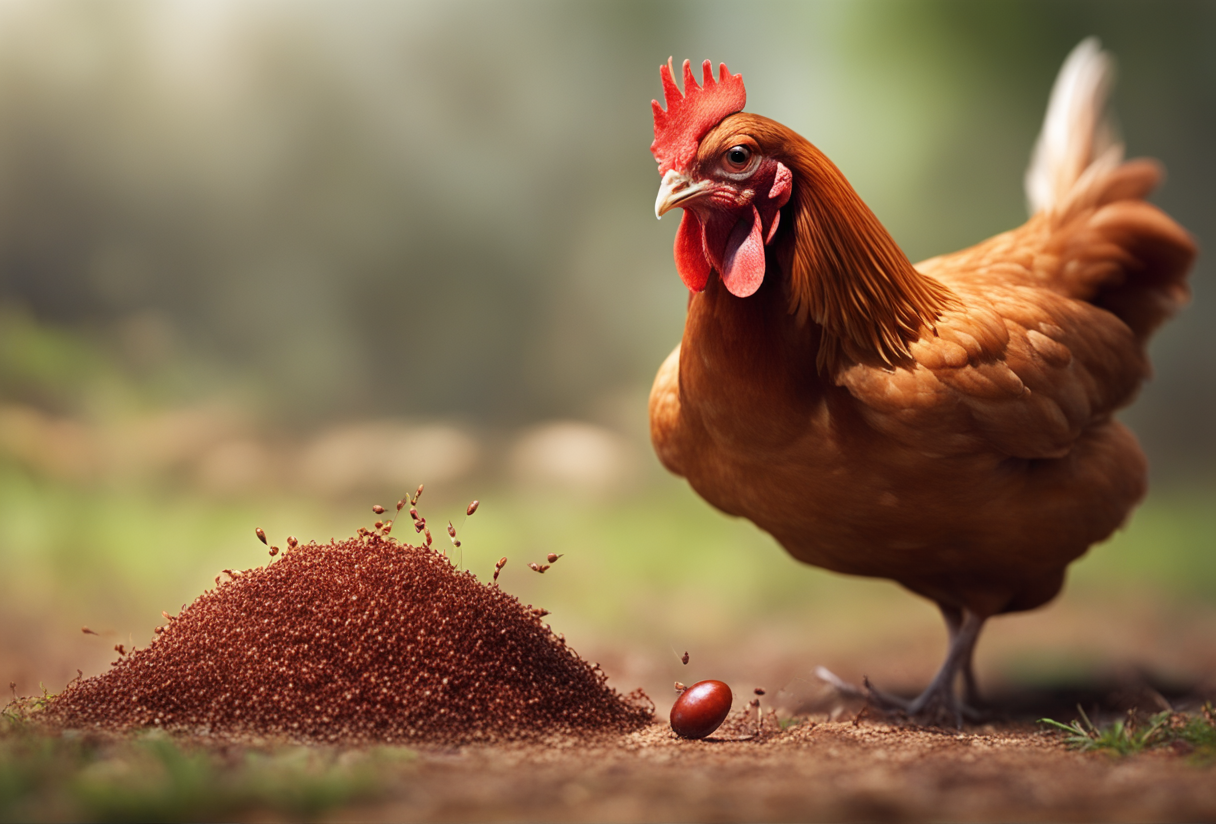
A keeper in Central Texas let her flock onto a fire ant mound three days after hitting it with Ortho Fire Ant Killer granules. Two hens dead inside 48 hours. Her vet confirmed bifenthrin toxicity and handed her a $340 invoice for the privilege. I think about that story every single time someone in a Facebook group says “just let your chickens at the mound, they love it.” They do love it. That’s not the problem.
Yes, Chickens Eat Fire Ants — Here Is What the Protein Math Actually Looks Like
Fire ants are real food. A single worker runs 40–48% crude protein by dry weight, which is competitive with black soldier fly larvae if you’re the kind of person who reads those comparisons. Free-range foraging studies have documented chickens eating 14 different ant genera willingly, no coaxing needed. My rooster, who hates everything including me, will hustle across the yard for an exposed ant column.
The venom angle gets overstated constantly. Solenopsin alkaloids — the compounds in fire ant venom — break down in the digestive tract. Eating an ant is not the same as being stung by one. A lot of content online mixes those two things up and makes fire ants sound uniquely toxic to eat. They aren’t.
But here’s the number that actually matters: colony density. A mature fire ant colony holds 100,000 to 500,000 workers. Individual workers weigh 1–2 mg each. Eating a few dozen ants is fine. Scratching into a mound with 300,000 workers per square foot is not a foraging opportunity — it’s a contact event. The “chickens love fire ants” framing buries this completely. Volume is what creates sting load. Not the act of eating one ant.
The Chemical Mound Problem Nobody Warns You About
This is the part that actually kills birds, and almost nobody covers it.
Most consumer fire ant products in the US contain bifenthrin, hydramethylnon, or spinosad. They are not the same. Bifenthrin — found in Ortho Fire Ant Killer and Hi-Yield Bifenthrin — carries a 12-hour re-entry interval for humans. For poultry? Most consumer labels don’t list one. That gap isn’t accidental. Bird metabolic pathways for pyrethroids differ meaningfully from mammalian ones, and “pet-safe after dry” language on ant products refers to mammals. Cats and dogs. Not birds.
The EPA puts bifenthrin in toxicity category II for birds. The LD50 in bobwhite quail is 1,800 mg/kg, which sounds reassuring until you factor in chronic low-dose exposure — that disrupts laying. A hen walking through treated granules and then preening isn’t getting an acute lethal dose. She’s getting a little bit, repeatedly. Her production will quietly slide before you connect the dots.
Hydramethylnon (Amdro) is moderately toxic to birds at 28 mg/kg and breaks down in sunlight within 1–2 weeks. Better. Still not something I’d apply three days before rotation.
Spinosad is honestly the only product I’d use anywhere near my foraging zone. Ferti-lome Come and Get It and Monterey Fire Ant Bait are both spinosad-based and OMRI-listed, and they carry a 0-day pre-harvest interval for poultry areas when applied as directed. That’s the standard every fire ant product near chickens should be held to. Most fall well short of it.
My conservative number: wait a minimum of 14 days after any synthetic pyrethroid granule application before chickens go onto treated soil. I’d go longer if we’d had rain that could drive residue deeper. Recommending a pyrethroid product to a chicken keeper without that specific window is irresponsible advice, full stop.
How Big a Colony Can a Flock Actually Handle Without Getting Hurt
Size matching is the conversation the internet skips straight past.
A mature RIFA mound — the classic dome you see in a Southern lawn — covers 18–24 inches in diameter, rises 12–18 inches, and holds roughly 200,000 to 300,000 workers. Six adult hens on that mound is not pest control. It’s a bad day for your chickens. The colony mobilizes faster than your birds can eat through the surface layer, and soft tissue damage follows quickly.
Veterinary case reports flag eye and comb tissue as the highest-risk sting sites. Soft, highly vascular, exposed. I’ve seen photos of periorbital swelling bad enough to close an eye within two hours of heavy exposure. Two hours. By the time you notice your hen squinting, the damage is already done.
Six adult hens can manage a mound under 6 inches tall and under 8 inches across — roughly under 50,000 workers — without facing sting loads likely to cause real injury. That’s the threshold I work from. Anything bigger and I’m using bait first, chickens second.
Cornish Cross and other fast-growth meat breeds are more vulnerable than most keepers realize. They’re already running elevated cortisol from the metabolic stress of their growth rate. Add a sting event and they fall apart faster than a heritage hen would under the same conditions. I don’t keep meat birds anymore, partly for this reason.
And no, chickens do not self-regulate. They will not sense a mound is “too big” and step back. They will scratch an active super-colony until they’re standing in it. Assuming they’ll back off is how you lose birds.
RIFA vs. Tropical Fire Ants: The Species Detail That Changes Your Risk Assessment
Most fire-ant-and-chickens content was clearly written by someone in Georgia or Texas. It reads like RIFA is the only fire ant on earth, which is a problem if you’re keeping birds in Southern California dealing with S. xyloni, or in Florida with a mixed-species situation, or anywhere tropical fire ants (S. geminata) are what you’ve actually got.
Red Imported Fire Ant, Solenopsis invicta, is the aggressive one. Fourteen US states, primarily Southeast. Mound disturbance triggers mobilization within 8–10 seconds. Their venom contains piperidine alkaloids (solenopsins) at concentrations roughly 35% higher than native ant species. This is the species driving the worst case reports.
Tropical fire ants (S. geminata) build shallower mounds, max colony size around 100,000, and mobilize 30–45 seconds slower when disturbed. Still not something to be casual about — but a categorically different risk level for your birds.
USDA APHIS maintains a RIFA range map at aphis.usda.gov, updated annually. If you’re outside the 14-state RIFA zone, you’re almost certainly dealing with lower-aggression species, and some of the strictest guidance here doesn’t apply to you at the same severity. Treating all fire ants as the same leads keepers in California to follow precautions built for a species they don’t have. And sometimes leads keepers in Louisiana to underestimate a species they do have. Both mistakes are worth avoiding.
What a Real Sting Injury Looks Like and When to Call a Vet
Mild exposure — a bird caught a few ants on comb or wattle before you pulled her back — shows up as localized swelling that clears in 6–12 hours without intervention. Monitor. You’re probably fine.
Moderate exposure is a different picture. Periorbital swelling closing an eye, labored breathing, obvious distress. That bird needs a vet within four hours. Not “tomorrow morning.” Four hours. Avian tissue responds fast and the window for effective intervention is short.
Severe or anaphylactic response — ataxia, open-mouth breathing, collapse — is documented in broiler chicks under three weeks old, and it is a genuine emergency. The standard avian anaphylaxis intervention is epinephrine at 0.01 mg/kg IM. That’s a vet call, not a home treatment.
Diphenhydramine (Benadryl) gets used off-label in poultry at 1–2 mg/kg orally for mild allergic responses. I’ve done it once, under phone guidance from my vet. It is not something I’d just eyeball. Confirm the dose and the situation with a vet before you reach for it.
On eggs after treatment: there’s no formal withdrawal period for diphenhydramine in laying hens. The pragmatic number floating around is 7 days. I’d hold eggs at least that long and not argue about it.
The “chickens are tough, they’ll shake it off” attitude that runs through this topic is genuinely dangerous for young chicks and lightweight bantam breeds. A bantam hen under two pounds faces comparable risk to a three-week chick from the same colony size — the surface-area-to-body-weight ratio is close enough that a mass stinging event can overwhelm them fast. Bantam keepers especially: don’t let the casual tone of most fire ant content make you underestimate this.
Deploying Chickens as Deliberate Pest Control: The Setup That Actually Works
If you want chickens to actually suppress fire ants rather than just wander past them, the setup matters and the timeline is longer than most people expect.
I use Premier 1 PoultryNet — the 164-foot roll runs about $190 — to rotate a small zone over target areas. This is not optional if you want to direct pressure where you need it. Without containment you’re just hoping your flock forages in the right direction, which mine reliably does not.
Effective suppression of a given mound zone takes 3–5 disruption cycles over 4–6 weeks. One pass does not eliminate a colony. Fire ant colonies satellite and re-establish. The first disruption just moves workers around. You need repeated pressure, and you need to give it time between passes — minimum 48 hours off a disrupted zone before returning, so surviving ants re-emerge and your birds are making real contact on return passes rather than scratching empty tunnels.
Density matters too. For actual ground-scratching pressure, you want no fewer than 1 bird per 30 square feet in the active patrol zone. Spread too thin and they just meander.
If you have guinea fowl mixed in, they’ll outpace your chickens on fire ant consumption per bird. Field study data backs this up. If suppression is the goal and you’re open to guineas, they’re worth considering. They’re also loud enough to make your neighbors hate you, which is a separate calculation.
Chickens are a suppression tool. Not eradication. Any content promising elimination of fire ants via chickens is overselling the biology, and keepers who go in expecting elimination will abandon the method inside a month when the mounds come back. They always come back. Sustained rotational pressure is what produces real results — and “real results” means fewer mounds, not zero mounds.
Treating Super Colonies: The 200,000+ Worker Scenario Requires a Different Protocol
Polygyne RIFA colonies — the multi-queen type — operate differently and at a scale that makes chicken-only disruption genuinely dangerous. Southeast Texas and Florida document polygyne infestations reaching 3–7 million workers across interconnected mounds within a single acre. Those numbers aren’t a typo.
Visual ID for polygyne: multiple small mounds, each under 6 inches tall, clustered within 10–20 feet of each other. No single dominant mound. A lot of keepers see small mounds and think “easy,” which is exactly backwards. Small mounds spread across a zone means the total worker count surrounds your birds from multiple directions when they start scratching.
For this scenario I use the two-step approach. Broadcast spinosad bait first — Monterey Fire Ant Bait runs about $18 a pound, apply at 1.5 lbs per acre. Wait 7 days. Then rotate chickens into the treated zone. Don’t skip the wait.
Two things that kill the effectiveness of the bait step: cold soil and incoming rain.
Fire ants don’t forage when soil temperature drops below 60°F, so the bait just sits there. And spinosad bait degrades within 24–72 hours in sunlight and moisture — apply it before rain and you paid $18 to feed the lawn. Check the forecast.
Sending chickens into an unaddressed polygyne super colony without prior bait treatment is the single most common mistake I see in keeper groups. It’s also the scenario most likely to produce a mass casualty event in a small flock. The distributed mound structure means there’s no clean edge for birds to approach from. They’re surrounded before they know it.
Egg and Meat Safety After Fire Ant Exposure: What Testing Actually Shows
Short version on the ant biology side: no peer-reviewed study has detected solenopsin alkaloids in egg yolk or albumen after natural foraging. The compounds are metabolized hepatically. Chickens eating fire ants is not a food safety concern. The concern runs entirely through chemical inputs.
Spinosad is clean at label rates. The EPA tolerance for spinosad residues in poultry eggs is 0.04 ppm, and USDA monitoring data shows residues in eggs as non-detectable when bait is applied at the label rate for fire ant control. Use Monterey Fire Ant Bait correctly and your eggs are fine.
Bifenthrin is the regulatory gap that almost nobody talks about honestly. The EPA tolerance in poultry fat is 0.5 ppm. In eggs? No established tolerance. Which means any detectable residue in eggs is technically a violation. If you sell eggs — even informally at the farm stand or to a neighbor — and your birds are ranging on synthetically treated ground, you’re operating in that gap. I’m not trying to scare anyone, but this is not theoretical, and the egg-safety section of this topic gets glossed over in virtually every post I’ve read on it.
If you treated a bird with diphenhydramine, USDA FSIS recommends a 7-day informal egg withdrawal pending formal tolerance establishment. Hold the eggs. It’s not complicated, and it’s not worth the alternative.
Related read: How to Raise Chickens for Eggs — Instant PDF download. Secure checkout by Stripe